Transcription of DIPLOMA PROGRAMME Language A2
1 international baccalaureate ORGANIZATION DIPLOMA PROGRAMME Language A2 For first examinations in 2004 Language A2 February 2002 international baccalaureate Organization 2002 international baccalaureate OrganizationRoute des Morillons 15 Grand-SaconnexGeneva, SWITZERLANDCH-1218 CONTENTSINTRODUCTION1 GROUP 2 3 GROUP 2 AIMS7 NATURE OF Language A28 Language A2 OBJECTIVES9 SYLLABUS OUTLINE11 SYLLABUS DETAILS13 ASSESSMENT OUTLINE27 ASSESSMENT DETAILS29 ASSESSMENT CRITERIA: GENERAL38 ASSESSMENT CRITERIA HL40 ASSESSMENT CRITERIA SL52 INTRODUCTIONThe international baccalaureate DIPLOMA PROGRAMME is a rigorous pre-university course of studies,leading to examinations, that meets the needs of highly motivated secondary school students betweenthe ages of 16 and 19 years.
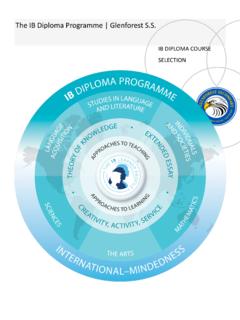
2 Designed as a comprehensive two-year curriculum that allows itsgraduates to fulfill requirements of various national education systems, the DIPLOMA Programmemodel is based on the pattern of no single country but incorporates the best elements of many. TheDiploma PROGRAMME is available in English, French and curriculum is displayed in the shape of a hexagon with six academic areas surrounding the are studied concurrently and students are exposed to the two great traditions of learning: thehumanities and the DIPLOMA PROGRAMME guide: Language A2, February 20021 DIPLOMA PROGRAMME candidates are required to select one subject from each of the six subjectgroups. At least three and not more than four are taken at higher level (HL), the others at standardlevel (SL).
3 Higher level courses represent 240 teaching hours; SL courses cover 150 hours. Byarranging work in this fashion, students are able to explore some subjects in depth and some morebroadly over the two-year period; this is a deliberate compromise between the early specializationpreferred in some national systems and the breadth found in others .Distribution requirements ensure that the science-orientated student is challenged to learn a foreignlanguage and that the natural linguist becomes familiar with science laboratory procedures. Whileoverall balance is maintained, flexibility in choosing higher level concentrations allows the student topursue areas of personal interest and to meet special requirements for university DIPLOMA PROGRAMME candidates meet three requirements in addition to the six interdisciplinary Theory of Knowledge (TOK) course is designed to develop a coherent approachto learning which transcends and unifies the academic areas and encourages appreciation of othercultural perspectives.
4 The extended essay of some 4000 words offers the opportunity to investigate atopic of special interest and acquaints students with the independent research and writing skillsexpected at university. Participation in the creativity, action, service (CAS) requirement encouragesstudents to be involved in creative pursuits, physical activities, and service projects in the local,national and international first examinations in 2004 INTRODUCTION2IB DIPLOMA PROGRAMME guide: Language A2, February 2002 GROUP 2 Group 2 consists of a broad spectrum of modern Language courses and two classical languages: Latinand Classical Greek. The main emphasis of the modern Language courses is on Language acquisitionand usage, from the comparatively elementary, practical usage at ab initio level to the sophisticatedusage of the near-native (or bilingual) speaker who is studying a Language A2.
5 In between are thelanguage B group 2 course is offered in a number of languages, which are listed on IBNET. Within eachlanguage course the syllabus and assessment details are common to all the available languages andare closely comparable in the demands that they make on students. With the exception of classicallanguages, the assessment is conducted in the Language LanguagesThe study of a modern Language entails acquiring a Language system and applying it in fouractive and interrelated ways: through listening, speaking, reading and writing. These four skillsinvolve exchanging ideas and effective communication. Effective communication, in turn,involves the intellectual process of understanding how ideas can best be expressed to theaudience concerned.
6 Understanding ideas, and expressing them clearly and convincingly,demands an awareness of the cultural characteristics of the study of a modern Language , at any level, should enable students to use it spontaneouslyand appropriately in unfamiliar as well as in familiar circumstances. Each of the group 2modern Language courses is generally set in different communicative and interactivesituations, thus reflecting the different expectations of Language proficiency. The situationshypothesized at ab initio level are, of necessity, more mundane and everyday than theirrelatively sophisticated equivalents in a Language A2. At ab initio there is an emphasis onpractical utility; the domains covered by Language B range from the practical and social, tothe expressive and intellectual; while at A2 the student explores the subtleties of thelanguage in a wide variety of contexts, including literature.
7 For example, the ab initiostudent should be able to give clear directions to someone looking for the beach, andunderstand the information in a tourist brochure. The Language A2 student, on the otherhand, should be able to describe in detail the beauty of the waves, and critically analyse themisleading use of Language in the brochure. It is essential that DIPLOMA PROGRAMME coordinators and teachers ensure that students arefollowing the course that is most suited to their present and future needs and that will providethem with an appropriate academic challenge. The degree to which students are alreadycompetent in the Language , and the degree of proficiency they wish to attain by the end of theperiod of study, are the most important factors in identifying the appropriate placement pointon the spectrum of modern Language courses available.
8 Appropriate placement is the responsibilityof teachers and coordinators, not the DIPLOMA PROGRAMME guide: Language A2, February 20023If students are not adequately challenged by their choice of group 2 course they will have beendenied an educational opportunity. If, for example, they have been advised to pursue anab initio course when a Language B would have been more appropriate, or a Language B whenan A2 would have been ideal, then they will have been, in effect, advised to seek the mostexpedient way to amass points, in an educationally sterile fashion. Students should beencouraged to pursue a course that is rigorous and worthwhile, and that will stand them ingood stead for their tertiary studies and/or careers.
9 University admissions officers will beaware of the hierarchy of linguistic proficiency signified by the different Ab InitioThe Language ab initio courses are Language learning courses for beginners, designed tobe followed over two years by students who have no previous experience of learningthe target Language . The main focus of the courses is on the acquisition of languagerequired for purposes and situations usual in everyday social interaction. Language abinitio courses are only available at standard ab initio courses aim to develop a variety of linguistic skills, and a basicawareness of the culture(s) using the Language , through the study of a core syllabus andlanguage-specific syllabuses. Language BMostly available at both higher and standard levels, the Language B courses occupy themiddle ground of the group 2 modern languages spectrum and are Language learningcourses for students with some previous experience of learning the target Language .
10 Themain focus of these courses is on Language acquisition and the development of skillsconsiderably beyond those expected of an ab initio candidate, up to a fairly sophisticateddegree at higher level. Language B courses give students the opportunity to reach a high degree of competence ina Language and explore the culture(s) using the Language . The range of purposes andsituations for which and in which the Language is used extends well beyond those at abinitio, to the domains of work, social relationships, and the discussion of abstract ideas, forexample. The types of Language needed for these purposes and situations are more A2 The Language A2 courses, at the upper end of the spectrum, are designed for studentswith an already high level of competence in the target Language .