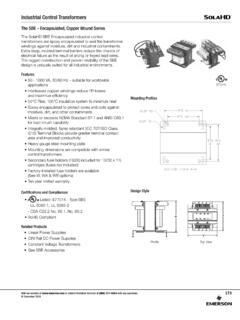
Transcription of Dry Type Distribution Transformers
1 Dry Type Distribution TransformersVisit our website at or contact Technical Services at (800) 377-4384 with any questions. January 2017246 Accessories Surge Protective Devices Active Tracking FiltersSelection Steps1. Input Line Voltage Measure the supply voltage with a Voltage Required for the Load Check the load equipment to determine the voltage kVA or Ampere Rating of the Load Find either the load kVA or the load amperage requirements. This information is listed on the nameplate of the load Frequency Either 50 or 60 Hz.
2 The frequency of the transformer must match the frequency of the Number of Phases Single or three phase line and load must match. (A transformer cannot convert single to three phase.) A common application is to make a single phase connection from a three phase supply by using one phase of the three phase supply circuit. Be careful not to overload that phase of the three phase supply. For buck-boost applications the supply must provide load kVA not just the nameplate rating of the buck-boost.
3 Refer to the Selection Tables on the following Transformers are small, single phase, dry type Distribution Transformers designed and shipped as insulating/isolating Transformers . They have a dual voltage primary and a dual voltage secondary. These Transformers can be connected for a wide range of voltage combinations. The most common use is to buck (lower) or boost (raise) the supply voltage a small amount, usually 5 to 27%. Buck-boost Transformers are in compliance with NEC Article , Exception 1 when field connected as an major advantages of Buck-boost Transformers are their low cost, compact size and light weight.
4 They are also more efficient and cost less than equivalent isolation Transformers . When connected as an autotransformer, they can handle loads up to 20 times the nameplate rating. A buck-boost transformer is the ideal solution for changing line voltage by small a buck-boost has the primary and secondary windings connected, per recommended instructions, it becomes an autotransformer. Now, only the secondary windings are transforming voltage and current. The majority of the kVA load passes directly from the supply to the load.
5 This is the reason buck-boost Transformers can supply a load with a much larger kVA rating than the nameplate indicates. Low voltage lighting control applicationsSolaHD buck-boost Transformers are designed to supply power to low voltage lighting circuits, control panels or other systems requiring 12, 16, 24, 32, or 48 Volts. When connected as an insulating transformer (by following the wiring diagram located after the specification tables on the inside of the transformer case), the transformer s capacity matches the nameplate kVA buck-boost Transformers are also suited for low voltage landscape lighting.
6 They are UL Listed for outdoor service and their compact size makes them the perfect solution for providing power to accent lighting applications. Electrical Connection diagrams are shown at the end of this dimmers on the output of the transformer that are designed and rated for use with magnetic loads. We strongly recommend contacting the dimmer manufacturer for advice on your specific lighting and Compliances Listed- UL 506 - CSA No. 66E77014 Dry Type Distribution TransformersVisit our website at or contact Technical Services at (800) 377-4384 with any questions.
7 January 2017247 Using the Selection Tables1. Determine if you are trying to Boost (raise) or Buck (lower) your voltage. Select an input/output voltage combination that comes closest to matching your application from the appropriate single or three phase charts on the following Move across your selected input/output voltage row to the amperage or kVA rating closest to, but greater than the rating required by your Reading the top of the column will give you the catalog number of the exact buck-boost transformer you need.
8 See the Specification Tables on the next Connect the Transformers according to the diagram indicated. See the Electrical Connections section at the end of this section. Connection diagrams are packed with each phase, buck-boost applications require two or three Transformers . Check the Quantity Required column of the Three Phase Selection Tables for the exact quantity. Fusing Buck-Boost TransformersFor determining the correct size of breaker or fuse for a given range of input or output ampere ratings, refer to Section , of the National Electric Code (NEC).
9 Where an overcurrent protection device is required, the electrical connections and selection tables will reference appropriately. Overcurrent devices OC-1a and OC-1b are shown correctly installed in accordance with NEC Locating an overcurrent device in series with the shunt winding anywhere between A and B is not permitted. The shunt winding is the winding common to both the input and the output Type Distribution TransformersVisit our website at or contact Technical Services at (800) 377-4384 with any questions.
10 January 2017248 Group 2 120 x 240 Volt Primary, 16/32 Volt Secondary Note: Weights and dimensions may change and should not be used for construction purposes. Specification TablesGroup 1 120 x 240 Volt Primary, 12/24 Volt Secondary KVAC atalog NumberMaximum Secondary AmperageHeight in (mm)Width in (mm)Depth in (mm)Approx. Ship Weight lbs (kg)Design StyleElec Conn12 V24 V Non-Encapsulated - 50/60 Hz, Single Phase ( ) ( ) ( ) ( ) ( ) ( ) ( ) ( ) ( ) ( ) ( ) ( ) ( ) ( ) ( ) ( )21 Encapsulated - 60 Hz, Single ( ) ( ) ( ) ( ) ( ) ( ) ( ) ( )311 ( ) ( ) ( ) ( ) ( ) ( ) ( ) ( )412 ( ) ( ) ( ) ( )413 ( ) ( ) ( ) ( )415 ( ) ( ) ( ) ( ) ( ) ( ) ( ) ( )41 KVAC atalog NumberMaximum Secondary AmperageHeight in (mm)Width in (mm)Depth in (mm)Approx.