Example: biology
DYNAMIC-MECHANICAL PROPERTIES OF POLYMERS
Left: silicon rubber with a glass transition at –117°C and a melting transition at –40°C. Beyond the melting temperature this crosslinked (vulcanised) material shows rubber-elasticity with modulus that increases with the temperature. Right: also a silicone rubber that contains silicone oil as diluent, as plasticizer. The oil causes a ...
Tags:
Information
Domain:
Source:
Link to this page:
Documents from same domain

Chapter Outline: Phase Diagrams
www.eng.uc.edufunction called the free energy. Thermodynamics tells us that: Equilibrium and Metastable States • Under conditions of a constant temperature and pressure and composition, the direction of any spontaneous change is toward a lower free energy. • The state of stable thermodynamic equilibrium is the one with minimum free energy.
1/2000
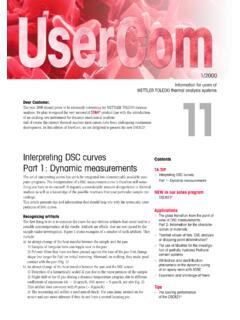
www.eng.uc.edutemperatures of their peak maxima (Fig. 4b and c). Partially crystalline polymers give rise to very broad melting peaks be-cause of the size distribution of the crystal-lites (Fig. 4c). Many organic compounds melt with de-composition (exothermic or endothermic, Figs. 4d and 4e). An endothermic peak in a DSC heating curve is a melting peak if

Review The use of nitrogen adsorption for the ...
www.eng.uc.eduColloids and Surfaces A: Physicochemical and Engineering Aspects 187–188 (2001) 3–9 Review The use of nitrogen adsorption for the characterisation of
Chemical Engineering Thermodynamics CHE 3062
www.eng.uc.eduChemical Engineering Thermodynamics Quizzes: Weekly quiz composed of quesKons similar to homework and example problems. ~Every Thursday Group Homework: Weekly Group Homework.We will go through homework in a work session. ~Every Wednesday.

100416 Exam 1 Materials and Energy Balances ANSWERS ON ...
www.eng.uc.edu! 1! 100416 Exam 1 Materials and Energy Balances ANSWERS ON SEPARATE SHEETS. NAME IN THE UPPER RIGHT CORNER OF EACH PAGE AND NUMBER THE PAGES.

021206 Final Exam: Mechanics of Materials a) Von Misses ...
www.eng.uc.edu3 021206 Answers Final Mechanics of Materials Part I: 1) a) Von Mises criterion is a yielding criterion based on the second invariant of the deviatory

5603 FM p1-15 - University of Cincinnati
www.eng.uc.eduPOLYMER SOLUTIONS An Introduction to Physical Properties IWAO TERAOKA Polytechnic University Brooklyn, New York A JOHN WILEY & SONS, INC., PUBLICATION
Ethiopia: Brief History - University of Cincinnati
www.eng.uc.edu•Ethiopia: area of 1.12 million square Kilometers (slightly less than twice the size of Texas), is located at 4 and 14 degree north, 33 and 48 degrees east.

BROOKFIELD DV-II+ Pro PROGRAMMABLE VISCOMETER
www.eng.uc.eduThe Brookfield DV-II+Pro Viscometer measures fluid viscosity at given shear rates. Viscosity is a measure of a fluid’s resistance to flow. You will find a detailed description of the science of viscosity in the Brookfield publication “More Solutions to Sticky Problems” a copy of which was included with your DV-II+Pro.

Properties of Gases and Liquids - University of Cincinnati
www.eng.uc.edu9-3 Theory of Gas Transport Properties / 9.2 9-4 Estimation of Low-Pressure Gas Viscosity / 9.4 9-5 Viscosities of Gas Mixtures at Low Pressures / 9.15 9-6 Effect of Pressure on the Viscosity of Pure Gases / 9.29 9-7 Viscosity of Gas Mixtures at High Pressures / 9.47 9-8 Liquid Viscosity / 9.51 9-9 Effect of High Pressure on Liquid Viscosity / 9.55
Related documents
Measuring and Understanding Tg (Glass Transition …
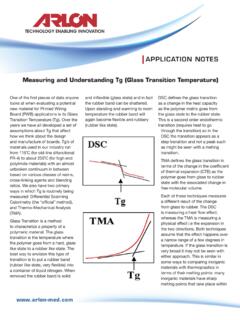
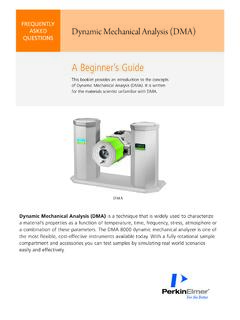
imageserv10.team-logic.comThe glass transition is the temperature where the polymer goes from a hard, glass like state to a rubber like state. The best way to envision this type of transition is to put a rubber band (rubber like state, very flexible) into a container of liquid nitrogen. When
A Beginner’s Guide - PerkinElmer
resources.perkinelmer.comThe glass transition is really a range of behavior where scientist have agreed to accept a single temperature as the indicator per certain standards. Different industries have used different points from the same data set that can vary as much as 15 ˚C. DSC, TMA, and DMA measure different processes and therefore, the numbers vary a bit.

Glass Transition Temperature of Polymer - Atma Ram …
www.arsdcollege.ac.inT∞g is the glass transition temperature of sample having infinite molecular weight, K is positive constant and Mn is number average molecular weight. 4. Co-polymerization: Random co-polymerization causes disorder and reduces molecular packing therefore glass transition temperature is often lower. Glass transition temperature of random ...

Chapter 2 Measurement of Temperature
www.jma.go.jpThe international temperature scale is a temperature scale to accord with the results of thermodynamic temperature measurements along with the definition of thermodynamic temperature in 2.1.1 and it is defined based on several fixed points of temperature (defining fixed points) such as phase transition temperature of

Assignment 6 solutions - University of California, San Diego
maecourses.ucsd.edu(b) Determine a ductile-to-brittle transition temperature as that temperature corresponding to the average of the maximum and minimum impact energies. (c) Determine a ductile-to-brittle transition temperature as that temperature at which the impact energy is 70 J. Solution The plot of impact energy versus temperature is shown below.
1660 EVALUATION OF THE INNER SURFACE DURABILITY OF …
www.uspnf.comthe durability of the glass. Colored glass (e.g., amber glass) is produced by transition metal oxides such as iron oxides. All additives to pure silicon dioxide can be viewed as potential extractables in glass. Glass compositions do not exist at a stoichiometric chemical composition but rather are expressed over a range of compositions.
Interpreting DSC Data - UC Santa Barbara
www.mrl.ucsb.eduimpact at what temperature or time the phase transition will reach its maximum. As a result it is generally a poor indicator of a sample’s properties. Using Proteus Identifying Transition Events When a file is first opened in Proteus the default display use an x-axis of time and both temperature and signal along either y-axis.

ROADMAP FOR CARBON RNC2050) - UNFCCC
unfccc.int4.1.3.2 Glass 4.1.3.3 Ceramics 4.1.3.4 Chemical products 4.1.3.5 Iron and steel 4.1.3.6 Cement 4.1.3.7 Pulp and paper 4.1.3.8 Other industries 4.1.4 Buildings - residential and services 4.2. Role of agriculture, forests and other land uses in the transition to Carbon Neutrality Emission reduction in livestock production and pastures