Transcription of ELECTRON CONFIGURATION AND THE PERIODIC TABLE
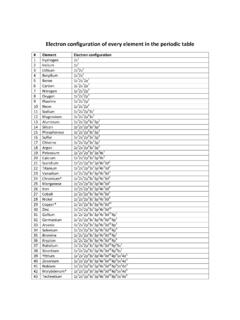
1 Chemistry 101 Chapter 8 15 ELECTRON CONFIGURATION AND THE PERIODIC TABLE The electrons in an atom fill from the lowest to the highest orbitals. The knowledge of the location of the orbitals on the PERIODIC TABLE can greatly help the writing of ELECTRON configurations for large Free Templates & Forms at Speedy Template 101 Chapter 8 16 For A Groups (Representative Elements): For B Groups (Transition Elements) (s and pblocks) n = period number d blocks: n = period number 1 f blocks: n = period number 2 The electronic CONFIGURATION of an element can now be given if the position in the PERIODIC TABLE is known: 1s 2 2s 2 2p 6 3s 2 3p 6 4s 2 3d 10 4p 6 5s 2 1s 2 2s 2 2p 6 3s 2 3p 3 or [Kr] 5s 2 or [Ne] 3s 2 3p 3 (2 outermost shell electrons) (5 outermost shellelectrons) 1s 2 2s 2 2p 6 3s 2 3p 6 4s 2 3d 6 or [Ar] 4s 2 3d 6 (2 outermost shell electrons)Download Free Templates & Forms at Speedy Template 101 Chapter 8 17 Group VIIIA elements (Noble Gases) have a stable outermost shell ELECTRON CONFIGURATION .
2 Element Orbital Notation ELECTRON CONFIGURATION # of Outermost Shell Electrons He 1s 1s 2 2 Ne 2s 2p 2s 2 2p 6 8 Ar 3s 3p 3s 2 3p 6 8 Kr 4s 4p 4s 2 4p 6 8 Xe 5s 52p 5s 2 5p 6 8 Rn 6s 6p 6s 2 6p 6 8 The ELECTRON CONFIGURATION ofns 2 np 6 (or ns 2 ) is referred to as a noble gas core Chemical Properties of elements are determined by the outermost shell electrons (electrons in highest energy level) these electrons are involved in bonding. VALENCE ELECTRONS: Valence electrons are thoseoutside the noble gas core For transition elements,the s and p electrons of the outermost shell (highest energy level) ( d electrons are not valence electrons) NOTE: Most transition elements have 2 valence electrons Reason: They fill d or f orbitals which are not part of the outer most shell Exceptions: Transition elements with irregular electronic configurations: Cr, Cu, Free Templates & Forms at Speedy Template 101 Chapter 8 18 MAGNETIC PROPERTIES OF ATOMS Every ELECTRON acts like a small magnet Magnetic attractions from 2 electrons with opposite spin cancel each other It follows: An atom with paired electrons has no magnetism.
3 An atom with unpaired electrons (excess of one spin) exhibits magnetism. An element with atoms that exhibit magnetism is attracted to a strong magnet DIAMAGNETIC ELEMENTS PARAMAGNETIC ELEMENTS Are not attracted by a magnetic field Sometimes even repelled by a magnetic field Atoms contain paired electrons only Are weakly attracted by a magnetic field Atoms contain unpaired electrons Hg [Xe] 6s 2 4f 14 5d 10 Na [Ne] 3s 1 C [He] 2s 2 2p 2 FERROMAGNETIC ELEMENT Are strong permanent magnetism in iron due to the alignment of many unpaired electrons Fe [Ar] 4s 3d Examples: 1. Write complete and condensed ELECTRON CONFIGURATION for bromine (Z=35) and determine the number of valence electrons.
4 2. Write complete and condensed ELECTRON CONFIGURATION for palladium(Z=46) and determine the number of valence electrons. 3. Write complete and condensed electronconfiguration for antimony(Z=51) and determine the number of valence Free Templates & Forms at Speedy Template 101 Chapter 8 19 PERIODIC PROPERTIES PERIODIC properties are properties of the elements that are repeated according to a regular PERIODIC trend. Three important PERIODIC properties will be discussed: 1. Atomic Radius(size of the atoms) 2. Ionization Energy ( ) energy needed to remove the outermost ELECTRON from a neutral atom in the gaseous state to form a positive ion. 3. ELECTRON Affinity ( ) energy (absorbed orreleased) during the process of adding an ELECTRON to a neutralatom in the gaseous state to form a negative ion The variation of these 3 PERIODIC Properties will be discussed : within a group (vertical trend) along a period (horizontal trend) Two important factors determine these trends: Effective Nuclear Charge increasesDownload Free Templates & Forms at Speedy Template 101 Chapter 8 20 Effective Nuclear Charge Effective nuclear charge (Zeff) is the positive charge that an ELECTRON experiences from the nucleus.
5 Consider the ELECTRON CONFIGURATION of the Na atom ( Z = 11) 1s 2 2s 2 2p 6 3s 1 3 energy levels: 2 electrons on 1 st energy level 8 electrons on 2 nd energy level 1 ELECTRON on 3 rd energy level 8e 2e What is the positive charge that the outermost ELECTRON feels ? +11 1. It is not +11, since its electrons of the 1 st and 2 nd energy level (10 electrons carry a charge equal to 10) = cancel out some of the + 11 charge of the nucleus ( shielding effect ) 2. It is not + 1,since the 10 core electrons (charge = 10) cannot completely cancel out 10 positive charges of the nucleus. Reason: The 10 core electrons are in the nucleus, but some distance away Note: The closer to the nucleus the core electrons are, the more effective they are in canceling out some of the positive charge of the nucleus (shielding effect) shielding effect shielding effect of a 1 st shell ELECTRON of a 2 nd shell ELECTRON 3.
6 The outermost ELECTRON is attracted to the nucleus by a positive charge which is less than the actual nuclear charge (Z = +11) because of the shielding effect of the core electrons, but more than +1 Effective Nuclear Charge = Zeff= + (in this particular case) The Nuclear Charge an outermost ELECTRON experiences is reduced by the shielding effect of other electrons (Zeff = Z Shielding Effect) Zeff = Z Shielding effect Effective Nuclear Actual Nuclear Charge ChargeDownload Free Templates & Forms at Speedy Template 101 Chapter 8 21 Along a period, moving from left to right: Protons are added to the nucleus Z increases considerably Electrons are added tothe outermost shell Minimal increase in shielding effect Zeff = Z Shielding effect Effective Actual Nuclear Nuclear Charge Charge Increases Minimal considerably increase Moving across a period Zeff increases (Z increases a lot, Shielding Effect increases little) Along a group, moving from up to down.
7 Protons are added to the nucleus Z increases considerably Electrons are added tothe new shell Considerable increases shielding effect Zeff = Z Shielding effect Effective Actual Nuclear Nuclear Charge Charge Increases Increases considerably considerably Moving down a group Zeffdoes NOT increase (Z increases a lot, Shielding Effect increases a lot)Download Free Templates & Forms at Speedy Template 101 Chapter 8 22 ATOMIC RADIUS Values of Atomic radii are obtained from measurements of distances between the nuclei of atoms in the chemical bonds of molecular substances. Example: experimental Determination of the radius of H atom: Atomic Radius = distance between nuclei distance between nuclei is determined experimentally (by X ray crystallography) Atomic Radius determined in this manner are referred to as Covalent Radii.
8 Atoms are very small consequently, atomic radii have very small values Values of Atomic Radii are listed on the PERIODIC TABLE (back side) and are commonly expressed in: Angstroms (1 A = 10 -10 m) or Nanometers (1 nm = 10 -9 m) or Picometers (1 pm = 10 -12 m) H is the smallest atom: Covalent radius of H atom = ADownload Free Templates & Forms at Speedy Template 101 Chapter 8 23 ATOMIC RADII Atomic Size IncreasesDownload Free Templates & Forms at Speedy Template 101 Chapter 8 24 ATOMIC RADII Note: There is little variation in atomic Size throughout a row of Transition Elements: Reason: Consider the elements completing the 3d subshell: From Sc ..to ..Zn [Ar] 4s 2 3d 1 ..to .. [Ar] 4s 2 3d 10 Moving along period 4 from left to right: 1 proton is added when moving from one transition element to the next ACTUAL NUCLEAR CHARGE (Z) INCREASES CONSIDERABLY Sc.
9 Zn 1 ELECTRON is added to the 3d subshell of the 3 rd shell (an inner shell) SHIELDING EFFECT CAUSED BY ADDED ELECTRON INCREASES CONSIDERABLY Recall: Zeff = Z Shielding Effect increases increases considerably considerably Result: Zeff does not change Insignificant variation in Atomic Size for 3d block elements This trend holds true for all transition elements (d block elements)Download Free Templates & Forms at Speedy Template 101 Chapter 8 25 IONIZATION ENERGY Ionization Energy (IE) is the energy needed to remove the outermost ELECTRON from a neutral atom in the gaseous state to form a positive ion. Ionization Energy : is commonly measured in kJ/mol is also referred to as Ionization Potential (electrical energy) and canalso be measured in Volts is listed on the PERIODIC TABLE (back side) Consider the removal of the outermost shell ELECTRON from sodium: Na(g) + IE1 Na + (g) + 1 e - 1s 2 2s 2 2p 6 3s 1 First Ionization 1s 2 2s 2 2p 6 [Ne] 3s 1 Energy [Ne] (11p, 11e) (11p, 10e) Co nsider the removal of a second ELECTRON : Na + (g) + I E2 Na 2+ (g ) + 1 e - 1s 2 2s 2 2p 6 Second Ionization 1s 2 2s 2 2p 5 [Ne] Energy [He] 2s 2 2p 5 (11p, 10e) (11p, 9e) NOTES: 1.
10 Removal of an ELECTRON is an endothermic process (it requires energy to remove an ELECTRON ) Atoms do not lose electrons Energy is required to remove the electrons 2. All the electrons can be removed successivelyform an atom. The energies required at each step are known as: First Ionization Energy (IE1), Second Ionization Energy (IE2), Third Ionization Energy (IE3) .. 3. In general: The Ionization Energies for a given element increase as more electrons are removed: I E1 <I E2 <I E3 < I E4 < I E5 < I E6 <I E7 <I E8 and so on. Reason: The ELECTRON is being removed from ions with increasingly larger positive charges (The larger the positive charge of the ion, the stronger the ELECTRON is attracted)Download Free Templates & Forms at Speedy Template 101 Chapter 8 26 IONIZATION ENERGY Down a group IE decreases, due to increased atomic size (the larger the atom, the less strongly it holds its electrons in the outer shell) Across a period, IE generally increases, due to increased effective nuclear charge (the greater the nuclear charge, the stronger the atom hold its electrons in the outer shell) Some anomalies in IE trend occur in each period ( in period 2, B is lower than Be and O is lower than N similarly in period 3, Al is lower thanMg and S is lower than P).