Transcription of Entity AEOI self-certification guidance notes
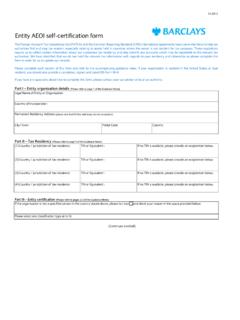
1 Sections are mandatory. Please include Entity status Ltd or LLP. PO Box addresses are not II Tax ResidencyBeginning with the Foreign Account Tax Compliance Act (FATCA) in 2014 and additionally the Common Reporting Standard (CRS) in 2016, new international agreements involving a large number of countries have come into force to help tax authorities find and stop tax evasion, especially relating to assets held in countries where the owner is not resident for tax of tax residencePlease provide for each of these jurisdictions a Tax Identification Number (TIN)
2 Of your Entity where applicable. InstructionsPart I Entity organisation detailsPlease complete each box and ensure you include your Entity s legal status ( Ltd, Plc, LLP).Part II Tax residencyComplete a separate row for every country that this Entity tax III Entity certificationAll entities are required to complete this IV Controlling PersonsComplete if you are 'Financial Institution that is an Investment Entity located in a non-participating jurisdiction and managed by another FI or Passive V - Declaration & Signature Complete ensuring the signature has been completed by an authorised signatory of the AEOI self-certification guidance notesThese
3 International agreements create a legal obligation requiring all financial institutions, including Barclays, to:It is mandatory to supply a TIN or functional equivalent if the country in which you are tax resident issues such identifiers. The TIN is combination of letter's and/ or numbers assigned to the Entity or organisation by its country of residence (or its tax authorities) to identify the Entity for tax purposes. An example of a TIN from a country tax resident in the UK is an Entity 's Unique Taxpayers Reference Number (xxxxx xxxxx).
4 If unable to obtain a TIN then please provide an explanation, such as: "the company has yet to recieve its TIN from the relevant tax authority"Part I Entity /Organisation DetailsTIN or functional equivalentb) the stock of the NFE is regularly traded on an established securities market or the NFE is a Related Entity of an Entity the stock of which is regularly traded on an established securities market;c) the NFE is a Governmental Entity , an International Organisation, Central Bank or an Entity wholly owned by one or more of the foregoing.
5 D) substantially all of the activities of the NFE consist of holding (in whole or in part) the outstanding stock of, or providing financing and services to, one or more subsidiaries that engage in trades or businesses other than the business of a Financial Institution, except that an Entity does not qualify for this status if the Entity functions (or holds itself out) as an investment fund, such as a private equity fund, venture capital fund, leveraged by you to fund, or any investment vehicle whose purpose is to acquire or fund companies and then hold interests in those companies as capital assets for investment purposes.
6 E) the NFE is not yet operating a business and has no prior operating history, (a start-up NFE ) but is investing capital into assets with the intent to operate a business other than that of a Financial Institution, provided that the NFE does not qualify for this exception after the date that is 24 months after the date of the initial organisation of the NFE; f) the NFE was not a Financial Institution in the past five years, and is in the process of liquidating its assets or is reorganising with the intent to continue or recommence operations in a business other than that of a Financial NFE primarily engages in financing and hedging transactions with, or for, continue or recommence operations in a business other than that of a Financial Institution; InstructionAn NFE is an Active NFE if it meets any of the criteria listed below.
7 In summary, those criteria refer to: Active NFEs by reason of income and assets; Publically traded NFEs; Governmental Entities, International Organisations, Central Banks, or wholly owned Entities; Holding NFEs that are members of a nonfinancial group Start-Up NFEs; NFEs that are liquidating or emerging from bankruptcy; Treasury centres that are members of a nonfinancial group; or Non-profit NFEsAn Entity will be classified as Active NFE if it meets any of the following criteria:a) less than 50% of the NFE s gross income for the preceding calendar year or other appropriate reporting period is passive income and less than 50% of the assets held by the NFE during the preceding calendar year or other appropriate reporting period are assets that produce or are held for the production of passive income.
8 Part III Entity CertificationActive Non-Financial Entity ("NFE") classificationPlease select one classification, a) to h).Specified PersonThe term Specified Person is defined by reference to local laws in the country where the Entity is established. In the UK a Specified United Kingdom Person means a person or Entity who is resident in the UK for tax purposes, other than:(i) A corporation the stock of which is regularly traded on one or more established securities markets;(ii) Any corporation that is a Related Entity of a corporation described in clause (i);(iii) A Depository Institution.
9 (iv) A broker or dealer in securities, commodities, or derivative financial instruments (including notional principal contracts,futures, forwards, and options) that is registered as such under the laws of the United Kingdom;(v) a Government Entity ;(vi) An International Organisation (examples of which include The International Monetary Fund, The World Bank, TheInternational Bank for Reconstruction and Development and The European Community For a full list please see therelevant guidance under the Tax Regulations);(vii) A Central Bank.
10 Or(viii) A pension scheme or other arrangement registered with HMRC under Part 4 of the Finance Act 2004 Specified Persong) the NFE primarily engages in financing and hedging transactions with, or for, Related Entities that are not Financial Institutions, and does not provide financing or hedging services to any Entity that is not a Related Entity , provided that the group of any such Related Entities is primarily engaged in a business other than that of a Financial Institution or;h) the NFE meets all of the following requirements (a non-profit NFE ) :i) it is established and operated in its jurisdiction of residence exclusively for religious, charitable, scientific, artistic, cultural, athletic, or educational purposes.