Transcription of Environmental Report 2017 - Toyota
1 Toward the Toyota Environmental Challenge 2050 Environmental Report 2017 Environmental Report 2017 Toward the Toyota Environmental Challenge 2050 Toyota Motor Corporation considers Environmental issues to be one of its management priorities. Since 1998, we have published an annual Environmental Report to explain our Environmental initiatives. From FY2016, the content of the Report is presented in conformance with the six challenges defined under our long-term initiative, the Toyota Environmental Challenge Environmental Report is a specialized publication excerpted from the Sustainability Data Book. It covers only our Environmental initiatives. For information on Toyota s CSR management and initiatives, please refer to our Sustainability Data Book have also published the Annual Report , in which Toyota shares with our stakeholders the ways in which Toyota s business is contributing to the sustainable development of society and the Earth on a comprehensive basis from a medium- to long-term PolicyEnvironmental Report 2017 Toward the Toyota Environmental Challenge 2050 Data Book 2017 Report Securities Reports (Japanese text only) SEC Governance data featured in this Report covers the period from April 2016 to March 2017 .
2 For major ongoing initiatives, data from April 2017 onward is also Party Assurance Denotes data confirmed through Independent Practitioner s AssuranceThe Report covers Toyota Motor Corporation (TMC) s initiatives as well as the activities of consolidated subsidiaries and affiliates in Japan and overseas. GRI Sustainability Reporting Guidelines, Version 4 (G4) Ministry of the Environment of Japan Environmental Reporting Guidelines (FY2012 Version)Period Covered by ReportAbout the IconsScope of ReportCompany ProfileReference Guidelines The Toyota Official Website lists our initiatives not included in the above annual Contribution Activities NameToyota Motor CorporationPresident and Representative DirectorAkio ToyodaCompany AddressHead OfficeTokyo Head OfficeNagoya Office1 Toyota -cho, Toyota City, Aichi Prefecture 471-8571, Japan1-4-18 Koraku, Bunkyo-ku, Tokyo 112-8701, Japan4-7-1 Meieki, Nakamura-ku, Nagoya City, Aichi Prefecture 450-8711, JapanDate FoundedAugust 28, billion yen (as of March 31, 2017 )
3 Main BusinessesMotor Vehicle Production and SalesNo. of Employees (consolidated)364,445 (as of March 31, 2017 )1 Environmental Report 2017 CONTENTSH ighlights3 Message from the President4 Toyota Environmental Challenge 20505 FY2016 Review of the Sixth Toyota Environmental Action Plan7 Special Feature: Eco-friendly Vehicles Contribute to the Environment Only When Widespread13 Challenge 1 New Vehicle Zero CO2 Emissions ChallengeDeveloping Technologies to Achieve the Leading Fuel Efficiency Performance15 Promoting Development of Next-generation Vehicles Using Electric Power, and Widespread Use According to Their Features17 Challenge 2 Life Cycle Zero CO2 Emissions ChallengePromoting Environmental Management in Product Development (Eco-VAS)18 Pursuing Transport Efficiency and Reducing CO2 Emissions in Logistics Activities19 Promoting an Integrated Approach to Reduce CO2 Emissions in Road Transport Sectors21 Challenge 3 Plant Zero CO2 Emissions ChallengeReduce CO2 Emissions in Production Activities22 Toward a Low-carbon Society in 205025 Challenge 4 Challenge of Minimizing and Optimizing Water UsageReduce Water Consumption in Production Activities27 Toyota s Water Environment Challenge: Connecting with Society to Make Our Plants No.
4 1 Regionally29 Challenge 5 Challenge of Establishing a Recycling-based Society and SystemsReduce Consumption of Dwindling Natural Resources through Use of Renewable Resources and Recycled Materials31 Achieve Industry-leading Levels in Easy-to-dismantle Design for Effective Resource Recycling32 Contribute Worldwide through Appropriate End-of-life Vehicle Treatment and Recycling Technology Developed in Japan33 Expand Original Recycling Systems for End-of-life Vehicles Worldwide33 Reduce Waste and Use Resources Efficiently in Production Activities34 Reduce Packaging and Wrapping Materials and Use Resources Efficiently in Logistics Activities35 Challenge 6 Challenge of Establishing a Future Society in Harmony with NaturePromote Expansion of Nature Conservation Activities Connecting Communities36 Boost Grant for Environmental Activities Connecting to the World - Toyota Today for Tomorrow Project39 Boost Contributions to Environmental Education Connecting to the Future Toyota ESD Project41 Environmental Management43 Promote Strengthening of Consolidated Environmental Management45 Reduce Vehicle Exhaust Emissions to Improve Urban Air Quality in Each Country and Region47 Reduce VOC Emissions in Production Activities47 Promote Environmental Activities in Cooperation with Business Partners (Suppliers)48 Promote Environmental Activities in Cooperation with Business Partners (Dealers and Distributors)
5 49 Further Strengthen Global Employee Education and Awareness Activities50 Enhance Active Disclosure of Environmental Information and Communication50 Environmental Data51 Independent Practitioner s Assurance Report572 Environmental Report 2017 *1 CDP: A UK-based nonprofit organization which acts on behalf of the world s institutional investors to request information disclosures from leading companies on climate change, water and forestry resources. CDP analyzes and assesses survey results, sharing the information with institutional investors. *2 Toyota New Global Architecture (TNGA): Toyota s company-wide vehicle development framework. The goal of TNGA is to significantly improve the basic performance and marketability of Toyota vehicles by reforming and integrally redeveloping powertrain components and the CDP Climate Change Report 2016, which summarizes the CDP s*1 survey on corporate response to climate change, Toyota attained the organization s highest possible A List ranking.
6 CDP Water Report 2016 ranked Toyota in its highest possible A List ranking of corporate water management. Toyota was the only Japanese automaker to make the hybrid technologies in the new Prius, Toyota s first car adopting TNGA*2, won the Energy Conservation Grand Prize at the FY2016 Minister of Economy, Trade and Industry Award, the highest accolade from the sponsor, the Energy Conservation Center, Japan, in the product and business model has been widely acclaimed for setting highly-motivated Environmental goals known as the Toyota Environmental Challenge 2050, and explaining clearly its specific initiatives and progress in achieving the goals, along with quantitative production affiliate TMMIN won the Best Indonesia Green Awards 2017 from the sponsor, the La Tofi CSR School, at its 7th Indonesia Green Awards.
7 Granted by the Okochi Memorial Foundation, the Okochi Memorial Prize, which began in 1954, is one of the most prestigious industrial awards in Japan, as well as the application of production engineering and production technology. This marked the first time in 16 years that Toyota was awarded the prize. A List top ranking on CDP corporate climate change survey A List top ranking on CDP water management corporate survey for two consecutive yearsHybrid technologies in new Prius won the Energy Conservation Grand Prize at the FY2016 Minister of Economy, Tr ade and Industry AwardToyota won the 63rd Okochi Memorial Production Prize for developing a new car painting line that reduces Environmental footprint Environmental Report 2016 won a Excellence Prize in the Global Warming Countermeasure Reporting Category at the 20th Environmental Communication Awards sponsored by Ministry of the Environment of Japan and other organizationsTMMIN s Environmental initiatives recognized with The Best Indonesia Green Awards 2017CO emissionsfrom car painting line reduced by 32%Volume.
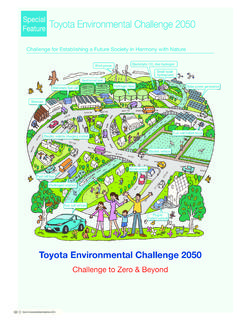
8 40% reductionEnvironmental Communication AwardsExcellence PrizeEnvironmental Report Category3 Environmental Report 2017 Firstly, I would like to express my sincere gratitude for your continued support and understanding. In recent years, we have seen an increasing number of terrible disasters, such as floods and heat waves, which is said to be the result of global warming. Countries around the world are now implementing initiatives to balance emission and absorption of CO2 and other greenhouse gases in the second half of this century, which will help keep temperature increases at the target of less than 2 Toyota , we have been engaged in our business under the founding philosophy of contributing to society through car manufacturing. Because everything that we and our automobiles do in life generates CO2 emissions, global warming, or CO2 emissions, is the root issue to our on this understanding, we announced the Toyota Environmental Challenge 2050 in October 2015.
9 Our goal is not just to contribute to keeping global warming below 2 C through zero CO2 emissions, but to accelerate initiatives aiming for a positive impact on the Earth and societ have so far focused our efforts on developing eco-friendly vehicles such as hybrid vehicles, plug-in hybrid vehicles and fuel cell vehicles. In August 2017 , we announced collaboration with Mazda Motor Corporation to explore joint development of technologies for the basic structure of competitive electric reason behind this announcement is our earnest wish to leave this beautiful planet, our hometown, to the next generation, and to create a future mobility society that is an environment-friendly, safe, happy, and fun place to this period of great change, I would like to keep two loves in mind.
10 Those are a love for cars and a love for kindly request the continued support and understanding of all our 2017 Akio ToyodaPresident, Member of the Board of DirectorsToyota Motor CorporationMessage from the President Leaving this beautiful planet, our hometown, to the next generation 4 Environmental Report 2017 Toyota has promoted a wide range of initiatives to address increasingly severe global Environmental issues, such as extreme weather phenomena attributed to greenhouse gas emissions, biodiversity depletion due to development, and water shortages caused by population Toyota Environmental Challenge 2050 was announced in October 2015 as a means of contributing to the realization of a sustainable society. The challenge reaffirms our commitment to reducing the Environmental burden of automobiles to as close to zero as possible, while developing measures to contribute to positive impact on the Earth and its societies.