Transcription of Epoxy Curing Agents and Modifiers - indur.com
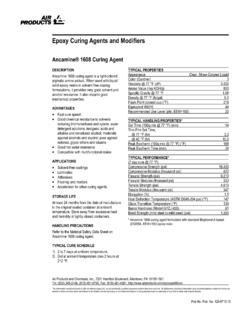
1 Epoxy Curing Agents and Modifiers Ancamide 2396 Curing agent DESCRIPTION Ancamide 2396 Curing agent is a modified amidoamine intended for use at ambient temperature with liquid Epoxy resins. Compared with standard amidoamines, it imparts better chemical resistance, improved film appearance, better low temperature cure and resistance to blush. Ancamide 2396 Curing agent is ideal for systems applied to concrete, such as trowelable flooring, self-leveling flooring, grouts and concrete primers. ADVANTAGES Very good chemical resistance Excellent adhesion to cold, damp concrete Improved film appearance Long pot life Good strength and modulus APPLICATIONS Concrete primers, adhesives and bonding Agents Self-leveling and trowelable flooring Tile grouts Chemically-resistant mortars and grouts STORAGE LIFE At least 24 months from the date of manufacture in the original sealed container at ambient temperature.
2 Store away from excessive heat and humidity in tightly closed containers. HANDLING PRECAUTIONS Refer to the Material Safety Data Sheet for Ancamide 2396 Curing agent . TYPICAL CURE SCHEDULE 7 days at ambient temperature. TYPICAL PROPERTIESA ppearance Amber LiquidColor(1) (Gardner) 8 Viscosity(2) (cP) @ 77 F 680 @ 50 F 5,000 Specific Gravity(4) @ 77 F Value(3) (mg KOH/g) 350 Flash Point(5) (closed cup) ( F) 267 Equivalent Wt/{H} 93 Recommended Use Level (phr, EEW=190) 49 TYPICAL HANDLING PROPERTIES A* B*Mixed Viscosity(2) @ 77 F (cP) 3,700 1,440 Gel Time(6) (min) (150 g mix @ 77 F) 102 145 Gel Time(6) (min) (150 g mix @ 50 F) 137 245 Thin Film Set Time(7) (hr) @ 77 F 12 @ 50 F 14 35 @ 40 F 28 35 Peak Exotherm(8) (150 g mix @ 77 F) ( F) 178 116 TYPICAL PERFORMANCE(7 day cure @ 77 F)
3 A* B*Glass Transition Temp(9) ( F) 137 126 Compressive Strength(10) @ yield (psi) 13,600 10,900 Compressive Modulus(10) (thousand psi) 345 279 Tensile Strength(11) (psi) 8,600 8,700 Tensile Modulus(11) (thousand psi) 243 190 Tensile Elongation(11) @ break (%) Strength(12) (psi) 17,300 13,600 Flexural Modulus(12) (thousand psi) 496 389 Hardness(13) (Shore D) 82 81 A* Ancamide 2396 formulated with DGEBA (EEW=190) resin B* Ancamide 2396 with 90% DGEBA resin (EEW=190) and 10% Epodil 748 diluent (C12 C14 alkyl glycidyl ether) blend Note: Please see last page for footnotes. Air Products and Chemicals, Inc., 7201 Hamilton Boulevard, Allentown, PA 18195-1501 Tel: (800) 345-3148, (610) 481-6799, Fax: (610) 481-4381, The information contained herein is offered without charge for use by technically qualified personnel at their discretion and risk.
4 All statements, technical information and recommendations contained herein are based on tests and data which we believe to be reliable, but the accuracy or completeness thereof is not guaranteed and no warranty of any kind is made with respect thereto. Pub. No. SUPPLEMENTARY DATA Chemical Resistance Chemical immersion studies following ASTM D543 were performed on coupons formulated with Ancamide 2396 and Ancamide 500 (a standard amidoamine) Curing Agents . Both were formulated with DGEBA (EEW=190) resin and cured for 7 days at 77 F. Table 1 shows the percent weight change after 3 days and 28 days in various chemicals at 77 F. Spillage resistance studies were conducted on Ancamide 2396 Curing agent formulated with a 90% DGEBA resin (EEW=190) and 10% Epodil 748 diluent (C12-C14 alkyl glycidyl ether) blend.
5 Samples were cured for 7 days at 77 F; three samples were tested for each reagent. The immersion/recovery schedule for the testing is shown in Table 2. Percent weight change and Shore D hardness were measured after each of the immersion periods. Hardness retention is relevant in flooring applications because it indicates the ability of the floor to support traffic after exposure. Results of this study are presented in Table 3. These studies show that compared with standard amidoamines, Ancamide 2396 Curing agent imparts superior chemical resistance to a variety of solvents, inorganic acids and bases. This resistance makes Ancamide 2396 a cost-effective alternative to standard amidoamines when moderate chemical resistance is required.
6 Table 1 Chemical Resistance for Ancamide 2396 Formulation vs. Ancamide 500 Formulation % Weight Change as a Function of Time Continuous Immersion Reagent 3 day % Weight Change 28 day % Weight Change Ancamide 2396 Ancamide 500 Ancamide 2396 Ancamide 500 Deionized Water Methanol Not Tested Not Tested Ethanol
7 Toluene Destroyed <24 hours Destroyed between 7 and 14 days Xylene Not Tested Not Tested Butyl Cellosolve MEK Destroyed between 1 and 3 days Destroyed <24 hours 10% Lactic Acid 10% Acetic Acid 10% Sulfuric Acid 70% Sulfuric Acid 98% Sulfuric Acid Destroyed < 24 hours Not Tested Not Tested 50% Sodium Hydroxide Not Tested Not Tested 10% Sodium Hypochlorite Not Tested Not Tested 1,1,1, Trichloroethane Destroyed between 1 and 3 days 10% Hydrochloric Acid 40% Nitric Acid Destroyed between 14 and 28 days Destroyed between 14 and 28 days Note: Samples were formulated with DGEBA (EEW=190) resin and cured for 7 days at 77 F before testing.
8 They were tested in accordance with ASTM D543-84. Page 3 Table 2 Spillage Resistance Test Method Schedule Castings of 1/8" thickness were immersed for specified time period. Sample was then removed, weighed and hardness was tested immediately. Sample was then allowed to recover for specified time before re-immersion. 3 hr imm test 24 hr recover 24 hr imm test 24 hr recover 3 day imm test 3 day recover 7 day imm test 7 day recover 28 day imm test 7 day recover 90 day imm test Table 3 Spillage Resistance for Ancamide 2396 with 90% DGEBA / 10% Epodil 748 % Weight Change and Shore D Hardness as a Function of Time REAGENT Initial Hard.
9 After 3 hr After 24 hr After 3 days After 7 days After 28 days After 90 days % wt. Hard % wt. Hard % wt. Hard % wt. Hard % wt. Hard % wt. Hard 10% Acetic Acid 81 81 77 75 73 70 62 Toluene 81 80 72 47 Destroyed Xylene 81 81 79 74 68 56 49 Trichloroethane 81 80 79 77 73 64 62 Methanol 81 71 52 42 27 22 22
10 Ethanol 81 78 69 64 59 50 37 Butyl Cellosolve 81 80 76 71 64 57 Destroyed Methyl Ethyl Ketone 81 70 35 Destroyed Skydrol 81 80 79 79 79 79 78 70% Sulfuric Acid 81 81 81 80 81 81 81 98% Sulfuric Acid 81 69 Destroyed Deionized Water 81 80 80 80 80 80 80 50% Sodium Hydroxide 81 81 81 81 81 81 81 Bleach 81 81 80 79 79 79 78 Note: Samples were cured for 7 days at 77 F before testing.