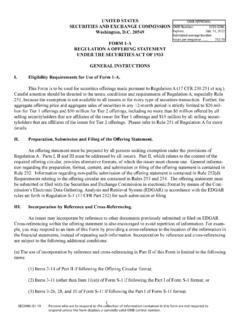
Transcription of EXHIBIT A TITLE 23. FOREIGN JUDGMENTS, WAGE …
1 1 TITLE 23. FOREIGN judgments , wage EXECUTIONS & subpoenas chapter 1. RECOGNITION OF FOREIGN judgments 23 ch. 1 1 1. Definitions The following words and phrases are defined for the purposes of this TITLE : a. " FOREIGN Judgment" means any final judgment of a court or agency of competent jurisdiction in the United States, other than the Mashantucket Pequot Tribal Courts. b. "Employer" means the Mashantucket Pequot Tribal Nation, its enterprises, governmental divisions or departments thereof, including the Mashantucket Pequot Gaming Enterprise and Pequot Pharmaceutical Network, but does not include any entity owned in whole or part by the Tribe and formed under the laws of any state. c. "Issuing Tribunal" means the tribunal which rendered the FOREIGN Judgment. d. "Judgment Creditor" means a party to whom an obligation is owed under the FOREIGN Judgment.
2 E. "Judgment Debtor" means a party who owes and is responsible for payment of an obligation under the FOREIGN judgment. f. "Tribal Court" means the Mashantucket Pequot Tribal Court. 23 ch. 1 2 2. Filing of FOREIGN Judgment. Enforcement a. Any party seeking to have a FOREIGN Judgment recognized and enforced in the Tribal Court must: (1) File a certified copy of the FOREIGN Judgment with the Tribal Court Clerk; (2) File an application for registration and enforcement of the FOREIGN Judgment. The application shall contain a certification to the Court that the FOREIGN Judgment is final, and that said Judgment has not been modified, altered, amended, set aside or vacated, and that the enforcement of the FOREIGN Judgment has not been stayed or suspended. The application shall set forth the full name and last known address of the Judgment Debtor and the name of the Issuing Tribunal; (3)Pay a fee of $ to the Tribal Court Clerk; and, (4) Serve a summons and a copy of the FOREIGN Judgment and application on the 2 Judgment Debtor pursuant to 3.
3 23 ch. 1 3 3. Notification a. With the filing of such FOREIGN Judgment and application for registration and enforcement, the Judgment Creditor or the Judgment Creditor s attorney shall present a summons to the Tribal Court Clerk for signature. b. The summons and copy of the application and FOREIGN Judgment must be served upon the Judgment Debtor either by (1) personal service pursuant to Rule 4 of the Mashantucket Pequot Rules of Civil Procedure; or, (2) registered or certified mail, signed receipt requested, at the Judgment Debtor s last known address. c. If the Judgment Debtor fails to sign for the registered or certified mail service, then the Judgment Creditor shall provide said summons and documents by personal service, as provided in Rule 4 of the Mashantucket Pequot Rules of Civil Procedure. d. No action to register or enforce such judgment shall be taken until 20 business days after proof of service of the FOREIGN Judgment, application, and summons has been filed with the Court.
4 A party may file an objection to the application for recognition and enforcement of a FOREIGN Judgment within 20 business days from the filing of proof of service. 23 ch. 1 4 4. Stay of Proceedings, Modifications, Hearings a. If either party files an affidavit and supporting documents from the Issuing Tribunal that an appeal from the FOREIGN Judgment is pending in a FOREIGN jurisdiction or that a stay of execution has been granted, the Court shall stay enforcement of the FOREIGN Judgment until the appeal is concluded or the stay of execution expires or is vacated. b. If either party files an affidavit and supporting documents from the Issuing Tribunal that such FOREIGN Judgment has been modified or amended, the Court shall enforce such FOREIGN Judgment as so modified or amended. c. The Tribal Court may accept the jurisdictional facts and other information documented in the certified copy of the FOREIGN Judgment as presumptively true.
5 A FOREIGN Judgment so recognized shall have the same effect and may be enforced or satisfied in the same manner as any like judgment of the Tribal Court provided that in modifying or altering such FOREIGN Judgment, the substantive law of the Issuing Tribunal shall be controlling. 23 ch. 1 5 3 5. Enforceability a. Upon motion to the Court, either party shall be entitled to a hearing on any disputed issue of fact or law concerning the enforceability of the FOREIGN Judgment in Tribal Court. A FOREIGN Judgment shall not be enforceable in Tribal Court if the Issuing Tribunal lacked jurisdiction. The party challenging the enforceability of the FOREIGN Judgment shall bear the burden of proof. b. A FOREIGN Judgment shall become a judgment of the Tribal Court and shall be enforceable provided that such judgment is valid and enforceable and does not contravene the public policy of the Mashantucket Pequot Tribe.
6 chapter 2. wage EXECUTIONS 23 ch. 2 1 1. Application If a Judgment Debtor fails to comply with an installment payment order or satisfy a Tribal Court judgment, the Judgment Creditor may apply to the Tribal Court for a wage execution . The application shall contain the Judgment Creditor's or the Judgment Creditor's attorney's statement: a. Setting forth the particulars of the installment payment order, if any; and b. The Judgment Debtor's failure to comply with such installment payment order and Judgment Debtor's failure to otherwise satisfy the Tribal Court Judgment. 23 ch. 2 2 2. Installment Payment Order Prior to issuing a wage execution the Court may in its discretion enter an installment payment order which order shall include direction as to the circumstances under which a wage execution shall be issued.
7 23 ch. 2 3 3. Amount Subject to Levy a. Except as provided in subsection b hereof, the maximum part of the aggregate disposable income, as defined in 6 , chapter 8, Section 1(d), of a Judgment Debtor for any workweek which may be subject under this law to levy or other withholding for payment of judgments may not exceed: (1) Where such Judgment Debtor is supporting a dependent child pursuant to TITLE VI, chapter 8 (other than a child with respect to whose support such order is used ), 50% of the Judgment Debtor's disposable income for that week; 4 and (2) Where such Judgment Debtor is not supporting such dependent child described in subsection a(1) hereof, 60% of the Judgment Debtor's disposable income for that week. b. The maximum portion of the aggregate disposable income of a Judgment Debtor for any work week which is subject to garnishment for any one judgment shall not exceed: (1) 25% percent of the Judgment Debtor's disposable income for that week; or (2) The amount by which the Judgment Debtor's disposable income for that week exceeds 30 times the Federal minimum hourly wage prescribed by Section 206(a)(1) of TITLE 29 of the Code in effect at the time the income is payable, whichever is less.
8 C. The restrictions of subsection (b) above do not apply in the case of: (1) Any order for the support of any person issued by a FOREIGN Tribunal or in accordance with an administrative procedure, which is established by law, which affords substantial due process, and which is subject to judicial review. (2) Any order of any tribunal or court of the United States having jurisdiction over cases under chapter 13 of TITLE 11 of the United States Code. (3) Any debt due for any tribal or federal tax. 23 ch. 2 4 4. Issuance Upon receipt of the application and subject to the provisions of this law, the Tribal Court shall issue a wage execution against the Judgment Debtor to enforce payment of the judgment. 23 ch. 2 5 5. Contents The wage execution shall include: a. the names and last-known addresses of the Judgment Creditor and Judgment Debtor; b.
9 The name of the Issuing Tribunal and the date on which the money judgment was rendered, if not the Mashantucket Pequot Tribal Court, then as recognized by the Tribal Court; c. the original amount of the money judgment and the amount due thereon; 5 d. any limitation on the execution ordered by the Tribal Court pursuant to a motion for modification thereof; e. the portion of the Judgment Debtor's income which is subject to levy thereunder, or the information necessary to determine such portion; f. any information which the Judgment Creditor provides to identify the Judgment Debtor's Employer; and g. the signature of the Tribal Court Judge. The wage execution shall notify the Employer in the manner prescribed by this section for complying with the wage execution and shall be accompanied by a notice of Judgment Debtor's right and a claim form.
10 23 ch. 2 6 6. Service a. The Tribal Court shall deliver the wage execution to the Senior Financial Officer for all Mashantucket Pequot Gaming Enterprise employees or to the Chief Financial Officer of the Mashantucket Pequot Tribal Nation for all other employees and receipt thereof shall be deemed service upon the Employer as required herein. The Employer will be served with: (1) two copies of the wage execution ; (2) the required notice of Judgment Debtor's rights; and (3) the claim forms. b. On receipt thereof, the Employer shall forthwith deliver a copy thereof to the Judgment Debtor, or mail such copy postage prepaid to the Judgment Debtor at Judgment Debtor's last-known address. Upon service of the wage execution on the Employer, the wage execution shall automatically be stayed for a period of 20 days and shall thereafter immediately become a lien and continuing levy on such portion of the Judgment Debtor's income as is specified therein, provided if a claim is filed within 20 days of such service on the Employer, the stay shall continue until determination of the claim.