Transcription of Experiment 10: Archimedes’ Principle
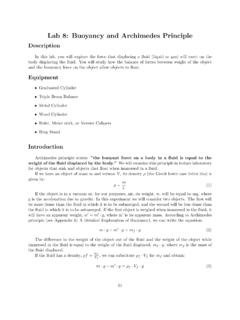
1 Experiment 10: archimedes PrincipleFigure Balance with stringGraduated CylinderPipetteCylinders: (2) Metal, (1) Wood(Note: The cylinders have sharp hooks)Overflow ContainerSpouted CanDigital Balance(2) 123-BlocksWood Board/BlockRod & ClampPaper TowelsWater5354 Experiment 10: archimedes PrincipleAdvance ReadingText: archimedes Principle , buoyant force, densityObjectiveThe objective of this lab is to investigate the buoyantforce acting on a variety of objects, the density of theobjects, and the density of our tap Principle states that a body wholly or par-tially submerged in a fluid is buoyed up by a force equalin magnitude to the weight of the fluid displaced by is the buoyant force that keeps ships afloat (ob-ject partially submerged in liquid) and hot air balloonsaloft (object wholly submerged in gas).
2 We will inves-tigate the buoyant force using the following methods: Direct Measurement of Mass Displacement MethodWhen an object is submerged in water, its weightdecreases by an amount equal to the buoyant measurement of masswill measure theweight of an object first in air, then while it is sub-merged in water. The buoyant force,FB, is equalto the weight in air (Fg) minus the weight in water,F g=m g:FB=Fg F g( )Thedisplacement methodrequires measurement ofthe volume of fluid displaced by the object. The weightof the fluid displaced is equal to the buoyant force ex-erted on the object. Thus, the buoyant force is givenby:FB= gV( )where (Greek letter,rho) is the density of the fluiddisplaced,Vis the volume of fluid displaced by theobject, andgis the acceleration due to following exercises will be informative, as bothfloating and sinking objects are used in this experi-ment.
3 Sketch a free-body diagram for an object thatisfloatingin water. How much water does itdisplace? Does it displace its volume in water?Does it displace its weight in water? Sketch a free-body diagram for an object thatissubmergedin water. How much water does itdisplace? Does it displace its volume in water?Does it displace its weight in water?The accepted value for the density of pure water at 4 Cand 1 atm is water= (1000 1) kg/m3. We will usethis value for the density of water forPart 2throughPart 5. That is, we assume a temperature in the labof 4 C!We will then experimentally determine the density ofthe tap water we used (Part 6) and compare it to thedensity of water at 20 C. The density of pure water at20 C is: water= ( ) kg/m3( )When comparing the experimental densities of yourobjects or tap water, please use Table provided atthe end ofExperiment 1: Measurement & AnalysisonPage 10: archimedes Principle55 Name:1.
4 State archimedes Principle . (20 pts)2. Explain the relationshipFB= V g. (25 pts)3. Briefly explain the methods used inPart 1throughPart 3of this Experiment to determine buoyant force. (25 pts)4. Draw a free-body diagram for an object of massM, for the following two submerged object suspended by a string; floating object. Draw to scale. (30 pts)56 Experiment 10: archimedes PrinciplePROCEDUREPART 1: Overflow Method1. Measure the mass of the brass cylinder. Determineits weight, Place the overflow container on the digital Fill the spouted can with water. Position it so thatits spigot pours into the overflow Submerge the brass cylinder in the water, allowingdisplaced water to collect in the overflow Measure the mass of the displaced water; calculateits weight. This is the buoyant force, Calculate obj(density of the object): obj= WFgFB( )PART 2: Direct Measurement - Mass7.
5 Calibrate the triple beam Suspend the object (brass cylinder) from a stringattached to the Partially fill the overflow container with water, thensubmerge the object. Do not allow the object totouch the container. Measure the apparent mass ofthe object in water,m . CalculateF DetermineFBfor the object. How much less doesit weigh in water than in air? (Eq. )11. Calculate objusing Eq. 3: Displacement Method - Volume12. Partially fill the graduated cylinder with water; takenote of the water level. Use the pipette to fine-tunethe Carefully submerge the object in water and deter-mine its Remove and dry the object, then empty the gradu-ated cylinder and invert it on a paper towel to DetermineFBon the object with Eq. Calculate objusing Eq. : obj=mV( )Use the volume determined from the displacementmethod andm, notm.
6 PART 4: Aluminum Cylinder17. RepeatPart 1throughPart 3for the next object(aluminum cylinder).18. Draw a free-body diagram for this object submergedin 5: Buoyant Force - Floating Object19. Although you need to modify or omit certain steps,repeatPart 1throughPart 3for the wood cylinder: Omit Step 6,Step 11, andStep 16. Modify Step 9andStep 13: Allow the woodobject to Draw a free-body-diagram for the wood object float-ing in 6: Density of Tap Water21. For each metal object: Use Eq. and the gradu-ated cylinder volume fromPart 3to determine thedensity of our tap m V= W( )QUESTIONS1. Consider situations A and B, below. Does one tubweigh more than the other, or do they weigh thesame? Draw a free body diagram for each A tub filled to the brim with A tub filled to the brim with water, with aboat floating in A 827 cm3gold nugget and a 827 cm3aluminumblock are immersed in water.
7 Which object experi-ences the greater buoyant force?3. A ship made of steel ( steel= 103kg/m3) willfloat in water. Explain, in terms of densities, howthis is Verify that Eq. is true for an object submergedin water. (Start by writing the equations for eachforce.)5. Consider a pirate boat in a pond with the anchoron the boat. When the pirates throw the anchoroverboard, what happens to the water level at theshore? Does the water at the shore rise, fall, or stayat the same level? Explain, in terms of archimedes Principle (density, volume, or weight), why this hap-pens.