Transcription of Experiment 12: Make-Up Experiment Copper Analysis by ...
1 61 Experiment 12: Make-Up Experiment Copper Analysis by Complexometric Titration A quantitative Analysis of Copper in a soluble Copper salt will by performed by complexometric titration. The complexing agent will be ethylenediaminetetraacetic acid (EDTA) in the form of its disodium dihydrate salt (Na2C10H18N2O10), with a molar mass of g mol 1. Since EDTA forms complexes with many metal ions, this particular method can only be used in the absence of such ions as Ca2+, Ni2+, etc. The reaction of complexation is: Cu2+(aq) + (EDTA)2 (aq) Cu(EDTA)2 (aq) + 2H+(aq) The stoichiometry is one metal cation to one EDTA anion. However, for Cu2+ (since it has lost 2 electrons), the equivalent mass is = g eq 1, and since (EDTA)2 is a dianion its equivalent mass is = g eq 1 (for the disodium dihydrate salt).
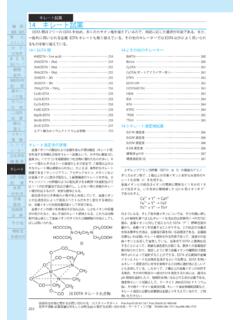
2 The equation above represents two equivalents reacting with two equivalents. The complex dianion is formed with the release of two moles of H+ from EDTA, with the indicator being released from the Copper ion. The complex dianion has the structure shown in Figure Note that the anion completely surrounds the cation, forming six coordinate covalent bonds to Copper and a very stable complex. The bonding to the Copper ion is nearly octahedral. The indicator used for the titration is called murexide. This indicator is highly colored and will complex with the Copper ion to give a different colored species. During the titration, the EDTA2 forms a more stable complex and frees the indicator, which then displays its original color. The appearance of the free indicator means that all metal ions have been complexed by EDTA2 , which signals the end point.
3 At the end point, the following equation applies: NEDTAVEDTA = NCu(II)VCu(II) = #eq Cu(II), if V is given in L = #meq Cu(II), if V is given in mL The mass of Cu equals (#eq Cu(II)) (equivalent mass of Cu(II)), and mass Cu(II) mass Cu(II) salt 100 = % Cu Figure Structure of Cu2+ EDTA dianion 6212A Experiment 1. Rinse your burette and fill it with standardized Na2 EDTA 2H2O solution 2. ( g Na2 EDTA 2 H2O per liter of water). 3. Weigh accurately three approximately g samples of the Copper salt, reported to three decimal places. Your instructor may specify that each sample be > g and < g. If so, remember that this will limit your final results to two significant figures. 4. Dissolve each sample in 50 mL of de-ionized water.
4 5. Add exactly the same amount of indicator to each sample, three to five drops to start off with. If the indicator solution is not strong enough, add more but always the same for all samples. (The indicator's concentration should be 100 mg/100 mL H2O) 6. Titrate each sample with the standardized EDTA. The light yellow solution turns green near the end point, then suddenly purplish blue at the end point. This end point is fairly hard to see, so put a white sheet of paper under your beaker and watch carefully. The distinctly purplish hue, due to free murexide, is the key to observing the end point. Look for the complete absence of green. 7. For each titration, calculate the number of equivalents or (milliequivalents) of Cu(II) found. 8. For each titrated sample, calculate the mass of Copper in that sample.
5 9. For each titration, calculate the % Copper content in the sample, then average them. Sample 1 Sample 2 Sample 3 (a) Normality of EDTA (b) grams of Cu(II) sample (c) mL of EDTA solution (d) eq (or meq) of Cu(II) (e) mass of Copper Average % Copper content (f) % Copper content 12B Exercise Copper (II) sulfate forms a hydrate which contains by mass water. Since the only component (other than H2O and Cu2+) is the sulfate ion, SO42 , we can now determine the complete formula of the hydrated Copper (II) sulfate. Do this determination. NOTE Solutions preparation: Either weigh the EDTA analytically or standardize the solution.
6 Label the bottles with the normality of EDTA. Use deionized water. About 1 liter will be used by 20 students, 10 groups. Make these solutions up fresh, including the murexide solution. 63 Report Form 12: Copper Analysis by Complexometric Titration Name: Partner: 12A Experiment Sample 1 Sample 2 Sample 3 (g) Normality of EDTA (h) grams of Cu(II) sample (i) mL of EDTA solution (j) eq (or meq) of Cu(II) (k) mass of Copper Average % Copper content (l) % Copper content 12B Exercise Complete formula of hydrated Copper (II) sulfate.
7