Example: barber
Exploring Simple Siamese Representation Learning
representation learning are based on clustering [5, 6, 1, 7]. They alternate between clustering the representations and learning to predict the cluster assignment. SwAV [7] incor-porates clustering into a Siamese network, by computing the assignment from one view and predicting it from an-other view. SwAV performs online clustering under a bal-
Tags:
Information
Domain:
Source:
Link to this page:
Documents from same domain
What Have We Learned From Deep Representations for …
openaccess.thecvf.comwhat these powerful models actually have learned. In this paper we shed light on deep spatiotemporal net-works by visualizing what excites the learned models us-ing activation maximization by backpropagating on the in-put. We are the first to visualize the hierarchical features
Finding Tiny Faces in the Wild With Generative Adversarial ...
openaccess.thecvf.comfaces, which are unfriendly for the face classifier. Toward-s this end, we design a refinement sub-network to recover some detailed information. In the discriminator network, the basic GAN [17, 12, 8] is trained to distinguish the real and fake high resolution images. To classify faces or non-
Squeeze-and-Excitation Networks - openaccess.thecvf.com
openaccess.thecvf.comSqueeze-and-Excitation Networks Jie Hu1∗ Li Shen2∗ Gang Sun1 hujie@momenta.ai lishen@robots.ox.ac.uk sungang@momenta.ai 1 Momenta 2 Department of Engineering Science, University of Oxford Abstract Convolutional neural networks are built upon the con-
RegularFace: Deep Face Recognition via Exclusive ...
openaccess.thecvf.comRegularFace: Deep Face Recognition via Exclusive Regularization Kai Zhao Jingyi Xu Ming-Ming Cheng ∗ TKLNDST, CS, Nankai University kaiz.xyz@gmail.com cmm@nankai.edu.cn
Protecting World Leaders Against Deep Fakes
openaccess.thecvf.comProtecting World Leaders Against Deep Fakes Shruti Agarwal and Hany Farid University of California, Berkeley Berkeley CA, USA {shrutiagarwal, hfarid}@berkeley.edu
Auto-DeepLab: Hierarchical Neural Architecture Search for ...
openaccess.thecvf.comAuto-DeepLab: Hierarchical Neural Architecture Search for Semantic Image Segmentation Chenxi Liu1∗, Liang-Chieh Chen 2, Florian Schroff2, Hartwig Adam2, Wei Hua2, Alan Yuille1, Li Fei-Fei3 1Johns Hopkins University 2Google 3Stanford University Abstract Recently, NeuralArchitectureSearch(NAS)hassuccess-
PointNet: Deep Learning on Point Sets ... - CVF Open Access
openaccess.thecvf.comPointNet: Deep Learning on Point Sets for 3D Classification and Segmentation Charles R. Qi* Hao Su* Kaichun Mo Leonidas J. Guibas Stanford University
Frustum PointNets for 3D Object Detection From RGB-D Data
openaccess.thecvf.comFrustum PointNets for 3D Object Detection from RGB-D Data Charles R. Qi1∗ Wei Liu2 Chenxia Wu2 Hao Su3 Leonidas J. Guibas1 1Stanford University 2Nuro, Inc. 3UC San Diego Abstract In this work, we study 3D object detection from RGB-D data in both indoor and outdoor scenes.
Class-Balanced Loss Based on Effective Number of Samples
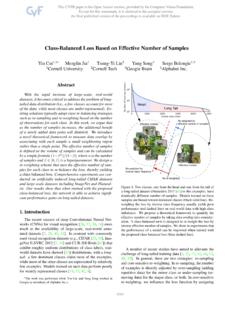
openaccess.thecvf.comand large-scale datasets including ImageNet and iNatural-ist. Our results show that when trained with the proposed class-balanced loss, the network is able to achieve signifi-cant performance gains on long-tailed datasets. 1. Introduction The recent success of deep Convolutional Neural Net-works (CNNs) for visual recognition [26, 37, 38, 16] owes
ESRGAN: Enhanced Super-Resolution Generative Adversarial ...
openaccess.thecvf.comESRGAN: EnhancedSuper-Resolution Generative Adversarial Networks Xintao Wang 1, Ke Yu , Shixiang Wu2, Jinjin Gu3, Yihao Liu4, Chao Dong 2, Yu Qiao , and Chen Change Loy5 1 CUHK-SenseTime Joint Lab, The Chinese University of Hong Kong 2 Shenzhen Institutes of Advanced Technology, Chinese Academy of Sciences 3 The Chinese University of Hong Kong, …
Related documents
Prototypical Networks for Few-shot Learning - NeurIPS
proceedings.neurips.ccseverely limited, we work under the assumption that a classifier should have a very simple inductive bias. Our approach, Prototypical Networks, is based on the idea that there exists an embedding in which points cluster around a single prototype representation for each class. In order to do this,
Applying dV/dT filters with VFDs - Eaton
www.eaton.comload would be closer to 200 ns (more inductive). With the increased impedance in the load, time increases as the AFD becomes larger. Figure 1 shows the representation of the service voltage and the reflected wave versus distance and the rise time of the IGBT. Figure 1. Cable Length Versus Overvoltage [2] The switching speed for standard IGBT ...
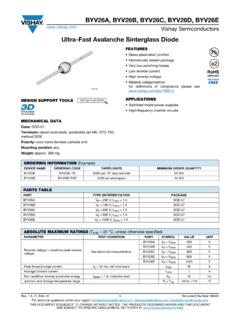
Ultra-Fast Avalanche Sinterglass Diode
www.vishay.comNon repetitive reverse avalanche energy I(BR)R = 1 A, inductive load ER 10 mJ Junction and storage temperature range Tj = Tstg-55 to +175 °C. BYV26A, BYV26B, BYV26C, BYV26D, BYV26E ... Vishay makes no warranty, representation or guarantee regarding the suitability of the products for any particular purpose or

Surface-Mount Glass Passivated Rectifier
www.vishay.comResistive or Inductive Load 0 1.2 20 40 60 80 160 Lead Temperature (°C) ard C u rrent (A) 100 120 140 1.0 0.8 0.6 0.4 0.2 0 0.2" x 0.2" (5.0 mm x 5.0 mm) Thick Copper Pad Areas S1A thru S1J S1K, S1M 0 10 100 1 10010 T L = 110 °C 8.3 ms Single Half Sine-Wave Number of Cycles at 60 Hz ard S u rge C u rrent (A) S1A thru S1J S1K, S1M

An Introduction to Experimental Research
cemast.illinoisstate.eduan inductive conclusion, rather then the acceptance or rejection of a hypothesis, like experimental research. Instead, the results are considered a tentative conclusion because the observations made are not a test of the pattern, but the source of …

Finite Automata - Computer Science
www.cs.unc.eduInductive step: Assume that መ 0, is correct for string . We need to prove that መ 0, remains correct for any symbol . This requires proving correctness for all possible transitions from all three states (mutual induction). Jim Anderson (modified by Nathan Otterness) 21 T u T v T w W

“Sampling Strategies” - NATCO
www.natco1.orgMost quantitative studies follow these steps: 1) Select the target population, 2) Select the accessible population, 3) State the eligibility criteria, 4) Outline the sampling plan, and 5) recruit the sample. Most qualitative studies might evolve this way: 1) a general idea of where and with what population to start and by soliciting a few cases through convenience procedures, 2) …