Transcription of Fetal Pig Dissection Introduction
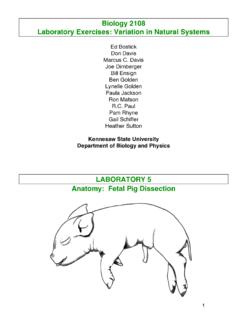
1 Fetal Pig DissectionIntroduction:Today, we begin a new chapter in our study of biology. In the first half of the year welooked at how the smallest units of life work, reproduce and pass on their genes. Duringthe next several months we are going to look at how larger organisms meet thecharacteristics of life. The biggest emphasis will be on making the connections betweenstructure and function within these begin our study of the connections between structure and function we are going toexamine the anatomy of a Fetal pig. The pigs we will dissect in this class were neverborn. Their mother passed away and their bodies were prepared so that we might gives all of us a tremendous responsibility. Because these pigs gave their lives forour learning we must be compelled by their sacrifice to learn as much as we can out ofrespect. Should you choose to disrespect your pig in any way, your transgression will bemet with serious consequences, including dismissal from class for the day, failure onclass grades, or failure on quizzes and being said, I honestly expect nothing but wonderful behavior from everyone.
2 All ofyou have demonstrated so much maturity during this year that I think this will be one ofthe highlights of our :This unit is entirely hands-on. You will work in pairs to dissect and learn from your are responsible for your pig and its well-being at all times. The grade for this unitwill be broken down into three basic ) Homework grade: you will receive a homework packet, which will becollected at the end of the unit. This packet will be graded for accuracy andeffort. I would try and spend a half-hour on it every ) Practical grade: there will be a practical quiz and a practical test during thisunit. These assessments will have you identify structures (and somefunctions) of the pig anatomy from several of our pigs. Your preparation forthese will consist of following through the Dissection manual exactly andlocating every will all have tons of questions during the next few weeks.
3 But, keep in mind that Iam one person and I cannot answer everyone s questions at once. Just be patient with meand polite to each other and I will be able to work with each group. Also, if your groupcan help others with their questions I encourage you to do so. Thanks so much, this isreally going to be great!-Mr. ElenbaasOrgans and Parts you need to know on The PigWhen learning these structures, it is helpful for you to learn them in a way that makessense, in the way they are connected by function. For example, the urinary system:the kidney is connected to the ureter, which is connected to the urinary bladder, whichis connected to the is a list of organs, which I tried to put into general sections based on cordAnal openingUrogenital openingMammary glandTongueTeethGlottisEpiglottisEsophag usStomachPyloric valveSmall intestine:Duodenum, jejunum, ileumCaecumLarge intestine.
4 Colon, rectumLiverGall bladderSpleenPancreasOvaryUterine tubesUterine hornsUterusVaginaUrogenital sinusVulvaProcessus vaginalisEpididymisTestisDuctus deferensPenisUrinary bladderUreterKidneyurethraDiaphragmLungs TracheaLarynxSubclavian veinsAnterior vena cava (precava)Brachiocephalic veinsInternal and external jugular veinsPosterior vena cava (postcava)Renal veinsCoronary veinCommon iliac veinUmbilical veinPulmonary arteryUmbilical arteriesAortic archDuctus arteriosisBrachiocephalic arteryCommon carotid arteriesSubclavian arteriesIntercostal arteriesRenal arteriesIliac arteriesThoracic aortaAbdominal aortaCoronary arteryLeft and right ventricleLeft and right atrium (or auricle)PericardiumMeningesCerebrumCereb ellumMedulla oblongataOlfactory bulbThymusThyroidFetal Pig LabCheck off each organ/structure as you locate it on your pig. Answer questions External Anatomy of the PigA.
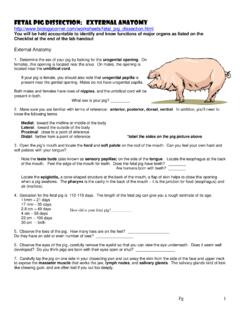
5 Age: i. By using this table and measuring the length of your pig in mmyou can determine the approximate Fetal age of the pig. This is thenumber of days since its father s sperm fertilized its mother segg. Measure your pig from snout to rump (this does not includethe length of the tail)Size (mm)cmAge (days sincefertilization) term (112-115) ii. How old is your Fetal pig? _____B. External features of the body: i. ____ Head ii. ____ Neck iii. ____ Trunk iv. ____ Tail v. ____ Appendages1. Head of the Pig:a. ____ Eyes: Are they open yet? _____b. ____ Earsc. ____ Nostrilsd. ____ Mouth: Can you see the tongue? _____2. Appendages:a. ____ Digits: How many digits does the pig have oneach foot? _____b. Note that the first digit (thumb) is missing and thesecond and fifth digits are reduced in size. Howmany digits does the pig walk on, on each foot?_____3. Trunk:a. ____ Thorax: The body cavity that extends from theneck to the diaphragm (the chest area)b.
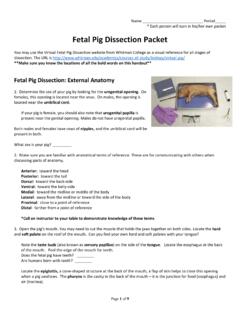
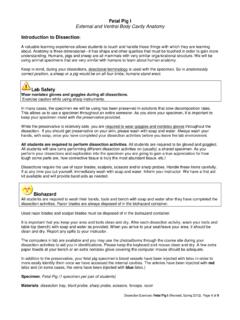
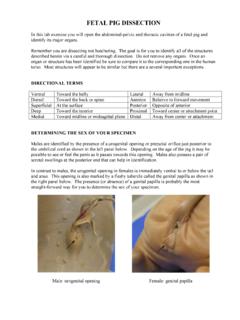
6 ____ Sternum: The bone in the center of the chest towhich the ribs attach in ____ Abdomen: Body cavity posterior to the thoraxd. Umbilical cord: Still partially attached to the ventralside of the abdomen. This used to be attached to theplacenta in the womb of the ____ Mammary glands: Nipples or teats found onthe ventral surface. How many mammary glandsdoes your pig have? Why are there so many?f. Anal opening: Located directly under (ventral) tothe Sex determination: You are responsible for knowing thereproductive structures on both a male and female , determine the sex of your pig. Then find a group topartner with that has a pig of the opposite sex. You will beresponsible for showing each other the relevant Female external anatomy: i. ____ Urogenital opening: Foundimmediately ventral to the anal opening; thisopening can be recognized by a fleshyprotuberance (vulva).
7 B. Male external anatomy: i. ____ Urogenital opening: Look for a smallhole just posterior to the base of theumbilical cord. ii. ____ Scrotal sacs: Two slight swellingsbehind the hind legs. iii. ____ Penis: This is the muscular tube lyingunder the skin, running posteriorly from theurogenital opening. You can feel this underthe is the sex of your pig? _____Who will be your partner group? _____Do male pigs have mammary glands? _____II. Digestive System: You are about to begin your examination of the alimentarycanal, consisting of: mouth, pharynx, esophagus, stomach, small intestine,large intestine, and a number of glands (liver, pancreas)A. ____ Mouth: This is the opening of the digestive system. Cut jawsstarting at the corners of the mouth and cut all the way through thecartilage to the ears. Deepen your cuts until the mouth opens freely. Donot cut into the back of the throat.
8 I. ____ Tongue ii. ____ Papillae: Bumps on the surface of the tongue iii. ____ Teeth: How many teeth can you count in your pig s mouth?1. Do both jaws move up and down or just one? _____ iv. ____ Pharynx: The throat (back of mouth) v. ____ Epiglottis: The small white tab found at the back of thepharynx. This is made of cartilage. The jaw must be open verywide to see this. vi. ____ Esophagus: Only the opening, or glottis, of the esophagus isvisible at this stage. It lies beyond (dorsal to) the epiglottis. It isessentially, the opening. vii. ____ Larynx: Not visible yet, but feel for the Adam s apple fromthe outside of the pig s throat. You will see this when the throatarea is dissected ____ Abdominal cavity: Now you are ready to examine the viscera(internal organs) of the abdominal cavity. Read through all of the stepsfirst, then go through them again performing each step.
9 I. Place pig on its dorsal side (belly up) ii. Lift the thin wall of the abdomen above the umbilical cord, holdingit away from the internal organs. Insert the fine point of yourscissors, or scalpel, through the wall of the abdomen where through the skin and muscle to the cavity. Always cut with anupward motion to avoid damaging the internal organs. iii. Cut in a straight line own the midline of the pig from the umbilicalcord to the bottom of the sternum. DO NOT CUT THROUGHTHE RIBS or DIAPHRAGM. iv. Refer to the diagrams below for help on the following directions:1. Cut around the umbilical cord. The umbilical vein extendsfrom the inside of the umbilical cord to the liver, the largegrown organ in the abdomen. You will have to cut theumbilical vein, but note it Female Only: Join the cuts from either side of theumbilical cord at a point just posterios to the cord. Then,continue this cut down between the Male Only: Do not join the cuts from either side of theumbilical cord.
10 Instead, continue the two cuts separatelytoward the posterior of the animal, between the hind is to avoid cutting the penis, which is just below theskin. v. In both cases, just in front of the hind legs, cut laterally through thebody on either side. Make another two lateral cuts at the top of theabdomen, exposing but not damaging the diaphragm. You shouldnow have two flaps which can be opened sideways to expose theinternal organs of the abdomen. vi. Remove and throw away any stray pieces of red or blue latexinside the abdominal cavity. Drain the juice and gently rinse outthe abdominal cavity of your pig. vii. As demonstrated in class, fasten the pig to the dissecting tray withtwo pieces of Abdominal Organs: You are now ready to locate the followingabdominal organs. i. ____ Mesentery: Thin membrane covering the organs. You cutthrough this when opening the abdominal cavity.