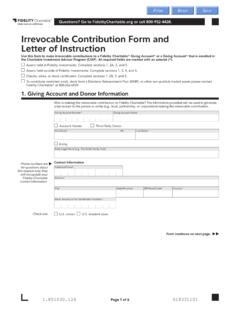
Transcription of Fidelity Charitable Program Guidelines
1 Fidelity Charitable Program GUIDELINESFIDELITY Charitable Program GUIDELINEST hese Fidelity Charitable Program Guidelines ( Guidelines ) describe the donor- advised fund Program of the Fidelity Investments Charitable Gift fund ( Fidelity Charitable ), as well as important policies, procedures, and benefits associated with establishing and maintaining a donor- advised fund ( Giving Account ) at Fidelity Charitable . All activities of Fidelity Charitable , and participation in the donor- advised fund Program , are subject to the terms and conditions of the Fidelity Charitable Declaration of Trust ( Declaration of Trust ) and these Guidelines .
2 Fidelity Charitable is governed by an independent Board of Trustees ( Trustees ), who are responsible for all aspects of its operations. The Trustees reserve the right to modify the Program and these Guidelines at any time, subject to the provisions of the Declaration of OF CONTENTS Fidelity Charitable : a Public Charity with a Donor- advised fund Program 1 Establishing a Giving Account 2 Contributions 4 Tax Considerations 9 Investment Options 10 Pool Allocation Process 12 Grantmaking 13 Recordkeeping and Reporting 19 Fees and Expenses 20 Successor Options 22 Naming an Individual Successor 23 Recommending a Charitable Organization Successor 23 Recommending the Endowed Giving Program 24 Fidelity Charitable Trustees Initiative 27 Service Providers 27 Other Information 28 Glossary 31 Last updated: August 2021[ 1 ]INTRODUCTIONFIDELITY Charitable .
3 A PUBLIC CHARITY WITH A DONOR- advised fund PROGRAMA public charityFidelity Charitable , an independent, section 501(c)(3) public charity that administers donor- advised funds, was organized, and operates exclusively, for Charitable donor- advised fund programFidelity Charitable Account Holders may make irrevocable Charitable contributions2 to Fidelity Charitable , and recommend grants to Qualified Charitable Organizations. Account Holders may also recommend that their contributions be allocated to one or a combination of investment pools, each of which is managed by Strategic Advisers LLC ( Strategic Advisers ), a Fidelity Investments company that provides investment advisory services to Fidelity policy and trademarksPersons and entities may not suggest that Fidelity Charitable endorses, sponsors or is affiliated with any non Fidelity Charitable website, entity, service, or product.
4 Account Holders wishing to describe the Charitable purpose of their individual Giving Account and/or the programs and services of Fidelity Charitable should state that the Giving Account is a donor- advised fund at Fidelity Charitable , an indepen-dent public charity, and submit such reference to Fidelity Charitable for review and written approval by an authorized representative. Account Holders, other individuals or entities may not use any Fidelity Charitable service mark without the express written consent of an authorized representative of Fidelity Fidelity Charitable has been recognized by the Internal Revenue Service (IRS) as a tax-exempt Charitable organization that is a public charity, as described in sections 501(c)(3), 509(a)(1) and 170(b)(1)(A)(vi) of the Internal Revenue Code ( the Code ) of 1986, as amended.
5 Fidelity Charitable is governed by an independent Board of Trustees under a Declaration of Trust, and all activities of Fidelity Charitable are subject to the Trustees discre-tion, directly or through staff or other agents, pursuant to the Declaration of Trust and these These Guidelines provide information that is general and educational in nature. It is not intended to be and should not be construed as legal or tax advice. Fidelity Charitable does not provide legal or tax advice. In compliance with IRS requirements, any information contained herein is not intended or written to be used, and cannot be used, for the purpose of avoiding tax penalties under the Internal Revenue Code.
6 Content provided relates to taxation at the federal level only. Availability of certain federal income tax deductions may depend on whether you itemize deductions. Rules and regulations regarding deductions for Charitable giving vary at the state level, and laws of a specific state or laws relevant to a particular situation may affect the applicability, accuracy, or completeness of the information provided. Charitable contributions of capital gain property held for more than one year are usually deductible at fair market value. Deductions for capital gain property held for one year or less are usually limited to cost basis or fair market value, whichever is less.
7 Consult an attorney or tax advisor regarding your specific situation.[ 2 ]ESTABLISHING A GIVING ACCOUNTE ligibility to establish a Giving AccountIndividuals,3 corporations and other business entities, trusts and estates4 are all eligible to establish a Giving Account. However, nonprofits and tax-exempt organizations, including charities exempt under section 501(c)(3) of the Internal Revenue Code, are not eligible to establish a Giving establish a Giving AccountIndividuals or trusts and estates may establish an individual Giving Account by completing a Donor Application and making an initial irrevocable contribution to Fidelity Charitable .
8 For organizational Giving Accounts (other than Corporate Giving Accounts), the minimum initial contribution is $25,000. For Corporate Giving Accounts (company-established organizational Giving Accounts for corporate philanthropy), the minimum is $100,000. Applications may be completed online at They may also be mailed or faxed to us. Applications for corporations or other business entities must be either mailed or faxed to us. Once the Giving Account is established, Account Holders may make additional contributions at any time, subject to approval by the Trustees. To name a Giving AccountAs part of the Giving Account establishment process, Account Holders are asked to name the Giving Account ( , The Smith Family Charitable fund ).
9 Fidelity Charitable reserves the right not to approve a name for a Giving name a Primary Account HolderThe Primary Account Holder on an individual Giving Account is the individual who has primary responsibility for the relationship with Fidelity Charitable . All Giving Account correspondence, with the exception of confirmations related to contributions made by Additional Account Holders and/or third-party contributors, will be sent to the Primary Account Holder at the Primary Account Holder s address (or email address, if requested) of record. Generally, Fidelity Charitable requires an individual to be named as the Primary Account Holder.
10 The authorized representative of a trust or estate may be named as the Primary Account Holder. 3 Minors may be named as Additional Account Holders (not Primary Account Holders) on Giving Accounts only where the minor s legal guardian (1) is the Primary Account Holder on the same Giving Account and (2) autho-rizes all transactions initiated by the minor, until the legal guardian establishes that the minor has reached the age of majority in the minor s state of Individual Giving Accounts may be established by trusts and/or estates. An individual must be named as the Primary Account Holder on the Giving Account and, therefore, an individual s Social Security number will be required.