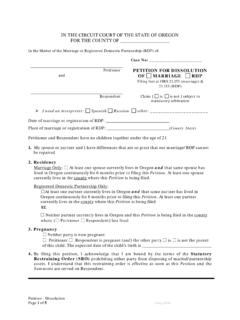
Transcription of FILING FOR DISSOLUTION (D
1 Page 1 of 22 (Aug 2019) FILING FOR DISSOLUTION (DIVORCE) TABLE OF FORMS 1. Starting your Case (See the last box of this table for additional forms you may need) ___ Petition for DISSOLUTION of marriage /RDP ___ Summons ___ Record of DISSOLUTION of marriage , annulment or Registered Domestic Partnership ___ Notice of Statutory Restraining Order Preventing Dissipation of Assets ___ Confidential Information Form (CIF) (one for each party) ___ Notice of CIF FILING Optional: ___ Fee Deferral or Waiver Application and Declaration 2. Notifying the Other Party ___ Acceptance of Service (if possible) ___ Certificate of Service 3.
2 Temporary Orders 4. Resolving Your Case By Agreement: ___ Declaration in Support of Judgment ___ General Judgment of DISSOLUTION of marriage /RDP Or By Default: ___ Ex Parte Motion for Order of Default and Declaration in Support ___ Order on Motion for Default ___ Declaration in Support of Judgment ___ General Judgment of DISSOLUTION of marriage /RDP Or By Hearing: ___ General Judgment of DISSOLUTION of marriage /RDP Additional forms you may need: (More information is in the Instructions below) ___ Uniform Support Declaration ___ Statement of Assets and Liabilities ___ Waiver of Personal Service ___ End-of-case Fee Waiver Application & Declaration Page 2 of 22 (Aug 2019) What these forms do This set of forms will help you to get a divorce (legally called a DISSOLUTION of marriage ) if you have no children under 21.
3 If you have only children over 18 and under 21 who are in school, use the DISSOLUTION with Adult Children Only forms (not yet available. Talk to a lawyer if you only have children 18, 19, or 20). TALK TO A LAWYER BEFORE USING THESE FORMS IF: You are part of a same-sex couple AND: o You are married, have a civil union, or registered in another state o You are married, have a civil union, or registered in another state in addition to Oregon o You registered as domestic partners in Oregon before February 4, 2008 o You are unsure if your partnership is a Registered Domestic Partnership (RDP) o If you want partner support and either party lives in (or may move to)
4 Another state You want to divide the retirement benefits of either party Either party is a debtor in a current bankruptcy case Important Contact Information Oregon Judicial Department Oregon State Bar Lawyer Referral Service - Phone: or toll-free in Oregon at If you are deployed or about to be deployed, contact the Oregon State Bar Military Assistance Panel ( ) for information about special rights and rules that may apply to you. Important Note STOP! You may not be able to use this form Caution! You may need a lawyer Concerns money Timing requirement Symbols used in this form: If Both Parties Already Agree If you agree on all of the issues, you can file as Petitioner and the respondent can accept service of the Petition and sign a completed Judgment form.
5 The respondent can also choose not to file a Response. If no response is filed, judgment will be entered based on what is in the Petition after you file a Motion for Order of Default (see By Default section below). You can also file as Co-petitioners. Talk to a lawyer if you want to file as Co-petitioners. Page 3 of 22 (Aug 2019) Table of Contents Information about DISSOLUTION .. 4 STEP 1: STARTING YOUR CASE .. 5 Where to File .. 5 Statutory Restraining Order .. 5 Name Change .. 6 Mandatory 6 SUPPORT ..7 PROPERTY AND 8 STATEMENT OF ASSETS AND LIABILITIES.
6 8 STEP 2: FILING AND SERVICE .. 9 SERVICE .. 9 Acceptance of Service .. 9 Formal Service ..10 STEP 3: TEMPORARY ORDERS .. 12 Domestic Violence .. 12 STEP 4: RESOLVING YOUR CASE .. 13 By Agreement .. 13 By Default .. 13 By .. 15 THE JUDGMENT .. 17 Appendix A Uniform Support Declaration .. 19 Appendix B - Property and Debts .. 20 Appendix C Statement of Assets and Liabilities .. 22 Appendix D Statutory Restraining Order .. 23 Page 4 of 22 (Aug 2019) Information about DISSOLUTION Notice about these instructions and forms These instructions are not a complete statement of the law.
7 They cover basic procedures for simple DISSOLUTION cases with no children under 21. If you have complicated issues or questions about the law, talk to a lawyer. All of the necessary forms should be online. If you cannot find a form, ask your local court. Each court has local rules, programs, and procedures that may not be explained in these instructions. Refer to the Supplementary Local Rules for your county. These rules are available online or at your local court or law library. Forms and information about your local court are on the Oregon Judicial Department website.
8 A DISSOLUTION case starts with a petition, which tells the court what you want. That s why you are called the petitioner. The other person is the respondent. The case ends with a judgment, which is the court s final decision. The judgment is the document that finalizes your case and contains your rights and responsibilities. Your DISSOLUTION is effective once the judge signs the judgment. o NOTE: the final judgment in this case will create rights and responsibilities that may be permanent. Support orders often can be modified later, but property orders usually can t.
9 Talk to a lawyer if you have questions about these issues. Divorce can affect other documents like wills, medical advance directives, trusts, and pensions. Divorce may also affect immigration status. Talk to a lawyer for more information. Keep the court informed of your current address so you get notice of all court dates. You don t have to use your home address on any court form. You may use any contact address where you regularly check in, as long as it is in the same state as your home. The court will assume that you receive all notices sent to that address.
10 It is YOUR responsibility to let the court know if you move or want to get mail at a different address. Page 5 of 22 (Aug 2019) STEP 1: STARTING YOUR CASE Keep In Mind: Talk to a lawyer if you or Respondent is already in bankruptcy. The court may not be able to proceed with your case until the bankruptcy is resolved. Registered Domestic Partners should see a lawyer if partner support is requested and either party might move out of state. If the new state does not recognize RDPs, you may have trouble collecting partner support. Note: Only same-sex couples can have Registered Domestic Partnerships.