Transcription of FIRST PEOPLES - Museum
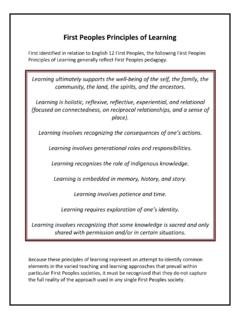
1 FEATURE ARTICLE. FIRST . PEOPLES . PRINCIPLES. Truth Telling at Living History Sites Burnaby is the shared territory of numerous reflect a respectful and holistic approach to Meagan FIRST Nations. However, our colonial past was teaching and learning. They were developed Innes & all too effective in driving out many of the by the FIRST Nations Education Steering Sanya Indigenous people who called these lands Committee (FNESC). Today, these principles Pleshakov home and in maintaining that status quo. are used with all learners in the school Settler narratives have suppressed these system; they are foundational to the revised historical realities, both in Burnaby schools BC curriculum. and the Burnaby Village Museum . Working respectively as a K-12 teacher and as a muse- The process of creating new Indigenous um educator, we have spent time considering programming at Burnaby Village Museum how children learn about colonialism and In- has taken years of consultation and there digenous ways of knowing.
2 When we reflect are many collaborators at the table today. on the Truth and Reconciliation Commission Museum staff have partnered with several of Canada's Calls to Action, we believe we local FIRST Nations, including Tsleil-Waututh, are still very much in the early days of truth Musqueam, Squamish, and Kwantlen, as well telling. as with Burnaby School District's Indigenous education team. These partnerships are not Burnaby Village Museum is a living history just institutional, but highly personal. They site in Metro Vancouver that represents a are based on Museum staff being vulnerable, small settler community in the 1920s. Cos- honest, and genuinely caring when spending tumed interpreters engage close to 150,000 time with FIRST Nations staff, artists, and visitors a year in the homes and shops of community members, sharing reflections a ten-acre historical village.
3 Recognizing about history, colonialism, and reconciliation, Indigenous educator that the Museum 's settler narrative has and slowly building trust. For Museum Carleen Thomas fundamentally contributed to the erasure staff, nurturing these relationships in a teaching students a of Indigenous history in Burnaby, staff saw good way is their single most important traditional dance. educational initiatives as a way to start right- goal. It trumps project deadlines, exhibit Photo credit: ing this wrong. In 2017, the Museum launched timelines, and forms the basis of all decisions Leanne Scherp, courtesy of Burnaby new Indigenous programming for schools made around programming. Village Museum based on the FIRST PEOPLES Principles of (BVM) Learning.
4 This set of nine pedagogical values 9. FEATURE ARTICLE. Reconciliation and Education Education has gotten us into this mess, and Education has gotten us into this mess, and education will get us out.. education will get us out. Senator Murray Sinclair Senator Murray Sinclair Murray Sinclair, as the Chair of the Truth and Reconciliation Commission of Canada, has been vocal that education is the key to walking on this journey of reconciliation. He reminds us that teachers have a sacred responsibility to ensure that all children, re- gardless of heritage, should explore four key questions throughout their education: Where do I come from? Where here am I going? Why am I here? Who am I? Education systems should be designed to help children answer these very basic, yet profound, questions.
5 Reconciliation is a loaded term that comes with pain, suffering and a deep sorrow that does not ease with time. In reconciling, we learn the multilayered, complexity of trau- ma and survival. We now understand that residential school survivors have not just survived; they are still surviving. This para- digm shift allows us to reframe the notion of reconciliation with the deep knowledge that each individual surviving carries their own personal experiences that in turn redefine the term for us. As educators, we can no longer shy away from the truth. Our students need to know about the cultural genocide the physical, emotion- al, spiritual, and sexual abuses inflicted on Indigenous PEOPLES in Canada that contin- ues to affect generations.
6 These truths have been missing from our historical narratives, our textbooks and our education system for too long. We must create age-appropriate resources that are creatively differentiated to address these truths. Canadians need to work together in the process of reconciliation, with the goal of creating a renewed relationship based on mutual understanding and respect. 10. FIRST PEOPLES PRINCIPLES. Indigenous educator Meagan Innes teaching students to count in S wx w 7mesh sn chim. Photo credit: Leanne Scherp, courtesy of BVM. FIRST PEOPLES Creating Indigenous Principles of Learning Space in the Village Indigenous educator FNESC is comprised of many Indigenous The Indigenous space at Burnaby Village T'uy't'tanat-Cease educators, scholars, knowledge keepers, Museum is meant to be a place of welcome.
7 Wyss. and strong leaders all dedicated to creating, It is contemporary with painted black sil- Photo credit: Leanne Scherp, providing and reviewing appropriate resourc- houettes representing animals considered im- courtesy of BVM es, which authentically reflect Indigenous portant to local FIRST Nations. Animal names worldviews and perspectives in many areas appear on the walls in both h n q min m and of education. One of those resources, the S wx w 7mesh sn chim. An intentional effort FIRST PEOPLES Principles of Learning, reflect was made to keep the look modern instead the Calls to Action of the Truth and Reconcil- of trying to recreate an exhibit authentic to iation Commission, including the call to in- the era, one which might stereotype Indig- tegrate Indigenous knowledge and teaching enous people as people of the past.
8 There is methods into classrooms and build student very little interpretation or explanation in capacity for intercultural understanding, the space no curatorial voice that might empathy and mutual respect. overpower others. Rather, it is a place for Indigenous staff and community members to Through the guidance of the FIRST PEOPLES engage with students on their own terms. Principles of Learning, students have begun to see parallels between themselves, Indigenous programming in a 1920s settler their families and Indigenous PEOPLES village may seem incongruous. Certainly, and communities. Learners see how doing so without the benefit of purpose-built traditional techniques and knowledge are exhibits comes with its challenges. But it is very much alive in society today and that precisely because the space does not fit per- Indigenous PEOPLES continue to build on fectly with everyone's idea of a 1920s settler these traditional teachings.
9 For educators, village that it can challenge assumptions following the FIRST PEOPLES Principles of about easy settler narratives conveniently ab- Learning is one place to start integrating sent of Indigenous people . It forces visitors to Indigenous pedagogies into classroom stop and think about why it might seem awk- and Museum environments that have tradi- ward to encounter Indigenous space on the tionally left them out. As educators, we are main street of the village. Its central location working together to find ways our learning makes the point that despite governments ef- can fit into Indigenous ways of knowing. forts to keep Indigenous and non-Indigenous 11. FEATURE ARTICLE. people separate with the colonial tools of the There is very little interpretation (not so distant) past reserves, residential or explanation in the space schools, incarceration Indigenous people never vanished from the land we now call no curatorial voice that might Burnaby.
10 Indigenous people found ways to overpower others. Rather, it occupy urban space in the past, and they are is a place for Indigenous staff still deeply connected to these lands today. and community members to engage with students on their Framing Indigenous Learning own terms. In developing new Indigenous programming, Museum staff worked closely with a group of Burnaby teachers and members of the district's Indigenous education team. This Students explore a map of what process has been one of collaboration, deep the lands now called Burnaby may have looked like in the past. inquiry and hard questions to ponder. Photo credit: Leanne Scherp, The Museum has implemented all requests courtesy of BVM made from the Teachers Focus Group in making space for dialogue around our shared history, the hard truths of colonization, and settler roles in colonialization.