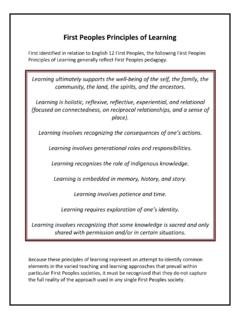
Transcription of First Peoples Principles of Learning
1 First Peoples Principles of Learning Created by: First Nations Education Steering Committee Excerpts and links helping with understanding are the work of Jo-Anne L. Chrona Jo-Anne L. Chrona, 2014. Today we will begin our work using the lens of the First Peoples Principles Of Learning Process each table has a facilitator each table has 1 of the nine Principles of Learning each table has people , and each person will be heard the principle is on a large placemat with lots of room for drawing, writing , creating fill the room with dialogue, what interests you, gives you pause, makes you wonder about this principle fill your page with words, thoughts, drawing.
2 Share your thoughts with us, one surprise or an ah ha .. Please begin your dialogue . Learning ultimately supports the well-being of self, the family, the community, the land, the spirits and the ancestors. (1). uniqueness of each learner is valued and appreciated each person enters this world with specific gifts that can be nurtured as they grow responsibility of the adults in a child's life to acknowledge those strengths so that gifts can flourish Learning ultimately supports the well- being of the family and community (1). there is a need to balance individual achievement against responsibilities to and for the family and community what is learned by individuals needs to benefit his or her family and community this connects back to we are all one.
3 What affects one person affects all others Learning ultimately supports . the well being of the land (1). the community and natural environment are regarded as the classroom . it is an understanding that people belong to the land , in contrast to people own the land the health of human beings is tied to the health of the land what is learned needs not to jeopardize the health of the land Learning ultimately supports the well being of the spirits, and the ancestors (1). people owe their lives to those that have come before Learning should respect what has been learned from those ancestors Learning is holistic,reflexive,reflective, experiential, and relational (focused on reciprocal relationships, and a sense of place) (2).
4 Holistic everything is interconnected education is not separate from the rest of life relationships are vital 4 aspects of being: mental, physical, spiritual and emotional with respect to education, each aspect carries equal value and weight spiritual, in FP context does not equate with religious beliefs one's spirituality is the inner resource that facilitates knowing oneself, one's surroundings and finding meaning for one's self in connection and relation to those surroundings ( Katz&St. Denise). Learning is reflexive (2). It builds upon itself exponentially increasing as learners develop new knowledge and deeper understandings of how everything is ultimately connected Learning is (2).
5 Learning does not happen with out reflection when stories are shared by Elders, there is an intention to help the listener learn without explicitly saying what the lesson is stories are often repeated in a lifetime with expectation that the listener will decide for themselves what needs to be learned from the story Learning is (2). Learning is made from direct experience by doing and engaging hands-on and minds-on approach there is a tactile connection between knowledge and life Learning is (2). we are all related as human beings we share commonality.
6 What affects one person affects others treating all people as related requires and reinforces a way of being that help shape our actions encompasses relationship to self, to others, current and past, and to place knowing ones community, then one can understand him or herself Learning involves recognizing the consequences of one's actions. (3). each person takes responsibility for his or her own actions actions have consequences we are all related and how will actions affect others need for authentic Learning situations need for learner's autonomy - providing motivation and a learner's understanding of themselves as a learner and their strengths Learning involves generational roles and responsibilities.
7 (4). the responsibility of teaching belongs to everyone this strengthens the community the responsibility for Learning belongs to the learner Elders share stories, learners determine what they should take from the story to help them at this time and place Elders are significant teachers, a knowledgable person who understands the things needed to be learned by young people Elders are models for learners respect for Elders is embedded in Peoples ' consciousness Learning recognizes the role of Indigenous knowledge. (5). the understanding that Indigenous people hold an extensive wealth of knowledge, even if it has not been recognized by post -industrious Euro- centric cultures.
8 ( Battiste). Indigenous knowledge contributes to the non-Indigenous understandings of the world First Peoples Principles of Learning represents a highly effective approach to education, inclusivity and recognizing multiple ways of meeting learner's needs, and uncovering pre-existing conceptual understandings Indigenous Knowledge can be defined as a complex knowledge system that has been developed over time by a particular people in a particular area and that has been transmitted from generation to generation. Learning is embedded in memory, history, and story.
9 (6). knowledge was kept in an oral tradition oral tradition still highly valued oral narratives are used to teach skills, transmit cultural values and mores, convey news, record family and community histories and explain the natural world spiritual and emotional truth were expressed through metaphor and symbols in stories emphasis on story and history help learners to organize new concepts that develop from their Learning oral tradition is very precise and follows a procedure historical and cultural context in oral tradition helps the learner understand what and who has come before and how it has influences what is now and how each person came to be.
10 Learning involves patience and time. (7). Learning is an individualist process and cannot be rushed Learning happens when a person is ready most effective when Learning can be applied in an authentic context all people in a group contribute according to their gifts group members learn from one and other group decisions made through consensus takes time, patience and encourages people to listen and understand differing perspectives consensus builds strong communities Learning requires exploration of one's identity. (8). identity connects people to each other and the land it includes developing an understanding of ones' place in the world understanding factors that contribute to how people see themselves know strengths and innate abilities, capacity to learn connects to the duty to contribute to others, family community, land.