Transcription of Foundations for Model-Based Systems Engineering
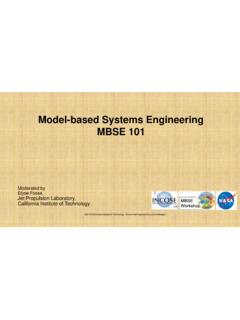
1 ENES 489P Hands-On Systems Engineering ProjectsFoundations for Model-Based Systems EngineeringMark AustinE-mail: for Systems Research, University of Maryland, College Park p. 1/31 Topic 4: Model-Based Systems for Model-Based Systems system concepts ( , definition, emergent properties). models of system Structure ( , hierarchies, layers, networks). and Reactive Engineering view of Modeling. p. 2/31 Model-Based Systems EngineeringGoalsModel- based Systems Engineering (MBSE) development is an approach to Systems -leveldevelopment in the focus and primary artifacts of development are models (as opposed todocuments).
2 Approach and BenefitsMBSE procedures provide a formal basis for: Closing the gap betweenwhat is neededandhow the system will work Assisting in the management of complex Systems . Early and formal approaches to system validation and verification. p. 3/31 Model-Based Systems EngineeringModel- based Systems Engineering process at Vitech p. 4/31 Basic system ConceptsDefinition of a SystemFor our purposes, a system is:.. a collection of components (some of which can be modules and sub- Systems ) thatare interconnected so that the system can perform a functionwhich cannot beperformed by the components may consist of products, people and of a SystemInputSubsystemconnectivityExternal threats.
3 OutputSubsystemSystem boundarySystem p. 5/31 Basic system ConceptsKey boundary separates the system from its external environment ( , walls in abuilding; starting and finishing times for a numerical analysis). are elements that enter the system ( , raw materials entering amanufacturing plant). are the finished products and consequences of being in the cars leaving a car assembly plant is an example of example of consequence of being is the ability of a highway bridge system tocarry threats are those things that can potentially affectacceptability of the systemconfiguration for example, a lack of knowledge, insufficient time to build, lack offinance p.
4 6/31 Basic system ConceptsDichotomies of system Classification Artificial versus NaturalArtificial Systems are Systems are not. Physical versus ConceptualPhysical Systems operate on matter (or from matter) in the physical Systems exist abstractly as ideas, plans, or information. Open versus ClosedOpen Systems interact with the surrounding environment through a Systems do not. p. 7/31 Basic system ConceptsEmergence and Emergent PropertiesEmergence is the way in which complex Systems and patterns arise out of a multiplicityof relatively simple sand ripples caused by wind and waterAxes of symmetry in natureTwo examples from nature: (1) parallel lines in sand caused by water and wind; (2) axesof symmertry in crabs, butterflys and bugs.
5 P. 8/31 Basic system Properties in Bridge : Aesthetics, load carrying capacity, physical symmetries, resistance toaeroelastic to understand emergent properties can be catastrophic!Tacoma Narrows Bridge p. 9/31 system StructureHierarchy StructureA hierarchy is .. an arrangement of items in which the items are represented as being above,below, or at the same level as one HIERARCHYHIERARCHY OF Systems / SUBSYSTEMS IN AN AUTOMOBILE p. 10/31 system StructureBenefits of the Hierarchy StructureFor designers the hierarchy structure is a powerful abstraction mechanism.
6 The hierarchy viewpoint enables a designer to visualize an entire related aspect of thesystem without the confusing detail of subparts and withoutthe unrelated anddistracted generality of super-parts. By reducing the distracting detail to a single object that islower in the hierarchy, onecan greatly simplify many system development example, simulation, verification, design-rule checking, and layout constraintscan all benefit from hierarchical representation, which makes them much morecomputationally tractable. p. 11/31 system StructureLayered StructureA layered system is.
7 One where the hierarchy of system components is clustered into horizontal Systems interconnection (OSI) model for computer LinkPhysical1 PresentationOpen Systems Interconnection model for p. 12/31 system StructureExample organization of multi-dimensional attributes in spatial Information SystemLayers of Data / Information in Military Decision Making p. 13/31 system StructureNetwork StructureA network is a .. set of elements (or modules or nodes or devices) that are connected by a set ofinterfaces (or links or communication channels).
8 Formally, a network is a modules may be computers, mechanical machines, interfaces may use a variety of communications subsystems in an p. 14/31 system StructureExample behavior of many man-made and natural Systems can be modeled asnetworks having cyclic behavior, , the water / SnowEvaporationOceanRiverClouds p. 15/31 system StructureNetwork TopologyA network topology describes the connectivity (or arrangement) of nodes on network topologies include star, ring, line, bus, and tree configurations: p. 16/31 system StructureNetwork science seeks to discover the common principles, algorithms, and tools thatgovern network behavior across a wide range of questions about networks: How big is the network?
9 How many hops does it take for a random node A to be connected tonode B? What is the shortest distance (in terms of edges or cost) fromnode A to node B? From a design standpoint, what are the pros/cons of each network structure?More interesting questions: What does nature do? Why? What kinds of relationships exist between real-world networks? How vulerable are networks to attack? And how does this change with networkstructure? p. 17/31 system StructureReal-World examples of network connectivities in four different real-world networks: (a) the Internet; (b)social networking; (c) a random graph; (d) track configuration in a metro in a typical scale-free network ( , air transportation networks).
10 P. 18/31 system StructureNetworks of NetworksMany large scale Systems are intertwined networks of the relationships among the networks and their combined behaviorscan be very have intertwinednetwork structures for: The arrangement of spaces, Fixed circulatory Systems (power,hvac, plumbing), and Dynamic circulatory Systems (flows ofenergy through rooms; flows of ma-terial). p. 19/31 system StructureExample 2. Cascading failure of networks caused by , New Zealand, am, September 4, 2010. A magnitude earthquakerolls into town.