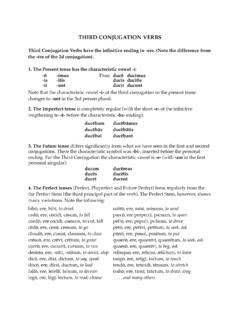
FOURTHCONJUGATION VERBSF ourth CONJUGATIONVERBS have the infinitive ending in Present Tense:-io-is-it-imus-itis-iuntThus:venio venisvenitvenimusvenitisveniuntNote that -i is the characteristic vowel of the FOURTHCONJUGATION in the present tense,changing to -iu in the 3rd person The Imperfect Tense has regular endings, but with the characteristic -i-:veniebamveniebamusveniebasveniebatis veniebatveniebant3. The Future Tense also shows the characteristic -i-, as well as the future tensesign -e- as in the 3rd CONJUGATION (instead of the -bi- of the lst and 2dconjugations). Note, however -iam in 1st person singular:veniamveniemusveniesvenietisven ietvenient4. The Perfect tenses (Perfect, Pluperfect and Future Perfect) are regular, formingnormally from the stem of the third principal part. Note the following:aperio, -ire, aperui, apertum, to openaudio, -ire, -ivi, -itum, to hearnescio, -ire, nescivi, nescitum, to be ignorant of,not to knowsentio, -ire, sensi, sensum, to feel, know, sensevenio, -ire, veni, ventum, to comeconvenio, -ire, -veni, -ventum, to meet, assemblepervenio, -ire, -veni, -ventum, to arriveThus:Perfect:venivenimusvenistiven istisvenitvenerunt Pluperfect:veneramveneramusvenerasvenera tisveneratvenerantFuture Perfect:venerovenerimusvenerisveneritisv eneri
FOURTH CONJUGATION VERBS Fourth Conjugation Verbs have the infinitive ending in -ire. 1. Present Tense:-io-is-it-imus-itis-iunt Thus: venio venis venit venimus
Transcription of FOURTH CONJUGATION VERBS - The Latin Library
1FOURTHCONJUGATION VERBSF ourth CONJUGATIONVERBS have the infinitive ending in Present Tense:-io-is-it-imus-itis-iuntThus:venio venisvenitvenimusvenitisveniuntNote that -i is the characteristic vowel of the FOURTHCONJUGATION in the present tense,changing to -iu in the 3rd person The Imperfect Tense has regular endings, but with the characteristic -i-:veniebamveniebamusveniebasveniebatis veniebatveniebant3. The Future Tense also shows the characteristic -i-, as well as the future tensesign -e- as in the 3rd CONJUGATION (instead of the -bi- of the lst and 2dconjugations). Note, however -iam in 1st person singular:veniamveniemusveniesvenietisven ietvenient4. The Perfect tenses (Perfect, Pluperfect and Future Perfect) are regular, formingnormally from the stem of the third principal part. Note the following:aperio, -ire, aperui, apertum, to openaudio, -ire, -ivi, -itum, to hearnescio, -ire, nescivi, nescitum, to be ignorant of,not to knowsentio, -ire, sensi, sensum, to feel, know, sensevenio, -ire, veni, ventum, to comeconvenio, -ire, -veni, -ventum, to meet, assemblepervenio, -ire, -veni, -ventum, to arriveThus:Perfect:venivenimusvenistiven istisvenitvenerunt Pluperfect:veneramveneramusvenerasvenera tisveneratvenerantFuture Perfect:venerovenerimusvenerisveneritisv eneritvenerint
PARTS OF SPEECH Latin, as English, has eight parts of speech: · NOUN · PRONOUN · ADJECTIVE · VERB · ADVERB · CONJUNCTION · PREPOSITION · INTERJECTION Noun - the name of a person, place, thing, or idea.
DEPONENT VERBS There is a group of verbs in Latin which have passive forms but active meanings. They are called deponent verbs because they have “laid aside” (dëpönö, -ere) their passive
ABLATIVE ABSOLUTE One of the most common uses of present and perfect participles in Latin is a construction called the Ablative Absolute. The ablatives of a participle and a noun (or pronoun) are used to form a substitute
PARTICIPLES A participle is a form of a verb used as an adjective. The participle may be active or passive, but will always agree in number, case, and gender with the noun that it …
The Fifth Declension Fifth declension nouns carry a characteristic -e- and are identified by the -eī in the genitive singular. Singular Plural Nom. rēs rēs ...
Infinitives General: An infinitive is, strictly speaking, an abstract verbal noun. The infinitive is used in Latin, as in English, as a noun: Errare humanum est = To err is ...
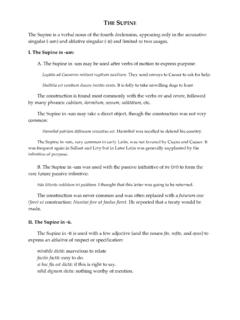
THE SUPINE The Supine is a verbal noun of the fourth declension, appearing only in the accusative singular (-um) and ablative singular (-ü) and limited to two usages.
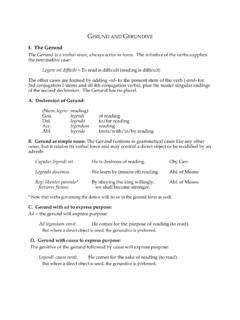
GERUND AND GERUNDIVE I. The Gerund The Gerund is a verbal noun, always active in force. The infintive of the verbs supplies the nominative case: Legere est difficile = To read is difficult (reading is difficult)
5. Third -io verbs: Some 3rd conjugation verbs end in -io in the 1st pers. sing., present tense. They show -iunt in the 3rd pers. pl., present tense.The -i- also appears throughout the imperfect and the future tenses. The perfect tenses are regular, formed from the stem of the third principal part.
When you write verbs in the present continuous and past continuous tenses, you use the ending -ing. Here are some rules to help you add that ending. Use these rules to add -ing to the following words: 1. shave 16. hope 31. save 2. comb 17. jump 32. tap 3. make 18. joke 33. carry 4. feed 19. marry 34. buy 5. do 20. put 35. sew 6. empty 21. say 36. eat 7. jog 22. talk 37. write