Example: confidence
Frequently Asked Questions about Form 8-K
FREQUENTLY ASKED QUESTIONS ABOUT FORM 8-K General Description and Summary of 8-K Items What is Form 8‐K? Form 8‐K is the form on which public companies report, on a current basis, the occurrence of significant corporate events. A reportable event is a transaction or occurrence of major significance.
Tags:
Information
Domain:
Source:
Link to this page:
Documents from same domain
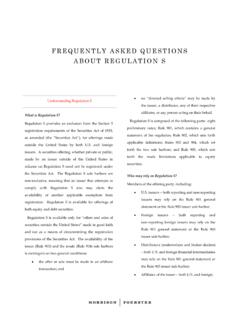
Frequently Asked Questions about Regulation S
media2.mofo.comFREQUENTLY ASKED QUESTIONS ABOUT REGULATION S Understanding Regulation S What is Regulation S? Regulation S provides an exclusion from the Section 5
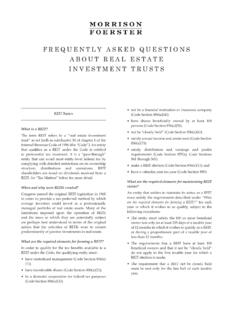
Frequently Asked Questions about Real Estate Investment …
media2.mofo.comIt is a “pass-through” entity that can avoid most entity-level federal tax by ... the Maryland ReIT law or as corporations under Maryland law. Many, if not most, non-ReIT public ... Frequently Asked Questions about Real Estate Investment Trusts ...

Frequently Asked Questions about Commercial Paper and ...
media2.mofo.comFREQUENTLY ASKED QUESTIONS ABOUT COMMERCIAL PAPER AND COMMERCIAL PAPER PROGRAMS Understanding Commercial Paper What is commercial paper? Commercial paper (“CP”) is a term used to refer to

Frequently Asked Questions About Business Development ...
media2.mofo.cominvestment adviser of an investment company or a registered investment adviser, unless such issuer is (A) a corporation all the outstanding securities of which

Frequently Asked Questions relating to Comfort Letters and ...
media2.mofo.comRELATING TO COMFORT LETTERS AND COMFORT LETTER PRACTICE ... dealer for a Section 3(a)(2) bank note offering, will request and receive comfort letters. A sample comfort letter delivered to a non‐underwriter can be found at Example P of SAS 72. ...
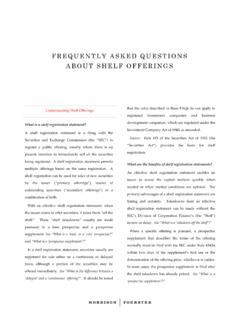
Frequently Asked Questions about Shelf Offerings
media2.mofo.comIn the case of a shelf registration statement on Form S-3 or Form F-3, the registration statement incorporates by reference the issuer’s reports filed under the Securities Exchange Act of 1934 (the Exchange Act ) after the shelf registration statement’s effective date. This enables the issuer to use a

Frequently Asked Questions about At-the-Market Offerings
media2.mofo.comthe market fluctuates, unlike an equity line of credit or a credit facility. At-the-market offerings also are still registered offerings, and despite enabling issuers to trickle shares into the market, are not as stealthy as private placements, including PIPe transactions, which are announced only after pricing and for which resale

SECTION 1202 QUALIFIED SMALL BUSINESS STOCK
media2.mofo.comAfter 9/27/10 & Before 1/1/12..... 1 2. Stock Held by a Non ... SECTION 1202 QUALIFIED SMALL BUSINESS STOCK ... Section 1202 of the Internal Revenue Code…

Privacy and Security Law Report - Morrison & Foerster
media2.mofo.comprivacy law requirements, imposes obligations with re- spect to international transfers, data breach notifica- tion, and the appointment of a data protection officer.

U.S. S O E LISTING - Morrison & Foerster
media2.mofo.comThe Acquisition of Control of a United States Public Company, click here. For the current version of Checkpoints: The Consequences of Crossing Various Ownership Thresholds ... describes the requirements for listing on New York Stock Exchangethe (“NYSE”) and the NASDAQ Stock Market (“NASDAQ”), the two principal U.S. securities exchanges, ...
Related documents

Frequently Asked Questions and Answers on Earned Paid ...
www.maine.govThese Frequently Asked Questions come from the listening sessions held in the Fall of 2019, public comments received on the proposed Rules, public webinar sessions in 2020, and conversations among Maine Department of Labor staff. The answers below are intended to clarify the Rules, the law, and the expectations for compliance.
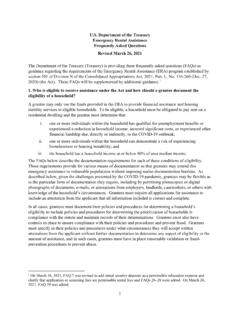
U.S. Department of the Treasury Emergency Rental ...
home.treasury.govFrequently Asked Questions. Revised March 26, 2021 . The Department of the Treasury (Treasury) is providing these frequently asked questions (FAQs) as guidance regarding the requirements of the Emergency Rental Assistance (ERA) program established by section 501 of Division N of the Consolidated Appropriations Act, 2021, Pub. L. No. 116-260 ...
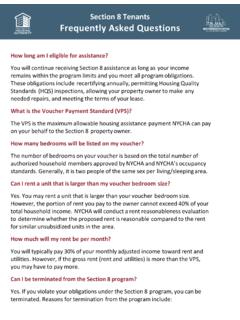
Section 8 Tenants Frequently Asked Questions
www1.nyc.govFrequently Asked Questions documentation by the deadline, NYCHA will send the tenant notices about possible termination of their Section 8 subsidy. A Section 8 tenant has the right to request an informal conference and/or an impartial hearing to contest the termination of his/her Section 8 subsidy. Information regarding this process is

Worker Adjustment and Retraining Notification Act ...
www.dol.govNotification Act Frequently Asked Questions Introduction The federal Worker Adjustment and Retraining Notification (WARN) Act (or Act) is enforced by private legal action brought in the U.S. District Court for any district in which the violation is alleged to have occurred or in which the employer transacts business. Any dispute regarding the

Frequently Asked Questions
us.aicpa.orgThe answers to these frequently asked questions (FAQs) are based on guidance the AICPA Professional Ethics Division staff provided in response to members’ inquiries. The FAQs are not rules, regulations, or statements of the Professional Ethics Executive Committee and, therefore, are not authoritative guidance.