Transcription of Functional Skills Maths - OCR
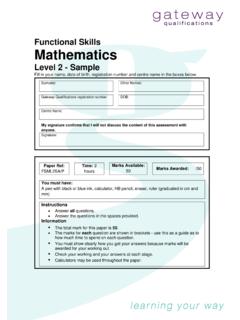
1 Oxford Cambridge and RSA Examinations Functional Skills Maths Level 2 Maths - 09866 OCR Report to Centres 2015-2016 OCR (Oxford Cambridge and RSA) is a leading UK awarding body, providing a wide range of qualifications to meet the needs of candidates of all ages and abilities. OCR qualifications include AS/A Levels, Diplomas, GCSEs, Cambridge Nationals, Cambridge Technicals, Functional Skills , Key Skills , Entry Level qualifications, NVQs and vocational qualifications in areas such as IT, business, languages, teaching/training, administration and secretarial Skills . It is also responsible for developing new specifications to meet national requirements and the needs of students and teachers. OCR is a not-for-profit organisation; any surplus made is invested back into the establishment to help towards the development of qualifications and support, which keep pace with the changing needs of today s society.
2 This report on the examination provides information on the performance of candidates which it is hoped will be useful to teachers in their preparation of candidates for future examinations. It is intended to be constructive and informative and to promote better understanding of the specification content, of the operation of the scheme of assessment and of the application of assessment criteria. Reports should be read in conjunction with the published question papers and mark schemes for the examination. OCR will not enter into any discussion or correspondence in connection with this report. OCR 2015 CONTENTS Functional Skills Level 2 Maths - 09866 OCR REPORT TO CENTRES Content Page Functional Skills Maths Level 2 - 09866 4 1. Overview: 4 2.
3 General Comments 5 3. Guidance For Centres 5 OCR Report to Centres 2015-2016 4 Functional Skills Maths Level 2 - 09866 1. Overview: This assessment is available on an On-Demand basis (OD) for both Paper Based Tests (PBTs) and Computer Based Tests (CBTs). Throughout the year the great majority of candidates appeared to have been suitably prepared for both PBT and CBT. Some of the poor efforts at the latter seemed the result of not being confident at using the CBT software the majority of screens left empty. Nevertheless the proportion of questions or part questions left unanswered in both modes was a strong indicator of appropriate entry level by centres. Literacy problems only became apparent within the context of appropriate mathematical vocabulary such as, for example, fortnight, quarter, proportion and some other legitimate mathematically specific words.
4 However instances of these were relatively rare. Number work was almost always legible in PBTs, and obviously always so in CBTs. However there was one important feature specific to CBTs: a small proportion of candidates had clearly worked out their solutions on paper then keyed what they considered relevant. This was evidenced by answers and conclusion in the first line followed by very obviously edited working. In such instances it was not always possible to award credit for using the correct process because of lack of evidence. Four general sources of credit loss, valid for both PBTs and CBTs, are worthy of mention. As in previous years, the greatest source of unnecessary lost credit was candidates failure to show clear evidence of achieving Level 2 Skill Standard 5, ( Use appropriate checking procedures and evaluate their effectiveness at each stage).
5 Indication of genuine and relevant checking was comparatively rare. Whilst any reflection on calculations or particular methods employed was virtually absent. Failure to meet this standard can lose 10% of the available marks in a task. Additionally there is the real possibility that checking and reflecting on results can give a signal to the candidate that all is not well and a question needs looking at again: cups of tea which cost 120 or carpets weighing 70 000 kg to cite two examples. Generally, Functional Skills tasks involve real quantities. Therefore where candidates calculations or sub-calculations give answers outside their life experiences they should be advised to suspect an error somewhere in their working. Some candidates still tended to be somewhat careless with units either omitting them or performing incorrect conversions between different metric units, examples of such misconceptions are 100 metres being equivalent to a kilometre and there being 100 millilitres in a litre.
6 Unfortunately such slips occurred in work by some otherwise capable candidates. In common with past years a small but significant proportion of less able candidates were still insecure working with area and volume. This usually manifested itself in areas of, say carpets, being calculated as the product of three lengths. Tasks which involved both area and volume together tended to be poorly answered. A number of candidate lost credit needlessly by not taking note of key command phases such as: show how .. , support your answer. , explain by .. , make it clear how you arrive at your estimate or explain how you decide . These indicate that more than a worked answer is required, OCR Report to Centres 2015-2016 5 and fulfil Level 2 Skill Standards 6 (Interpret and communicate solutions to multi-stage practical problems in familiar and unfamiliar contexts and situations) and 7 (Draw conclusions and provide mathematical justifications).
7 2. General Comments Areas of strength included: extracting information from tables, including timetables and graphs working with simple percentages using simple fractions calculating and commenting on simple theoretical probabilities using word formulae in CBTs, taking advantage of the several formatting commands available such as subscript etc. and paying more attention to response formatting generally. Areas of weakness (in addition to those already mentioned) included performing the correct division when calculating unit costs interpreting 2-D representations of 3-D situations such as those involving folding paper or material fitting problems recalling and using estimates of commonly encountered measures cup capacity, pace length, height of doorway, thickness of an average book etc.
8 3. Guidance For Centres Candidates need to: be encouraged to read all questions carefully both before and after answering them to make sure that they have answered them in full (especially stating any assumptions made) ask themselves; is this answer sensible? If not then they need to to re-check working note down in their work any checking or consideration of the reasonableness of their answers (Expressions such as I think this seems about right or checked it all and its ok are not sufficient.) think through how to answer a question before actually putting pen to paper or finger to key use underlining of text or key numbers (for PBTs) to help clarify their thinking use very brief sub-headings to make their working clear for themselves and the examiner be given the opportunity to practice problem solving tasks.
9 Centres are reminded that it is a regulation to return all unused papers. Also, centres should not make photocopies of tests under any circumstances unless permission has been gained from OCR or very exceptional; circumstances arise. Oxford Cambridge and RSA Examinations is a Company Limited by Guarantee Registered in England Registered Office; 1 Hills Road, Cambridge, CB1 2EU Registered Company Number: 3484466 OCR is an exempt Charity OCR (Oxford Cambridge and RSA Examinations) Head office Telephone: 01223 552552 Facsimile: 01223 552553 OCR 2015 OCR (Oxford Cambridge and RSA Examinations) 1 Hills Road Cambridge CB1 2EU OCR Customer Contact Centre Skills and Employment Telephone: 02476 851509 Fax: 02476 421944 Email: For staff training purposes and as part of our quality assurance programme your call may be recorded or monitored