Transcription of General Safety Start with a Safe Work Area …
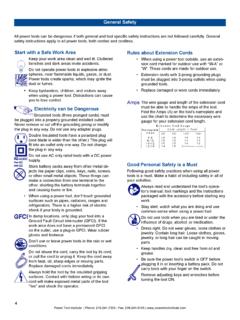
1 4 Start with a Safe Work Area Keep your work area clean and well lit. Cluttered benches and dark areas invite accidents. Do not operate power tools in explosive atmo-spheres, near flammable liquids, gases, or dust. Power tools create sparks, which may ignite the dust or fumes. Keep bystanders, children, and visitors away when using a power tool. Distractions can cause you to lose can be DangerousGrounded tools (three pronged cords) must be plugged into a properly grounded installed outlet. Never remove or cut off the grounding prong or modify the plug in any way. Do not use any adapter plugs. Double Insulated tools have a polarized plug (one blade is wider than the other.) This plug will fit into an outlet only one way. Do not change the plug in any way. Do not use AC only rated tools with a DC power supply. Store battery packs away from other metal ob-jects like paper clips, coins, keys, nails, screws, or other small metal objects. These things can make a connection from one terminal to the other, shorting the battery terminals together and causing burns or fire.
2 When using a power tool, don t touch grounded surfaces such as pipes, radiators, ranges and refrigerators. There is a higher risk of electric shock if your body is grounded. In damp locations, only plug your tool into a Ground Fault Circuit Interrupter (GFCI). If the work area does not have a permanent GFCI on the outlet, use a plug-in GFCI. Wear rubber gloves and footwear. Don t use or leave power tools in the rain or wet conditions. Do not abuse the cord, carry the tool by its cord, or pull the cord to unplug it. Keep the cord away from heat, oil, sharp edges or moving parts. Replace damaged cords immediately. Always hold the tool by the insulated gripping surfaces. Contact with hidden wiring or its own cord will make exposed metal parts of the tool live and shock the operator. General SafetyAll power tools can be dangerous if both General and tool specific Safety instructions are not followed carefully. General Safety instructions apply to all power tools, both corded and cordless .
3 Rules about Extension Cords When using a power tool outside, use an exten-sion cord marked for outdoor use with W-A or W . These cords are made for outdoor use. Extension cords with 3-prong grounding plugs must be plugged into 3-prong outlets when using grounded tools. Replace damaged or worn cords immediately. The wire gauge and length of the extension cord must be able to handle the amps of the tool. Find the Amps (A) on the tool s nameplate and use the chart to determine the necessary wire gauge for your extension cord Personal Safety is a MustFollowing good Safety practices when using all power tools is a must. Make a habit of including Safety in all of your activities. Always read and understand the tool s opera-tor s manual, tool markings and the instructions packaged with the accessory before starting any work. Stay alert, watch what you are doing and use common sense when using a power tool. Do not use tools when you are tired or under the influence of drugs, alcohol, or medication.
4 Dress right. Do not wear gloves, loose clothes or jewelry. Contain long hair. Loose clothes, gloves, jewelry, or long hair can be caught in moving parts. Keep handles dry, clean and free from oil and grease. Be sure the power tool s switch is OFF before plugging it in or inserting a battery pack. Do not carry tools with your finger on the switch. Remove adjusting keys and wrenches before turning the tool ON. Power Tool Institute | Phone: 216-241-7333 | Fax: 216-241-0105 | Always keep a firm footing when using power tools. Be sure you have balance and control before you Start the job. Use Safety equipment. Always wear eye protec-tion. A dust mask, non-skid Safety shoes, hard hat, or hearing protection must be used when needed. The reference to Safety goggles or Safety glasses in product specific sections provides potential options - always refer to the tool s operator s manual for the specific eye pro-tection recommended, which should be marked as complying with current national standards.
5 Unplug tool/remove battery before changing accessories. Keep hands away from rotating or moving the Job Safely Use the power tool accessories only for the jobs for which they were designed. Secure and support the workpiece. Use clamps and a stable work surface. Do not hold the work by hand or against your body. Keep guards in place and working properly. Do not force the tool. Use the right tool for your job. It will do the job better and safer. Use only accessories recommended by the tool manufacturer. Accessories that may be suitable for one tool may become hazardous when used on another tool. Do not touch the drill bit, blade, cutter or the workpiece immediately after operation; they may be very hot and may burn you. If a method of dust collection is available with the power tool, it should be used to reduce the risk of dust-related Keeps Tools Working Safely and Effectively Do not use a tool if the switch does not turn it on and off.
6 It must be repaired. Look at the tool before using it. Are moving parts misaligned or binding? Is anything broken? Damaged tools must be fixed before using them. Develop a maintenance schedule for your tool. Maintain accessories carefully. Keep blades and bits sharp and clean. Take your tool to be serviced by qualified repair people. Service or maintenance performed by unqualified personnel could result in a risk of injury. For example: internal wires may be mis-placed or pinched, Safety guard return springs may be improperly mounted. When servicing a tool, use only identical re-placement parts. Follow instructions regarding maintenance in the tool s operator s manual. Use of unauthorized parts or failure to follow the maintenance instructions may create a risk of electric shock or injury. Clean and lubricate a tool only as directed in its operator s manuals. Certain cleaning agents such as gasoline, carbon tetrachloride, ammo-nia, etc. may damage plastic parts.
7 Maintain labels and nameplates. These carry important information. If unreadable or missing, contact the manufacturer for a Done, Store the Tools out of Harm s Way To avoid accidental starting, unplug the cord, remove batteries or lock off the switch when the tool is not being used, when changing accesso-ries, and when adjusting or cleaning tools. Keep tools out of the reach of children and people unfamiliar with the Tool Institute | Phone: 216-241-7333 | Fax: 216-241-0105 | Personal Safety is a MustFollowing good Safety practices when using cordless tools is a must. Make a habit of including Safety in all your activities. Always read and understand the tool s opera-tor s manual, tool markings and the instructions packaged with the accessory before starting any work. cordless tools may create sparks, so do not use them in an explosive atmosphere, near flam-mable liquids, gases or dust. To avoid accidental starting, remove batteries or lock off the switch when the tool is not being used, when changing accessories, and when adjusting or cleaning tools.
8 Keep hands away from rotating or moving parts. Broken or abused battery packs can leak chemi-cals that can cause irritation or burns. If you come into contact with these chemicals, flush the area with water. If it contacts the eyes, flush with water and seek medical help. Batteries may vent gas that can explode near a source of ignition, like a pilot light. Never use any cordless tool in the presence of open flame. Do not place battery packs near fire or heat. The battery packs could the Right Battery Pack for the ToolUse cordless tools only with their recommended bat-tery packs. Other battery packs may create a risk of fire, burns, and Battery Packs Safely Charge battery packs only with their recom-mended chargers. Charge in a dry location. Do not charge near combustible materials. Do not use a charger or battery pack if it has been hit, dropped or damaged. Do not take apart the charger or battery pack. Take it to an authorized service center for all repairs.
9 Keep tools, battery packs and chargers out of the reach of children and people unfamiliar with the tools get their electrical power from batteries. They demand the same respect that corded tools demand. Re-member, cordless tools are very capable of causing injury if all Safety precautions are not followed. cordless tools come in many types; read and understand the section of this booklet for the type of cordless tool you are using, as well as the operator s manual provided with the tool. Maintain and Store Battery Packs Safely Clean the contacts on the battery pack and tool with a pencil eraser if the tool isn t working at full power with a fully charged battery pack. Take the tool, charger, and battery to an au-thorized service center for all repairs. Do not attempt to repair them yourself. Store battery packs away from other metal ob-jects like paper clips, coins, keys, nails, screws, or other small metal objects. These things can make a connection from one terminal to the other, shorting the battery terminals together and causing burns or fire.
10 Store the battery pack away from extreme tem-perature of Battery PacksProperly dispose of battery packs to help protect our environment. Battery pack chemistries can be dangerous to the environment under certain conditions. Re-cycle or dispose of properly. Refer to the instructions included with your bat-tery pack for proper disposal/recycling of the battery packs. Local, state, or federal laws may prohibit disposal of certain batteries in ordinary trash. Place electrical tape over the battery pack s terminals before disposing/recycling. Call 1-800-BATTERY for disposal information. RBRC Battery Recycling Seal on a battery pack indicates that the tool manufacturer has ar-ranged for the recycling of that battery pack with the Rechargeable Battery Recycling Corporation (RBRC). At the end of your battery pack s useful life, return the battery pack to the tool manu-facturer s branch office or service center or the participating retailer nearest you.