Example: biology
Genetically Modified (GM) Crops: Techniques and Applications
Agency (EPA), and the Food and Drug Administration (FDA). They do not, however, individually regulate all GM crops. For example, USDA is involved in approving the field release of most GM plants, but EPA is involved only in pest and pesticide resistance traits, and FDA only regulates crops destined for food, feed, or pharmaceuticals.
Tags:
Information
Domain:
Source:
Link to this page:
Documents from same domain
Canada Thistle - Extension
extension.colostate.eduCanada thistle allocates most of its reproductive energy into vegetative propagation. New shoots and roots can form almost anywhere along the root

Rainwater Collection in Colorado - Extension
extension.colostate.edudescribed below. Prior to the passage of House Bill 16-1005, in particular, rainwater collection was not permitted except under specific circumstances.
Nutrition for Athletes - Extension
extension.colostate.eduOptimal nutrition is essential for peak performance. ... Nutrition for Athletes ... intake to preserve athletic performance.
Ornamental Grasses - Extension
extension.colostate.eduPlant ornamental grasses in the spring. Container-grown grasses can be planted all season, stopping a month before first frost. Late planting of grass divisions is not recommended, particularly for warm season types. Grasses generally grow best in three to five hours of direct sun each day. In shade,
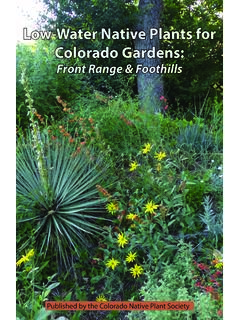
Low-Water Native Plants for Colorado Gardens
extension.colostate.eduLow-Water Native Plants for Colorado Gardens: Front Range & Foothills. Published by the Colorado Native Plant Society. ... pleasures of gardening with native plants. To maximize habitat for . pollinators, plant a diversity of plants, and aim to provide the longest possible season of bloom.

Low-Water Native Plants for Colorado Gardens
extension.colostate.eduLow-Water Native Plants for Colorado Gardens: Mountains 7,500’ and Above. Published by the Colorado Native Plant Society. 2 . 3. ... pleasures of gardening with native plants. To maximize habitat for . pollinators, plant a diversity of plants, and aim to provide the longest

Home Sprinkler Systems: Backflow Prevention Devices
extension.colostate.eduthe reduced pressure principle backflow assembly (RP device) to ensure safety. Winterizing Systems Backflow prevention devices will be damaged by freezing during the winter unless drained of all water. See 4.719, Home ... Home Sprinkler Systems: Backflow Prevention Devices Author:

Strawberries for the Home Garden - Extension
extension.colostate.eduStrawberries are adapted to nearly all areas of Colorado. They may be June bearing, everbearing or day neutral. This fact sheet describes varieties, culture, harvest, and pest management.

Poster Design Tips and Techniques
extension.colostate.eduin your field–minimize jargon and technical terms. For research posters, include only the major key results, not the entire history of the project. • Break your story into bullets and blocks of information. Refine your rough draft by cutting out extraneous words and phrases and creating smaller text segments that you can put on display panels.

Your Important Papers: What, Why, and How Long to Keep
extension.colostate.educasualty losses) Proof of filing and payment Support claims if return is audited 3-6 years* or permanently Insurance Policies** List of policy numbers Names of insured, beneficiaries Issuing company, agent, type, amount of coverage; copies of policies Reference for kinds and amounts of coverage Records of payments, premiums, and claims
Related documents
The Columbian Exchange: A History of Disease, Food, and Ideas
www.kellogg.northwestern.edunnels; namely, the biological exchange of food crops and disease. Our hope is that els; namely, the biological exchange of food crops and disease. Our hope is that oour broad descriptive overview of some of the neglected aspects of the Columbian ur broad descriptive overview of some of the neglected aspects of the Columbian
The importance of bees and other pollinators for food and ...
www.fao.orgThree out of four crops across the globe producing fruits or seeds for human use as food depend, at least in part, on pollinators. Improving pollinator density and diversity boosts crop yields – pollinators affect 35 percent of global agricultural land, supporting the production of 87 of the leading food crops worldwide.
Climate-Smart Agriculture
www.worldbank.orgresilient food crops and risk insurance. 1 Foreword Feeding people in decades to come will require ingenuity and innovation to produce more food on less land in more sustainable ways. Climate change will exacerbate already tight resource constraints by making weather more extreme and variable and by
CLASSIFICATION OF CROPS - Food and Agriculture ...
www.fao.orgwetland/dryland rice), crop use (for example, pumpkin for food/fodder), type of product (for example, fresh/dried beans), how the crop is processed (for example, industrial crops), and cultivation methods (for example, crops grown under protective cover). ICC has been developed based on the Central Product Classification (CPC) (UN, 2004a).
Summary - WHO
www.who.intof crops, and animals who consume the crops, and their resulting food output. The production of food itself may also be directly affected by climate change through the alteration of survival and/ or multiplication rates of some food-borne pathogens. For example, the multiplication of Salmonella spp., a . climate.

Written Food Safety Plans: Policies, Procedures, and ...
ag.purdue.eduWritten Food Safety Plans: Policies, Procedures, and Documentation. Purdue University is an Equal Opportunity/Equal Access Institution. Funded in part by a USDA Specialty Crops Block Grant from the Indiana State Department of Agriculture. Scott Monroe. Food Safety Educator. Purdue Extension
Cereal Crops: Rice, Maize, Millet, Sorghum, Wheat
www.afdb.orgpoorest and most food-insecure places in the world. 4. Poor mechanization: The low level of mechanization in African agriculture has continued to serve as a huge impediment towards advancing cereal production, especially of wheat and rice which, in turn, results in the high cost of producing these crops. 5.

USDA Coexistence Factsheets - Soybeans
www.usda.govOrganic food-grade soybeans are used in food products like tofu, tempeh or soymilk, and can be produced in the United States or abroad. Organic feed-grade soybeans are used to develop organic ... Additionally, conventionally grown crops can be identity-preserved and grown for specific end-use markets, and therefore also receive premium prices ...
The Facts about Rats - FWS
www.fws.govRats cause great damage to agricultural crops such . as sugarcane, macadamia nuts, pineapple, coconuts, coffee, and other fruit and vegetable crops. Rats climb trees, eat eggs, and prey on nestlings and adult birds. They are considered a leading . cause of the accelerated decline and extirpation of endemic Hawaiian forest birds and a major factor