Transcription of GENUS STREPTOCOCCUS: Isolation and Identification
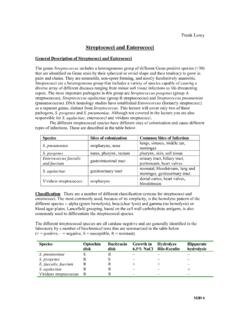
1 GENUS streptococcus : Isolation and Identification Streptococci are part of normal human microbiota, found on the skin, in the upper respiratory tract, digestive tract and oral cavity. Streptococci are Gram-positive cocci which grow primarily in pairs and in chains of cells. Strepococci are often grouped by hemolytic reaction on blood agar and by serological typing using the Lancefield classification system. The most significant pathogens are streptococcus pyogenes (Lancefield Group A), streptococcus agalactiae (Lancefield Group B) and streptococcus pneumoniae. Some streptococci (formerly group D) now placed in the GENUS Enterococcus are of medical significance because they are often difficult to treat because of antibiotic resistance. Streptococci, like staphylococci, cause a wide range of superficial skin infections along with more serious diseases like pneumonia, meningitis, erysipelas and necrotizing fasciitis.
2 Hemolysis is a very important feature used to identify the streptococci, so it is important that you understand the categories of hemolysis. alpha ( ) hemolysis green zone around colony, caused by leaking hemoglobin converted to biliverdin beta ( ) hemolysis complete clearing around colony caused by breakdown of RBCs by streptolysin enzymes gamma ( ) hemolysis VIRULENCE FACTORS OF PATHOGENIC STREPTOCOCCI. extracellular enzymes: hyaluronidase (spreading factor for necrotizing fasciitis). leucocidin (destroys WBCs). streptolysins exotoxins: toxic shock syndrome toxin scarlet fever toxin streptococcus is always facultatively anaerobic and catalase negative. When stained, it will be seen in pairs or chains that vary from a few to dozens. streptococcus can be beta, alpha, or gamma hemolytic. Enterococcus is usually gamma, nonhemolytic. streptococcus , although facultatitively anaerobic, likes higher CO2 levels than in ambient air.
3 For this reason, ALL PLATES WILL BE PLACED INTO CANDLE JARS FOR INCUBATION. The reduced oxygen atmosphere will encourage good hemolytic reactions and more luxuriant growth of streptococcus . OBJECTIVES: Obtain presumptive streptococci from throat swabs and attempt to isolate from blood agar plates Using isolates to identify different types of hemolysis Perform testing to narrow down the Identification of the streptococcal isolate Fall 2011 Jackie Reynolds, Richland College, BIOL 2420. MATERIALS NEEDED: 1 Blood agar plate (5% sheep red blood cells). 1 CNA Blood agar plates (Columbia naladixic acid). Sensitivity disks (Bacitracin, SXT, Optochin, Novobiocin). 1 Bile esculin slant 1 NaCl broth Candle jar for the class THE PROCEDURES: 1st Session 1. Have a lab partner obtain a throat swab from a single member of the group. Have the subject tilt their head back. Use a tongue depressor to push the tongue down so a sterile swab can be used to obtain a sample from the back of the throat (pharynx).
4 Avoid swabbing the cheeks, tongue or teeth. 2. Cover one half of a blood agar plate with the swab then use a sterile loop to streak a portion of the swab onto the other half of the plate. The procedure is identical to a streak plate procedure, with the exception of using a cotton swab for the first section and then switching over to the inoculating loop. 3. Incubate at 37 C in a candle jar. 2nd Session 1. Pick a colony that shows complete clearing ( -hemolysis) or partial clearing or greening ( hemolysis). A beta hemolytic is preferred, if you have one. 2. Use the sectional Isolation streak technique on a CNA plate. This will help to ensure that your isolated colonies are really Streptococci and free of contaminants. BE SURE. TO PICK 1 COLONY ONLY FOR A PURE CULTURE. 3. Incubate at 37 C in a candle jar. 3rd Session 1. Check the streaked culture by gram staining a single colony, looking for chains of gram-positive cocci and no other types of cells.
5 2. Depending on whether or not you have a -hemolytic streptococci or hemolytic streptococci perform the following tests. 3. Using a sterile swab, streak a blood agar plate completely with the organism USING. THE ZIG-ZAG STREAK TECHNIQUE, covering the entire plate. If your isolate is -hemolytic: Place a Bacitracin (A) disk and an SXT disk on the inoculated blood agar plate. If your isolate is -hemolytic: Place an Optochin disk and an SXT disk on the inoculated blood agar plate. 4. Inoculate the surface of a bile esculin slant and a tube of sodium chloride broth. 5. Incubate at 37 C in a candle jar. 2. 4th Session 1. Salt resistance in the NaCl broth is determined by turbidity. 2. Bile esculin agar is really 2 different tests---resistance in the presence of bile and the use of the sugar esculin. a. If bile resistant, you will see growth on the slant. b. If the bacterium is bile resistant AND it uses esculin, the slant will turn the color of black coffee.
6 C. Unfortunately, if your bacterium is NOT resistant to bile, it will not grow and, obviously, it cannot use esculin then. d. We have esculin sugar alone that could be used to identify your bacterium if it does not grow in the presence of bile. 3. For the SXT disc, look for any size zone. The zone around bacitracin disc should be 14mm or larger, and the optochin zone should be 16mm or greater. 4. Use the chart below to presumptively identify your streptococcus species, if possible to do so. 5. Take a small amount of colony growth from your blood agar plate and place on a clean glass slide. Add a drop of catalase reagent (H2O2). Organisms that produce catalase (peroxidase) will cause the reaction H2O2 H2O + O2 (gas) with very visibly bubbling. 6. The Streptococci are catalase negative and do not cause a bubbling reaction. This is in contrast to the Staphylococci which are catalase positive and produce very strong bubbling.
7 Organism Group Hemolysis Bacitracin SXT Optochin Bile: esculin NaCl S. pyogenes A beta S R R - : - - S. agalactiae B beta R R R -/+ : -/+ - S. equi C beta R S R - : - - S. equisimilis S. zooepidemicus E. faecalis D alpha, R R R + : + +. E. faecium beta, gamma S. bovis D* alpha, R R/S R + : + - gamma S. mitis viridans alpha, R S R - : + - S. salivarius gamma S. mutans S. pneumoniae alpha -R/S S - : - - R =resistant S =sensitive + =growth - =no growth Only the group A streptococci are sensitive to bacitracin. SXT (sulfamethoxazole) is especially useful in identifying group C streptococci. 3. LABORATORY REPORT SHEET. QUESTIONS: 1. Why is a bacitracin (A) disk so important in strepotococcal Identification ? What are the consequences of not making a diagnosis of bacitracin sensitivity? 2. Name two autoimmune diseases associated with the group A beta streptococci. 3. Why is the optochin test important for use on alpha streptococci?
8 4. Do a search using Google on the web, using the terms viridans and color. There is a group of Strep called the Viridans group. What category of hemolysis? 5. What does a hemolysin do? 4.