Transcription of Guidance for Soil Construction Standards and Testing ...
1 Guidance for soil Construction Standards and Testing frequencies Landfill Cell Construction Waste/Solid Waste # , May 2006 Solid Waste Program This guide has been developed to provide detailed information on recommended material quality and Construction methods for soil components used in landfill Construction . Long term problems can be avoided by taking care to specify clearly what the requirements are for material quality and Construction methods during the Construction bidding process. The attached soil Construction Standards and Testing frequencies table provides detailed information on specifications for the clay, sand drainage, subgrade, and gravel layers for constructing new landfill cells. Please refer to this table for information that should be included in specifications for a project. 1 May 2006 Contents : 1 Clay Liner .. 2 Sand Drainage layer .. 2 3 Contact Information .. 3 soil Construction Standards and Testing 4 Granular Filter Analysis.
2 7 w-sw5-XX The guide has been developed with the foremost thought of lined landfill cells; however, it may also be used for subgrade preparation when constructing an unlined landfill cell. It is recommended that inspectors be at borrow sites and delivery sites during Construction to ensure that the materials being used are properly tested and of the quality specified. Inspectors should be aware that variability in materials delivered to site during Construction will occur. This is acceptable within reason and the variability which can be allowed and still have a well constructed landfill varies with specific site conditions. Adequate Testing as recommended by the specification table will help reduce problems in the field. Unplanned variations in soil materials should be immediately reported to the MPCA review engineer. Any decision made during Construction regarding the use of variable soils must also be documented in the Construction certification report.
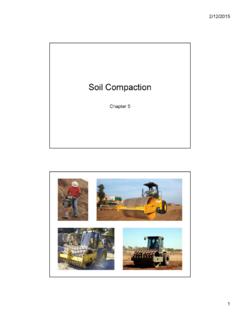
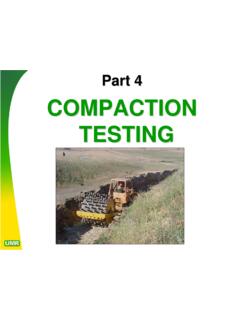
3 SUBGRADE The subgrade should be of firm soils free of organic matter and rocks. It is to provide a stable base on which the landfill liner will be constructed. Subgrade excavationn for cell Construction at the Elk River Landfill. Imported and in-situ soils should be smooth-rolled prior to constructing the Guidance for soil Construction Standards and Testing frequencies Landfill Cell Construction Waste/Solid Waste # 2 May 2006 landfill liner. soil seams should be inspected to determine if their presence may be detrimental to the stability of the site. CLAY LINER The purpose of the clay liner is to act as a barrier to leachate migration into ground water. The clay used for liner Construction shall not be too wet nor too dry to ensure compaction Standards can be met. Clay should be placed in lifts with a maximum lift being 10 inches of loose clay or less, so that each compacted lift is no greater than 8 inches thick. Compaction of the clay is done with a sheepsfoot compactor to meet the 95 percent Standard proctor maximum dry density as specified in the table.
4 The sheepsfoot should walk out of the clay at this density. It is recommended that the depth of the lift not exceed the depth of the sheepsfoot. The top lift should be smooth-rolled. If a geomembrane is to be installed over the clay liner then the finished clay surface needs to be free of solid particles ( rocks) that are greater than 3/8 inch in diameter. The finished clay surface must be smooth rolled and maintained in a moistened state until the geomembrane is installed or the liner integrity may be compromised. Clay liner Construction at the Morrison County Landfill. SAND DRAINAGE LAYER The purpose of the sand drainage layer is to allow leachate to pass freely through it for collection and management. When the drainage layer contains too many fines, this flow of leachate is impeded and can cause problems with the stability of the landfill and interfere long term leachate management. In the field, it is understood that gradation of materials can vary slightly as materials are delivered, however, limiting the fines to five percent or less should be the standard used to determine if loads should be accepted or rejected.
5 If crushed stone is used for the sand drainage layer and has sharp edges, the use of a heavy geotextile fabric on top of the geomembrane prior to installation of the sand drainage layer should be considered. This will protect the geomembrane from being damaged. The sand drainage layer should be installed in one lift. Equipment used for placement of the sand cannot be driven directly on the geomembrane. A minimum thickness of 1 foot of sand material must be in place between tracked equipment and the geomembrane. No rubber tired vehicles can be driven on the sand drainage layer during or after placement. Sand drainage layer in completed cell at Elk River Landfill. The layer should be constructed by pushing the sand up the landfill slope to prevent folding of the synthetic membrane (if one is used). Guidance for soil Construction Standards and Testing frequencies Landfill Cell Construction Waste/Solid Waste # GRAVEL Gravel is installed within the leachate collection trench and around the leachate collection pipe to provide a preferential pathway for leachate to be removed from the landfill cell.
6 Traditionally, filter fabric has been placed over the gravel to prevent intrusion of fine materials from overlying layers. However, evidence has shown that this practice may lead to biofouling of the filter fabric which in turn leads to plugging on the surface of the material that is there to prevent plugging in the first place. Thus, the MPCA recommends the use of a graded gravel filtration system. This consists of a layer of larger diameter gravel at the base of the leachate collection trench and around the collection pipe overlain by a second layer of intermediate sized gravel before placing the sand drainage layer over the trench area. This gradation in gravel sizes will act as a filter barrier and prevent the intrusion of fines into the lower level gravel. 3 May 2006 Gravel placement in leachate collection trench at the NE Otter Tail Landfill. CONTACT INFORMATION For more information on soils used for the Construction of landfills, contact the solid waste engineer assigned to the region in which your facility is located.
7 Duluth: Brett Ballavance (218)723-4837 Brainerd: Dan Vleck (218)855-5007 Detroit Lakes: Kathy Holland-Hanson (218)846-0470 Marshall/Wilmar: Tony Bello (651)296-7272 Rochester: Sherri Nachtigal (507)280-2997 Metro: Mike Lynn (651)296-8584 Geoff Strack (651)296-7716 For more information on industrial solid waste landfills, contact Bob Criswell at (651)296-870 or Julie Henderson at (651)296-8596. Guidance for soil Construction Standards and Testing frequencies Landfill Cell Construction Waste/Solid Waste # 4 May 2006 soil Construction Standards AND Testing frequencies CLAY SAND DRAINAGE SUBGRADE GRAVEL PARTICLE SIZE ( soil Construction standard) Min. 50% by weight passing through #200 sieve, gravel = 5% Max. rock size = 1 diameter, Max. clod size =3 Max. 5% by weight passing through #200 sieve 100% by weight passing through the 3/8 sieve Max. Rock size = 2 diameter Max. clod size =3 Max. 5% by weight passing through #4 sieve 100% passing 1 Max.
8 Size = 1 diameter Frequency of borrow source evaluation Testing (1) 1/3000 ASTM D422 1/2000 ASTM D422 1/acre ASTM D422 1/source ASTMD422 ATTERBERG LIMITS ( soil Construction standard) liquid limit > or = 25% plasticity index > or = 12% frequency of borrow source evaluation Testing (1) 1/3000 cu. yd. ASTM D4318 PERMEABILITY ( soil Construction standard) Liner: max. 1x10⁻⁷ cm/sec* min. 1x10⁻³ cm/sec Min. 1x10⁻² cm/sec frequency of soil Testing for borrow source evaluation (1) 1/5000 ASTM D5084 EPA 9100 1/2000 ASTM D2434 Frequency of in-place soil Testing (3) 1/acre/foot ASTM D5084 EPA 9100 1/acre ASTM D2434 Guidance for soil Construction Standards and Testing frequencies Landfill Cell Construction Waste/Solid Waste # 5 May 2006 soil Construction Standards AND Testing frequencies (cont.) CLAY SAND DRAINAGE SUBGRADE GRAVEL COMPACTION / NUCLEAR DENSITY ( Construction standard) using a minimum 4000 lb sheepsfoot compactor to penetrate full depth of loose lift with a recommended minimum of 5 passes 95% standard proctor * Note.
9 MPCA does not recommend compacting the sand drainage layers placed over FMLs 95% standard proctor surface shall be firm providing an unyielding foundation frequency of soil Testing for borrow source evaluation (1) (determines maximum density) 1/3000 ASTM D698 or ASTM D1557 1/acre ASTM D698 or ASTM D1557 frequency of in-place soil Testing (3) 100 foot grid/lift off set each lift ASTM D2922 ASTM D1556 1/acre ASTM D2922 ASTM D1556 soil CLASSIFICATION and soil DESCRIPTION ( Construction standard) CL,CH, possibly SC if soil meets permeability and other criteria No organic matter SC, SM, SW-SM, SW-SC, SP-SM, SP-SC Uniformity Coefficient less than 6 No organic matter No organic matter, debris, sticks, roots, sharp objects, protuberances or weed growth GW, GP Uniformity Coefficient less than 4 No organic matter frequency of borrow source evaluation Testing (1) 1/3000 ASTM D2487 1/2000 ASTM D2487 1/Source ASTM D2487 Guidance for soil Construction Standards and Testing frequencies Landfill Cell Construction Waste/Solid Waste # 6 May 2006 soil Construction Standards AND Testing frequencies (cont.)
10 CLAY SAND DRAINAGE SUBGRADE GRAVEL frequency of preconstruction Testing for verification at borrow source (2) 1/3000 cu. yd. (3 minimum) ASTM D2488 1/2000 (3 minimum) ASTM D2488 1/2000 (3 minimum) ASTM D2488 WATER CONTENT ( soil Construction standard) Maintain at 0%-5% above optimum* No standing water or excessive moisture shall be present frequency of soil Testing for borrow source evaluation (1) (determines optimum moisture content) 1/3000 ASTM D2216 1/acre ASTM D2216 Frequency of soil Testing for preconstruction verification at borrow source (2) 1/3000 ASTM D2216 or ASTM D3017 frequency of in-place soil Testing (3) 100 foot grid/lift off set each lift ASTM D2216 * - Standards followed by an asterisk are requirements of the Minnesota Solid Waste Rules. - Gravel or Pipe Bedding And Course Filter Aggregate. (1) - Frequency of soil Testing for borrow source evaluation - refers to all Testing requirements to determine the suitability of the properties of specified a borrow source for its desired use ( checking the properties of a clay borrow source for suitability as a liner material) (2) - Frequency of soil Testing for preconstruction verification at borrow source refers to Testing performed during the Construction event to ensure that borrow source material is homogeneous and at the proper water content.