Transcription of Guideline for the statement on origin/importer's knowledge ...
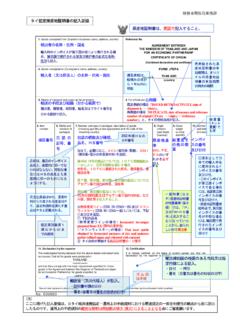
1 February, 2021. Guideline for the statement on origin/importer's knowledge and verification under the Japan-EU EPA. 1. Introduction In the Agreement between the European Union and Japan for an Economic Partnership (hereinafter referred to as the Agreement ), the self-declaration system is introduced. A claim for preferential tariff treatment is based either on a statement on origin or on importer's knowledge . 2. statement on Origin 1. Where an importer makes a claim for preferential tariff treatment based on a statement on origin in accordance with Article (a) of the Agreement, that statement on origin shall be made out by an "exporter" ("exporter" includes "producer".)
2 (hereinafter the same shall apply)), using one of the linguistic versions of the text set out in Annex 3-D of Chapter 3 (Rules of origin and origin procedures) of the Agreement on an invoice or on any other commercial document (please refer to Annex 1 of this Guideline ). Furthermore, the statement is not necessary to be translated. The exporter can be any person (such as a producer or a trading company) making out the statement on origin involved in the production and/or exportation of the product, as long as this person fulfils the obligations under the EPA.
3 It is not necessary that the exporter lodges the customs export declaration in respect of the products. The EPA imposes that the statement on origin is made out by the exporter but does not include any explicit requirement as to the identity of the person issuing the commercial document used for making out the statement . The obligation to provide a sufficient description of the products lies on the exporter even if its statement on origin appears on another person's document. Therefore, nothing in the EPA prevents the following scenarios to apply where the 1.
4 This Guidance incorporates common text, published in Annex 1 to this Guidance agreed between DG TAXUD and Japan Customs. 1. producer and a trading (exporting) company are both located in the exporting Party, and where: - the producer acting as the exporter , although not exporting the products, makes out a statement on origin on its own document;. - the trading company acting as the exporter , based on information from the producer, makes out a statement on origin on its own document;. - the producer acting as the exporter , although not exporting the products, makes out a statement on origin on a document of the trading company.
5 - the trading company acting as the exporter , based on information from the producer, makes out a statement on origin on a document of the producer. The two last scenarios nevertheless imply that the exporter making out the statement on origin, and not being the person having issued the commercial document, is clearly identified on that document. In the case where an Exporter's Reference Number has not been assigned, , the exporter cannot be identified, the exporter may indicate its full address under the part "Place and date".
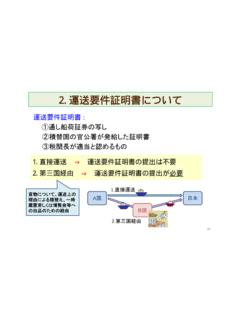
6 Where the exporter (producer or trader) is located in the exporting Party but the trader issuing the invoice is established in a third country, the exporter is not supposed to make out a statement on origin on a document of that trader. In that case, the statement on Origin should be placed on a commercial document issued by the exporter (producer or trader other than the trader established in a third country, under one of the scenarios provided for the question which document may be used for the statement on origin) in the exporting Party, such as a delivery note.
7 It should be reminded that a claim for preferential tariff treatment based on a statement on origin made out on a document issued by the exporter (producer or trader, under one of the scenarios provided for the question which document may be used for the statement on origin), shall not be rejected for the sole reason that an invoice was issued in a third country. There is no legal definition in the EPA of what constitutes a commercial document . which nonetheless can be considered as a written record of a commercial transaction.
8 It therefore covers, apart from the invoice itself, different types of documents such as a pro-forma invoice, a shipping document (packing list, delivery note), etc. The only legal requirement for the invoice or any commercial document to be considered as the basis for a statement on origin is that it shall contain a description of the originating 2. products in sufficient detail to enable their identification. Other products, which may be included in the same invoice or other commercial document, shall be clearly distinguished from the originating products.
9 A statement on origin can be printed on a separate paper ( a blank paper or a paper with a company letterhead), other than on an invoice or other commercial document, where: - that invoice or any other commercial document makes a reference to that separate paper, or - that separate paper makes a reference to the invoice or any other commercial document. The separate paper can then be seen as integral part of the invoice or other commercial document. The treatments above are also applied to the four scenarios provided for the question which document may be used for the statement on origin.
10 Furthermore, where identical products are imported more than one time within 12. months, the statement may be used comprehensively for these multiple shipments by the exporter indicating on the statement the period during which it is used. Please contact Customs if there are any questions. 3. Importer's knowledge The importer may claim preferential tariff treatment based on its knowledge in accordance with Article (b) of the Agreement. In such a case, it is assumed that the importer has information which demonstrates that the product is originating in accordance with Article of the Agreement and satisfies the requirements provided for in the Agreement.