Transcription of Guidelines for Specimen Handling and Processing
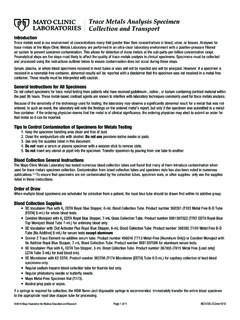
1 Revision July 2014 Reviewed 9/2018 Coagulation Studies Guidelines for Specimen Handling and Processing The Mayo Clinic Coagulation Laboratories have been performing coagulation factor testing on mailed-in specimens for many years. Accurate results can only be obtained on properly prepared specimens. The physician interpreting results may be misled by abnormal results obtained in mishandled specimens. To ensure the best possible Specimen , follow collection requirements as closely as possible. Adherence to these Guidelines will improve coagulation study results. 1. Patient should be fasting, if possible; for certain tests, the patient cannot be receiving anticoagulant medication: -Heparin -Warfarin/Coumadin -Direct thrombin inhibitor: Pradaxa(dabigatran), Acova(argatroban) -Direct Xa inhibitor: Xarelto(rivaroxaban), Eliquis(apixaban) 2.
2 Draw blood from the patient into light blue-top (sodium citrate) evacuated tubes containing sodium citrate. a. If the patient s hematocrit is >55%, the volume of anticoagulant in the tube should be adjusted. If the hematocrit is between 55% and 65%, it is acceptable to remove ml of the citrate anticoagulant from the tube and not perform the calculations. This will account for most of the patients with high hematocrits, since very few patients will have a hematocrit that is >65%. For those patients with hematocrit >65%, use the following formula to determine the correct anticoagulant volume: C = ( 10 3)(100 Hct)(V Blood) Abbreviations: C= volume of citrate remaining in the tube, Hct = patient s hematocrit, and V = the volume of blood to be added. (If a 5-mL tube is used, V= mL) b. The tubes must fill completely.
3 A clean venipuncture is essential to avoid activation of coagulation by tissue thromboplastin. c. Mix gently by inverting the tube end over end 5 to 6 times. Avoid vigorous mixing or additional inversion. Observe for the presence of clots. Specimens containing fibrin clots will, in most cases, be rejected. 3. The Specimen must be double-centrifuged to prepare a platelet-free plasma Specimen (platelet count <10,000/mcL) a. Immediately centrifuge Specimen at 1,500 x G for 10 minutes. b. Carefully remove plasma from cells, avoiding the platelet/buffy coat. c. Dispense into a plastic tube using a plastic transfer pipette. Do not pour off! d. Centrifuge the plasma in the plastic tube at 1,500 x G for 10 minutes. e. Remove the top portion of plasma leaving approximately 250 mcL in the bottom to discard. f. The double-centrifuged plasma should be aliquoted (1 to 2 mL per aliquot) into clearly labeled plastic tubes.
4 The number of tests ordered will determine the aliquots needed. Generally, a 1 mL aliquot per test is required although test volumes may be combined up to 2 mL of plasma per aliquot. Pay particular attention to the amount of Specimen required for the ordered test(s). Coagulation profiles (see individual test Specimen requirements) and multiple single-test orders will require multiple aliquots. g. After centrifugation, examine the plasma for fibrin clots and pour the cellular portion through gauze to observe for small red cell clots. Clotted specimens must be discarded and recollected. 4. Specimens should be frozen at below -40 C, if possible, and sent together in the same container with at least 5 lbs of dry ice. Specimens must arrive frozen. 5. Please include the requested information (see individual test descriptions) as the testing and interpretations are dependent on clinical history in many of the more complex abnormalities.
5 Reference 1. Clinical and Laboratory Standards Institute. Collection, Transport, and Processing of Blood Specimens for Testing Plasma- Based Coagulation Assays and Molecular Hemostasis Assays; Approved Guideline Fifth Edition. CLSI document 2008;H21 A5:Vol 28 No 5 Pediatric Hemostasis References 1. Hathaway WE, Corrigan J: Report of Scientific and Standardization Subcommittee on Neonatal Hemostasis: normal coagulation data for fetuses and newborn infants. Thromb Haemost 1991;65:323-325 2. Andrew M, Paes B, Milner R, et al: Development of the human coagulation system in the full term infant. Blood 1987;70:165- 172 3. Andrew M, Paes B, Milner R, et al: Development of the human coagulation system in the healthy premature infant. Blood 1988;72:1651-1657 Revision July 2014 Reviewed 9/2018 4. Andrew M, Vegh P, Johnston M, et al: Maturation of the hemostatic system during childhood.
6 Blood 1992;80:1998-2005 5. Andrew M: The hemostatic system in the infant. In Hematology of Infancy and Childhood. Vol. 1. 4th edition. Edited by DG Nathan, FA Oski. Philadelphia, WB Saunders Company, 1993, pp 115-153 6. Hathaway WE, Bonnar J: Perinatal Coagulation. New York, Grune and Stratton, 1978 7. Hathaway WE, Bonnar J: Hemostatic Disorders of the Pregnant Woman and Newborn Infant. New York, Elsevier Science Publishing Company, 1987 8. Hematologic Disorders in Maternal-Fetal Medicine. Edited by MN Bern, FD Frigoletto Jr. New York, Wiley-Liss, 1990 9. Perinatal Thrombosis and Hemostasis. Edited by S Suzuki, WE Hathaway, J Bonnar, AH Sutor. Tokyo, Springer-Verlag, 1991 10. Hathaway WE, Manco-Johnson M: Disorders of coagulation and platelets in the neonate. In Hematology: Basic Principles and Practice.
7 Edited by R Hoffman, EJ Benz Jr, SJ Shattil, et al. New York, Churchill Livingstone, 1991, pp 1409-1415 11. Corrigan JJ Jr: Normal hemostasis in the fetus and newborn: coagulation. In Fetal and Neonatal Physiology. Vol. 2. Edited by RA Polin, WW Fox. Philadelphia, WB Saunders Company, 1992, pp 1368-1371 12. Ignjatovic V, Kenet G, Monagle P: Developmental hemostasis: recommendations for laboratories reporting pediatric samples. J Thromb Haemost 2012 Feb;10(2):298-300