Transcription of Handoff Communications: A Systems Approach
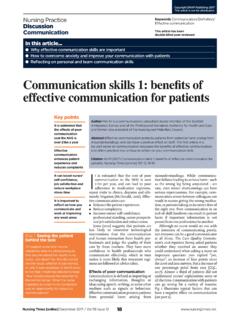
1 R E V I E W S & A N A LY S E S. Handoff Communications: A Systems Approach Lea Anne Gardner, PhD, RN INTRODUCTION. Senior Patient Safety Analyst Pennsylvania Patient Safety Authority Personnel at a Pennsylvania healthcare facility contacted the Pennsylvania Patient Safety Authority to learn about the types of Handoff -related events reported by other facilities in the state so they could adapt and improve their Handoff processes. ABSTRACT Handoffs involve sharing patient information and often include performing a visual Handoffs are an integral part of care inspection of the patient to confirm the accuracy of information Handoff coordination and the delivery of safe communications coordinate patient care by passing essential information about a patient care. effective handoffs have patient's health status and responsibility for the patient's care from one healthcare multiple functions: transferring responsi- worker to another.
2 They occur at change of shift ( , attending physicians, nursing bility and accountability for the patient's staff), transfer of patients from one area within a healthcare facility to another, trans- care and confirming the accuracy of fers between facilities, and during shifts when staff leave the unit or area to tend to information from one healthcare worker other patients or take a break. Each Handoff provides opportunities to catch and cor- to another and providing opportuni- rect ties to catch and correct errors. In When a Handoff is successfully completed, the next person responsible for the patient Pennsylvania, facilities reported 1,565 has the necessary information to inform care for that specific patient. In cases in which Handoff -related events through the information is incomplete or a Handoff fails to occur, an incomplete understanding Pennsylvania Patient Safety Reporting of a patient's condition may contribute to inappropriate or inadequate treatment.
3 In System (PA-PSRS) that occurred in 2014 a study by Tucker and Edmondson, missing or incorrect information was one of five and 2015. About 60% of the Handoff broad types of healthcare problems or process failures encountered by Lapses reports indicated discrepancies between in handoffs impact all groups of healthcare clinicians ( , physicians, nurses, allied information shared and the patient's health professionals) and nonclinicians ( , transportation staff). condition noted during or after a hand- Handoffs between healthcare workers occur hundreds to thousands of times each off with no description of a follow up; in day, creating opportunities to identify effective Handoff communications. The Joint 40% of the event reports, a follow up in Commission identified [inadequate] communication as the third most frequently patient care to address the discrepancy identified root cause for a sentinel event in 2014 and Good communication is was stated.
4 In addition, about 20% of a part of patient care and leadership The challenge in completing a suc- the event reports stated that there was cessful Handoff is knowing what information is most important and how to convey the no Handoff given and in another 16%. information in a clear and concise manner appropriate for the patient's circumstances. of the event reports, details about the For example, hospital intensive care units may adhere to Handoff criteria that differ patient's condition were omitted from from obstetric unit criteria. effective handoffs require teamwork, shared practices, and the Handoff . Using Handoff processes shared expectations ( , use of Handoff tools).8-10. that incorporate critical thinking and reasoning skills to address patient The literature is replete with articles focusing on the use of Handoff needs, addressing environmental dis- Healthcare professionals have developed and validated a variety of Handoff tools tractions and communication deficits, that provide a shared mental model to help complete a patient Handoff .
5 Examples of and providing Handoff training and edu- some well-known Handoff tools for clinicians include SBAR (Situation, Background, cation are strategies to improve patient Assessment, and Response) and I-PASS (Illness severity, Patient summary, Action list, Handoff communications. (Pa Patient Saf Situation awareness and contingency planning, and Synthesis by receiver), and for clini- Advis 2017 Mar;14[1]:17-26) cal and nonclinical staff, the ticket to ride tool, used when transporting Handoff tools help clinicians gather needed information and pass it on to other healthcare workers, but this integral part of coordinating patient care can ,14,19-23 (See Table 1.). METHODS. Analysts queried the PA-PSRS database to identify Handoff -related events reported by Pennsylvania healthcare facilities that occurred in 2014 and 2015. The query searched free-text data fields of the event type Other, event description, and recommenda- tions using the following keywords: handover , sign off, nursing report, shift report, off (continued on page 19).
6 Vol. 14, No. 1 March 2017 Pennsylvania Patient Safety Advisory Page 17. 2017 Pennsylvania Patient Safety Authority R E V I E W S & A N A LY S E S. Table 1. Handoff Barriers INSUFFICIENT. COMMUNICATION INCONSISTENT ENVIRONMENTAL TRAINING AND LEADERSHIP/STAFFING. DEFICITS PROCESS DISTRACTIONS EDUCATION CHALLENGES. Missing or incomplete No formal process Lack of time, inability Lack of resources Lack of leadership information1,2 in place1 to follow up or share to implement support; organization additional information2-5 Handoff program1,3 administrative structure that impedes open communication1,2. Use of unclear Lack of standardized Excessive noise or activity, Inadequate or no Different levels of staff language, such as forms, tools, or including background Handoff training experience and expertise abbreviations and process1-4,7 noise, leading to program1,3,7 or staff with different acronyms or similar- sensory and information expertise and training sounding medication overload1-3,7 ( , MD and RN)2,4,5.
7 Names2,5,6. Differences in Multiple Handoff Frequent transfers ( , Staffing challenges ( , communication tools used1 new admissions arising too few nurses, high staff patterns or language; during handoffs) or high turnover)1-3,7. cultural differences1-3,5 census1-4. Unclear roles and Process too time Complex patients with Missing or unclear Handoff responsibilities of team consuming or high-acuity or new acute- policies and procedure1. members1 reports too long1,2 care situation requiring immediate care1-4,7. Lack of attention or Illegible written Interruptions, distractions, Lack of teamwork and responsiveness of notes from outgoing or multitasking during a mutual respect; culture of receiver3 staff2 Handoff report1,2,4,7 blame3. Lack of mutual respect Difficulty accessing Cognitive bias4. or support1,3 records2. Unorganized or lengthy Lack of privacy1,2,4,5. reports1. Outgoing nurse not Staff fatigue or stress1,2,4.
8 Available1. Incorrect, extraneous, Poor lighting1. or irrelevant information1. Electronic device failure2. Notes 1. Riesenberg LA, Leitzsch J, Cunningham JM. Nursing handoffs: a systematic review of the literature. Am J Nurs. 2010 Apr;110(4):24-34; quiz 35-6. Also available: PMID: 20335686. 2. Friesen MA, White SV, Byers JF. Chapter 34: Handoffs: implications for nurses. In: Hughes RG, editor. Patient safety and quality: an evidence-based handbook for nurses. Rockville (MD): Agency of Healthcare Research and Quality (AHRQ); 2008. Also available: NBK2649/. 3. Halm MA. Nursing handoffs: ensuring safe passage for patients. Am J Crit Care. 2013 Mar;22(2):158-62. Also available: ajcc2013454. PMID: 23455866. 4. Bright J, Long B. ED handoffs - the problem and what we can do to improve. [internet]. emDocs; 2015 Nov 18 [accessed 2016 Sep 21]. [8 p]. Available: 5. Cohen MD, Hilligoss PB. Handoffs in hospitals: a review of the literature on information exchange while transferring patient responsibility or control.
9 Ann Arbor (MI): School of Information, University of Michigan; 2009 Jan 16. Also available: 6. Gardner LA. Health literacy and patient safety events. Pa Patient Saf Advis. 2016 Jun 16;13(2):58-65. Also available: ADVISORIES/AdvisoryLibrary/2016/jun;13(2 )/ 7. VandenBerg AK. Patient hand offs: facilitating safe and effective transitions of care. Grand Rapids (MI): Kirkhoff College of Nursing, Grand Valley State University; 2013. 66 p. (Master's Projects; Paper 1). Also available: projects. Page 18 Pennsylvania Patient Safety Advisory Vol. 14, No. 1 March 2017. 2017 Pennsylvania Patient Safety Authority (continued from page 17) receiver in the Handoff was not consis- [sure that the] patient's RN was shift, in shift, inshift, hand off, Handoff , tently stated. They are grouped as follows: aware [of the lab value]. Staff stated sign out, signout, cover, and to cover. Registered nurse ( , n = 928 of that the patient had left the unit and The initial query resulted in 3,566 event 1,074) was possibly having a procedure.
10 The reports. Analysts reviewed the event reports charge RN called the [procedure room], Medical doctor ( , n = 195). and excluded 2,001 with no mention of a reached the RN caring for the patient, Handoff or only a cursory mention ( , Allied health professional ( , and passed on these critical lab results. a statement of intent to provide patient n = 67). During change of shift report, the information at a future Handoff ). Analysts Nonclinical staff (2%, n = 22). outgoing RN reported that new skin then applied the following criteria when Student nurse or resident (2%, breakdown on the patient's buttock reviewing and identifying Handoff event n = 21) was present. The outgoing RN stated reports: the setting in which the Handoff the wound was not there when he occurred or should have occurred ( , shift Completed Handoffs cared for the patient previously. The reports or unit transfers); discrepancies such The majority of the event reports identi- oncoming RN's assessment of the as omitted or inconsistent information; lack fied the occurrence of a Handoff , 81% wound noted several areas of open of physical checks of equipment, orders, or (n = 1,268 of 1,565), versus events skin.