Example: marketing
HAPTER 2 BIOLOGICAL CLASSIFICATION
R.H. Whittaker (1969) proposed a Five Kingdom Classification. The kingdoms defined by him were named Monera, Protista, Fungi, Plantae and Animalia. The main criteria for classification used by him include cell structure, body organisation, mode of nutrition, reproduction and phylogenetic relationships. Table 2.1 gives a comparative account of ...
Tags:
Information
Domain:
Source:
Link to this page:
Documents from same domain
ntse exam notification - National Council Of …
ncert.nic.inExamination: The tentative pattern of written examination will be as follows: Stage-I & Il : examination at the State/UT level will comprise of three papers i.e.
14 Effects Electric Current and Its - National …
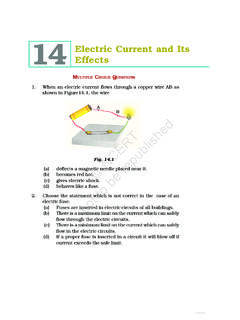
ncert.nic.in76 EXEMPLAR PROBLEMS 3. Three bulbs A, B, C are connected in a circuit as shown in Figure 14.2. When the switch is ‘ON’ (a) bulb C will glow first. (b) bulb B and C will glow simulaneously and bulb A will

SEMICONDUCTOR AND SIMPLE CIRCUITSnot to be …
ncert.nic.in469 Semiconductor Electronics: Materials, Devices and Simple Circuits semiconductors. However , after 1990, a few semiconductor devices using organic semiconductors and semiconducting polymers have been
ENVIRONMENTAL CHEMISTRY - National Council …
ncert.nic.in400 CHEMISTRY (c) Hydrocarbons: Hydrocarbons are composed of hydrogen and carbon only and are formed by incomplete combustion of fuel …
LAWS OF MOTION
ncert.nic.inLAWS OF MOTION 91 In practice, the ball does come to a stop after moving a finite distance on the horizontal plane, because of the opposing force of friction which
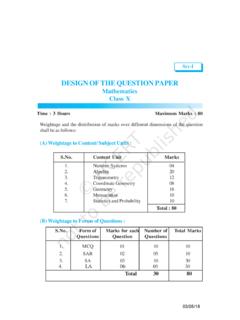
DESIGN OF THE QUESTION PAPER Mathematics …
ncert.nic.inDESIGN OF THE QUESTION PAPER, SET-I 207 (A) 18 5 (B) 17 5 (C) 17 8 (D) 1 7. In the adjoining figure, PA and PB are tangents from a point P to a circle with centre O.
CHAPTER 10
ncert.nic.in(A) Main Concepts and Results Circle, radius, diameter , chord, segment, cyclic quadrilateral. • Equal chords of a circle (or of congruent circles) subtend equal angles at the
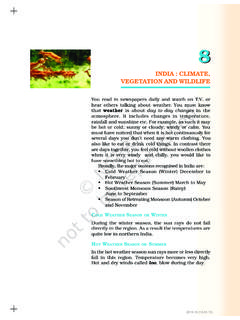
INDIA : CLIMATE, VEGETATION AND WILDLIFE
ncert.nic.inINDIA : CLIMATE, VEGETATION AND WILDLIFE 59 year. Therefore, they always appear gr een and are called evergreen forest as you may notice in Figure

Objectives Polymers - National Council of …
ncert.nic.in427 Polymers C:\Chemistry-12\Unit-15.pmd 28.02.07 Polymers can also be classified on the basis of mode of polymerisation into two sub groups.
TEXTBOOK IN GEOGRAPHY FOR CLASS IX
ncert.nic.inFOREWORD The National Curriculum Framework, (NCF) 2005, recommends that children’s life at school must be linked to their life outside the school. This principle
Related documents

C 2 IOLOGICAL CLASSIFICATION
ncert.nic.inBIOLOGICAL CLASSIFICATION 17 R.H. Whittaker (1969) proposed a Five Kingdom Classification. The kingdoms defined by him were named Monera, Protista, Fungi, Plantae and Animalia. The main criteria for classification used by him include cell structure, thallus organisation, mode of nutrition,

SUPPORT MATERIAL FOR BIOLOGY CLASS XI
www.edudel.nic.inCLASSIFICATION Divided plants into herbs, shrubs and trees. Animals into those with RBC’s and those who do not have it. •Two kingdom classification : Given by Carolous Linnaeus − Plant kingdom and Animal kingdom. • Five kingdom classification : By R. H. Whittaker. Monera, Protista, Fungi, Plantae and Animalia are the five kingdoms.

INTRODUCTION TO MYCOLOGY
www.microrao.comClassification of fungi: Fungi were initially classified with plants and were a subject of interest for botanists; hence the influence of botany can be seen on their classification. In 1969 R.H Whittaker classified all living organisms into five kingdoms namely Monera, Protista, Fungi, Plantae and Animalia.
Plant Classification
www.senecahs.orgScientific Classification Animal Plant Protista Kingdom. Plant Divisions Tracheophyta Thallophyta Pteridphyta Plant Kingdom Bryophyta Or Thallophyta.

Biology - Aga Khan University
www.aku.edu5. Classification and Acellular Life Students should be able to: 5.1 Classification of Living Organisms 5.1.1 describe basis of classification of living organisms, i.e. homology, biochemistry, cytology and genetics; * 5.1.2 exemplify hierarchy of biological classification (species, genera, family, order, class, phylum/ division and kingdom); *
Classification of Microorganisms
instruction2.mtsac.edu• 1866 Kingdom Protista proposed for bacteria, protozoa, algae, and fungi •1937Prokaryoteintroduced for cells "without a nucleus" •1961Prokaryote= cells in which nucleoplasm is not surrounded by a nuclear membrane • 1959 Kingdom Fungi • 1968 Kingdom Prokaryotae proposed • 1978 Two types of prokaryotic cells found Timeline
Classification of Microorganisms
lpc1.clpccd.cc.ca.usCompare and contrast classification and identification. Explain the purpose of Bergey’sManual. Describe how staining and biochemical tests are used to identify bacteria. Explain how serological tests and phage typing can be used to identify an unknown bacterium. Describe how a newly discovered microbe can be classified by ribotyping,