Transcription of Hazardous Locations CEC Classifications - tnb.ca.abb.com
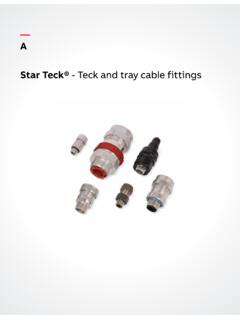
1 B1 copy starts hereB2 copy starts hereB3 copy starts hereA8 STAR TECK TECK AND TRAY CABLE FITTINGSCEC code changes In 1998, the Canadian Electrical Code (CEC) adopted the International Electrotechnical Commission s (IEC) three zone area classification system for Class I Hazardous Locations . The zone system is an alternate classification for Class I Hazardous Locations and was adopted to promote harmonization with international standards. The division system for Class I Hazardous Locations continues to be used for existing facilities and is expected to remain in use at least for the next few editions of the CEC. For this reason, this catalogue s certification information for Class I Hazardous Locations includes both the pre-1998 division system and the new IEC zone system.
2 The following pages provide an overview of CEC Hazardous location The Canadian Electrical Code (CEC), Part I, Section 18- Hazardous Locations , identifies three classes of Hazardous Locations : Class I gas and vapour environments Class II dust environments Class III fibers and flyings environments The 1998 revisions to the CEC affect only Class I gas and vapour environments. Hazardous location is defined by the CEC as premises, buildings or parts thereof in which there exists the hazard of fire or explosion due to highly flammable gases and/or flammable, volatile liquid mixtures that are manufactured, used or stored in other than the original containers. This definition can also be extended to include combustible dust and easily ignitable fibers that are likely to be present in sufficient quantities to produce an explosive I gas and vapour environmentsLocations which are deemed Hazardous due to the presence of gases or vapours that are present in the air in sufficient quantity to produce explosive or ignitable identified as Class I require that enclosures and fittings be explosion I Hazardous Locations are further subdivided into: Divisions (pre-1998 version of the CEC), or Zones (IEC classification - 1998 CEC)The division system may still be used for the maintenance and repair of existing facilities.
3 All new construction must use the IEC zone Division 1 a Class I location where the Hazardous atmosphere is expected to be present during normal operations on a continuous, intermittent or periodic basis. Division 2 a Class I location in which volatile flammable liquids or gases are handled, processed or used but in which they would normally be confined within closed containers or closed systems from which they can escape only in the event of an accidental rupture or breakdown of the containers or following abbreviations are used in this catalogue: HLA Hazardous location area OLA ordinary location area Area classification Divisions vs. zonesContinuous hazard Intermittent hazardHazard under abnormal conditionsZone 0 Zone 1 Zone 2 Division 1 Division 1 Division 2 Hazardous Locations CEC classificationsClass IB1 copy starts hereB2 copy starts hereB3 copy starts hereHeadline starts hereA9 Zones Zone 0 Class I Locations in which explosive gas atmospheres are present continuously or are present for long periods.
4 Zone 1 Class I Locations in which: i. explosive gas atmospheres are likely to occur in normal operation; or ii. explosive gas atmospheres may exist frequently because of repair or maintenance operations or because of leakage; or iii. the location is adjacent to a Class I, Zone 0 location, from which explosive gas atmospheres could be communicated. Zone 2 Class I Locations in which: iv. explosive gas atmospheres are not likely to occur in normal operation and if they do occur they will exist for a short time only; or v. flammable volatile liquids, flammable gases or vapours are handled, processed or used, but in which liquids, gases or vapours are normally confined within closed containers or closed systems from which they can escape only as a result of accidental rupture or breakdown of the containers or systems or the abnormal operation of the equipment by which the liquids or gases are handled, processed or used; or vi.
5 Explosive gas atmospheres are normally prevented by adequate ventilation, but they may occur as a result of failure or abnormal operation of the ventilation system; or vii. the location is adjacent to a Class I, Zone 1 location from which explosive gas atmospheres could be communicated, unless such communication is prevented by adequate positive-pressure ventilation from a source of clean air, and effective safeguards against ventilation failure are provided. Class I EquipmentElectrical equipment that is approved for use in Class I Hazardous location areas (HLAs) is referred to as explosion proof or flameproof. What this designation means is that the equipment has been designed and manufactured to ensure that it will not become a source of ignition when used in a Class I, gas and vapour explosion-proof equipment is clearly identified by either: a Class I Location marking (Division System); or a Type of protection d marking (IEC Zone System).
6 01 This diagram illustrates the escape paths of gases generated by an explosion within an electrical enclosure. When an explosion occurs, hot or burning gases pass through the threaded joint or Star Teck XP flame path and must make a number of changes in direction. These changes in direction cool the hot gases to the point that they are too cool to ignite the surrounding atmosphere once they escape paths for the hot gases include the enclosure cover flange and the interstices between the strands of wires entering the or burning gasesIntegral sealing compoundInternalexplosion Hazardous Locations CEC classificationsClass ICooled escaping gas 01 Hot or burning gasesCooled escaping gasHAZARDOUS LOCATIONSB1 copy starts hereB2 copy starts hereB3 copy starts hereA10 STAR TECK TECK AND TRAY CABLE FITTINGS Hazardous Locations CEC classificationsClass IGas group designationsTwo systems of groupings for gases are included in the 1998 CEC.
7 The pre-1998 division gas groups consisting of Groups A, B, C and D; and the IEC system consisting of Groups IIA, IIB and IIC. Both systems are accepted by the gas groups group AacetyleneGroup B butadiene, hydrogen, manufactured gases containing more than 30% hydrogen (by volume), propylene oxideGroup C acetaldehyde, cyclopropane, ether, ethylene, unsymmetrical dimethyl hydrazine (UDMH 1, 1-dimethyl hydrazine), hydrogen sulfideGroup D acetone, acrylonitrile, alcohol, ammonia, benzene, benzine, benzol, butane, 1-butanol, 2-butanol, butyl acetate, isobutyl acetate, ethane, ethanol, ethyl acetate, ethylene dichloride, gasoline, heptanes, hexanes, isoprene, methane, methanol, 3-methyl-1-butanol, methyl ethyl ketone, 2-methyl-1-propanol, 2-methyl-2-propanol, naphtha, natural gas, petroleum naphtha, octanes, pentanes, 1-pentanol, propane, 1-propanol, 2-propanol, propylene, styrene, toluene, vinyl acetate, vinyl chloride, xylenesIEC zone gas groups group IIC acetylene, carbon disulphide, hydrogen or other gases or vapour of equivalent hazard group IIB acrylonitrile, butadiene, diethyl ether, ethylene, ethylene oxide, hydrogen sulfide.
8 Propylene oxide, unsymmetrical dimethyl hydrazine (UDMH) or other gases or vapour of equivalent hazard group IIA acetaldehyde, acetone, alcohol, ammonia, benzine, benzol, butane, cyclopropane, dichloride, ethylene, gasoline, hexane, isoprene, lacquer solvent vapours, naptha, natural gas, propane, propylene, styrene, vinyl acetate, vinyl chloride, xylenes or other gases or vapour of equivalent hazard Comparison of Hazardous location gas group designations from most restrictive to least restrictiveTypical gas hazardDivision gas groups1998 CEC and IEC gas groupsAcetyleneAHydrogenBIICE thyleneCIIBP ropaneDIIAB1 copy starts hereB2 copy starts hereB3 copy starts hereHeadline starts hereA11 Class II Dust environmentsLocations which are deemed Hazardous due to the presence of combustible or electrical conducting dusts.
9 Class II Locations normally require that enclosures and fittings be dust III Fibers and flyings environmentsLocations which are deemed Hazardous due to the presence of easily ignitable fibers or flyings, but in which such fibers or flyings are not likely to be in suspension in the air in sufficient quantities to produce ignitable III Locations normally require that enclosures and fittings be constructed to minimize the entry of fibers or II and III DivisionsClass II and Class III Locations are further subdivided as follows: Division 1 Where the Hazardous atmosphere is expected to be present during normal operations on a continuous, intermittent or periodic basis. Division 2 Where volatile, flammable liquids or gases are handled, processed or used, but in which they would normally be confined within closed containers or closed systems from which they can escape only in the event of an accidental rupture or breakdown of the containers or II and III Dust and particles group designationsThe Canadian Electrical Code (CEC), Part 1 Section 18 Hazardous Locations defines various groups which have been established for the purpose of testing and approval.
10 group E Comprising atmospheres containing metal dust including aluminum, magnesium, and their commercial alloys, and other metals of similarly Hazardous characteristics. group F Comprising atmospheres containing carbon black, coal or coke dust. group G Comprising atmospheres containing flour, starch or grain dust, and other dusts of similarly Hazardous characteristics. Hazardous Locations CEC classificationsClass IHAZARDOUS Locations