Example: dental hygienist
HAZARDOUS MATERIALS TRANSPORTATION SECURITY
A large bulk quantity of a Class 3 material meeting the criteria for Packing Group I or II; A quantity of a desensitized explosive meeting the deinition of a Division 4.1 or Class 3 material requiring placarding in accordance with Subpart F of Part 172 of the HMR; • …
Tags:
Information
Domain:
Source:
Link to this page:
Documents from same domain

Guidelines for Hazardous and Prevention/Mitigation Training
www.phmsa.dot.gov2016 Guidelines for Hazardous Materials Response, Planning and Prevention/Mitigation Training Introduction – Page iv Guidelines Overview The Guidelines is designed to be used as a working reference manual by public sector managers of hazardous materials training.

172.101 App A Appendix A to §172.101 - List of Hazardous ...
www.phmsa.dot.gov172.101 App A Appendix A to §172.101 - List of Hazardous Substances and Reportable Quantities 1. This Appendix lists materials and their corresponding reportable quantities (RQ's) that are listed or designated as "hazardous
Guidance Manual for Operators of Small Natural Gas Systems
www.phmsa.dot.govGuidance Manual for Operators of Small Natural Gas Systems US Department of Transportation Pipeline and Hazardous Materials Safety Administration Office of Pipeline ...
Hazmat Transportation Training Requirements - …
www.phmsa.dot.govphmsa pipeline and hazardous materials safety administration 1 hazmat transportation training requirements an overview of 49 cfr parts 172-173 www.phmsa.dot.gov
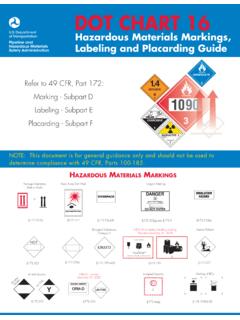
DOT CHART 16 Hazardous Materials Markings,Labeling and ...
www.phmsa.dot.govOct 24, 2017 · §172.436, §172.438, §172.440, §172.441 For Regulated Medical Waste (RMW), an Infectious Substance label is not required on an outer packaging if the OSHA Biohazard marking is used as prescribed in 29 CFR 1910.1030(g). A bulk package of RMW must display a BIOHAZARD marking. §172.323, §172.405(c), §172.429, §172.430, §172.432 §172.450

APR 2012 - phmsa.dot.gov
www.phmsa.dot.gov1200 New Jersey Avenue, SE Washington, D.C. 20590 This is in response to your January 17, 2012letter concerning how to describe and transport disposal and recycling products, including sharps, used by medical facilities to treat human ... 866-436-9264 (WCMI) • www.wastewise.com .

Billing Code: 4910-60-P DEPARTMENT OF TRANSPORTATION ...
www.phmsa.dot.govOn July 29, 2016, PHMSA, in consultation with FRA, published a Notice of Proposed Rulemaking (NPRM) under the same title as this final rule (81 FR 50068).

Requalification Guidance for Propane Cylinders - PHMSA
www.phmsa.dot.govPropane cylinders have identifying marks on the cylinder neckring (collar), or cylinder shoulder depending on the cylinder type. The diagram below depicts examples of several of the required markings.
THIS DOCUMENT SHOULD NOT BE USED TO DANGEROUS …
www.phmsa.dot.govPage 4 saFETy prEcauTions rEsisT rushing in! approach cauTiousLy From UPWIND, UPHILL or UPSTREAM: • Stay clear of Vapor, Fumes, Smoke and Spills • Keep vehicle at a safe distance from the scene sEcur E T hE sc EnE:
Pipeline Corrosion Report - FINAL
www.phmsa.dot.govcomprehensively addressing corrosion of offshore pipelines, this study does highlight aspects of corrosion in offshore pipelines in various sections and is specific in reference when discussed. 1.1 Corrosion Overview Corrosion is one of the leading causes of failures in onshore transmission pipelines (both gas and
Related documents
Guide to Explosive Atmospheres & Hazardous Locations
www.intertek.comIntertek Guide to Explosive Atmosheres and Hazardous Locations 7 Typical NEC® Marking NEC® 500 NEC® 505 Class I, Zone 0, AEx ia IIC T4 Hazard Class Protection Concept Code Area Classification Approved to US Standards Class I, Division 1, Groups A&B T4 Temperature Class Gas Group Hazard

HANDOUT Hazardous Locations - Occupational Safety and ...
www.osha.govClass II Locations The second type of hazardous location is called a “Class II Location”. This classification is created by the presence of combustible dust in the air in sufficient quantities to be explosive or ignitable. Some typical Class II locations are: Grain elevators; Flour and feed mills;
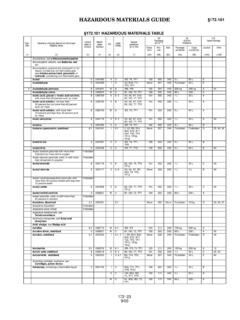
§172.101 HAZARDOUS MATERIALS TABLE
www.uakron.eduHAZARDOUS MATERIALS GUIDE §172.101 172--23 §172.101 HAZARDOUS MATERIALS TABLE Sym-bols Hazardous materials descriptions and proper shippingnames Hazard class or Identifi-cation PG Label Codes Special provisions (8) Packaging (§173.***) (9) Quantity limitations (10) Vessel stowage y bols p p p shipping names class or Division cation Numbers ...

Choose the Right Electric Motors for Hazardous Locations
www.zeton.comClass I and Class II locations are further divided into groups based on the behavior of the hazardous material after it has been ignited. Groups A, B, C, and D are used for Class I environments, Groups E, F, and G for Class II areas. Group A includes only acetylene, a colorless hydro-carbon gas that creates an intense explosion when ignited.

Product Bulletin Hazardous Area Classifications September ...
www.emerson.com3. Group—The Group defines the type of hazardous material in the surrounding atmosphere. Groups A, B, C, and D are for gases (Class I only) while groups E, F, and G are for dusts and flyings (Class II or III). a. Group A—Atmospheres containing acetylene. b. Group B—Atmospheres containing a flammable gas, flammable liquid-produced vapor, or

HAZARDOUS MATERIALS CHART
cdn.jjkeller.com5. Radioactive (Class 7) I or II labels. 6. Small quantities per §173.4. 7. Excepted quantities per §173.4a. Class 9 materials in domestic transport. 9. Materials prepared per §173.13. Division 1.4 or 1.5 placard not needed on vehicle already placarded Division 1.1 or 1.2. Division 1.4 placard not needed for compatibility group “S” (1.4S)