Example: marketing
Homework Chapter 31: Electromagnetic Oscillations and ...
oscillations is 1.50 V and the maximum current through the inductor is 50.0 mA. What are (a) the inductance L and (b) the frequency of the oscillations? (c) How much time is required for the charge on the capacitor to rise from zero ... 31.29 A 50.0 mH inductor is connected as in Fig. 31-12 to an ac generator with ...
Tags:
Information
Domain:
Source:
Link to this page:
Documents from same domain

5-9 Acoustic Impedance - University of Wisconsin–Stevens ...
www4.uwsp.eduCopyright © 2009 Wolters Kluwer Health | Lippincott Williams & Wilkins 5-9 Acoustic Impedance Acoustic impedance is the opposition of a medium to a longitudinal wave ...
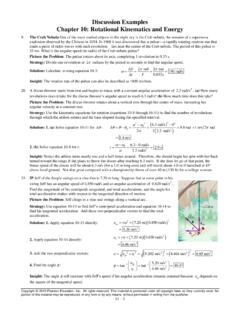
Discussion Examples Chapter 10: Rotational Kinematics and ...
www4.uwsp.eduChapter 10: Rotational Kinematics and Energy 9. The Crab Nebula One of the most studied objects in the night sky is the Crab nebula, the remains of a supernova explosion observed by the Chinese in 1054. In 1968 it was discovered that a pulsar—a rapidly rotating neutron star that
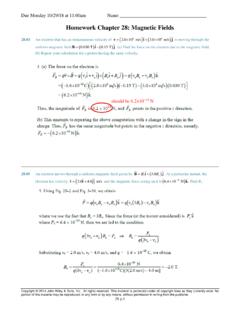
Homework Chapter 28: Magnetic Fields
www4.uwsp.eduThe lower plate is at the lower potential. Neglect fringing and assume that the electron’s velocity vector is perpendicular to the ... toward the north and inclined downward at 70.0° to the horizontal. Find the (a) magnitude and (b) direction of the

Homework Chapter 23: Gauss’ Law
www4.uwsp.edu23.03 The cube in Fig. 23-31 has edge length 1.40 m and is oriented as shown ... facilities handling grain or powder. Such an explosion occurred in chocolate crumb powder at a biscuit factory in the ... conditions for an explosion were met: (1) The magnitude of an electric field became 3.0 106 N/C or greater, so that electrical break-down and ...

Homework Chapter 24: Electric Potential
www4.uwsp.edu24.06 When an electron moves from A to B along an electric field line in Fig. 24-34, the electric field does 3.94 10−19 J of work on it. What are the electric potential differences (a) V B − V A, (b) V C − V A, and (c) V C − V B? 24.08 A graph of the x component of the electric field as a function of x in a region of space is shown in ...
Related documents

Chapter 12 Oscillations - UC Santa Barbara
www.deepspace.ucsb.eduChapter 12 Oscillations ... Damped oscillations • Real-world systems have some dissipative forces that decrease the amplitude. • The decrease in amplitude is called damping and the motion is called damped oscillation. • Figure illustrates an oscillator with a small amount of
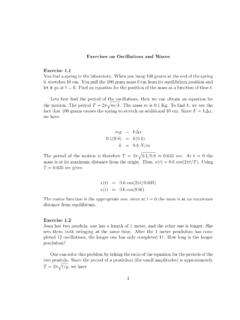
Exercises on Oscillations and Waves Exercise 1
www.cpp.edupleted 12 oscillations, the longer one has only completed 11. How long is the longer pendulum? One can solve this problem by taking the ratio of the equation for the periods of the two pendula. Since the period of a pendulum (for small amplitudes) is approximately T= 2ˇ q l=g, we have 1

Physical Pendulums and Small Oscillations
web.mit.edu12 τ cm =−γθ θ θ 0 θ ... Table Problem: Small Oscillations 26 A particle of effective mass m is acted on by a potential energy given by where U 0, a, and b are positive constants a) Find the points where the force on the particle is zero. Classify them as stable or unstable.
1 Physics I Oscillations and Waves
www.cts.iitkgp.ac.inm!0Af1 cos[2(!0t+˚)]g (1.12) shows similar oscillations which are exactly ˇout of phase. In a spring-mass system the total energy oscillates between the potential energy of the spring (U) and the kinetic energy of the mass (T). The total energy E= T+Uhas a value E= m!2 0A 2=2 which remains constant.

Topic: Coupled Oscillations
williamsgj.people.cofc.eduPhysics 235 Chapter 12 - 1 - Chapter 12 Coupled Oscillations Many important physics systems involved coupled oscillators. Coupled oscillators are oscillators connected in such a way that energy can be transferred between them. The motion of
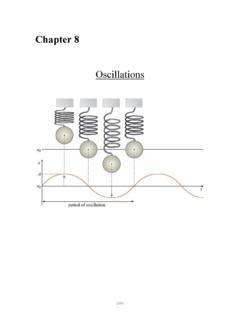
Chapter8 Oscillations - New Providence School District
www.npsd.k12.nj.us12. If both spheres have the same period of oscillation, which of the following is an expression for the spring constant (A) L / m1g (B) g / m2L (C) m2g / L (D) m1g / L 13. A simple pendulum and a mass hanging on a spring both have a period of 1 s when set …
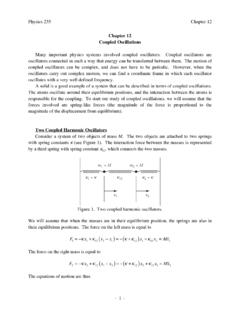
Physics 235 Chapter 12 - University of Rochester
teacher.pas.rochester.eduPhysics 235 Chapter 12 - 1 - Chapter 12 Coupled Oscillations Many important physics systems involved coupled oscillators. Coupled oscillators are oscillators connected in such a way that energy can be transferred between them. The motion of

Oscillations - UMD
www.physics.umd.eduDamped Oscillations The time constant, τ, is a property of the system, measured in seconds •A smaller value of τmeans more damping –the oscillations will die out more quickly. •A larger value of τmeans less damping, the oscillations will carry on longer. /W max ( ) x t Ae t

Oscillations - Harvard University
scholar.harvard.eduOscillations David Morin, morin@physics.harvard.edu A wave is a correlated collection of oscillations. For example, in a transverse wave traveling along a string, each point in the string oscillates back and forth in the transverse direc-tion (not along the direction of the string). In sound waves, each air molecule oscillates