Transcription of Oscillations - UMD
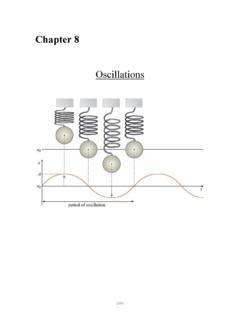
1 1 Oscillations Simple Harmonic Motion (SHM) Position, Velocity, Acceleration SHM Forces SHM Energy Period of oscillation Damping and Resonance2 Revision problemPlease try problem #31 on page 480A pendulum clock keeps time by the swinging of a uniform solid Harmonic Motion Pendulums Waves, tides Springs4 Simple Harmonic MotionRequires a force to return the system back toward equilibrium Spring Hooke s Law Pendulum and waves and tides gravityOscillation about an equilibrium position with a linear restoring force is always simple harmonic motion(SHM)
2 5 SpringsHooke s Law F=-kx6 SpringsHooke s Law F=-kx7 PendulumFor a small angle, the force is proportional to angle of deflection, . sinmgFreturn 8 PendulumFor a small angle, the return force is proportional to the distance from the equilibrium point:sLmgmgFLsreturn sin9 Kinematics of SHMS imple Harmonic motion can be described by a sinusoidal wave for displacement, velocity and acceleration:10 Kinematics of SHM The angle for the sinusoidal wave changes with time. It goes full circle 0 to 2 radians in one period of revolution, T. TtAtx 2cos)(11 Kinematics of SHM We define the frequency of revolution asFrequency, f, has units s-1or Hertz, Hz ftAtxTf 2cos)(1 12 Kinematics of SHM Velocity is 90oor /2 radians out of phase: ftvtv 2sin)(max 13 Kinematics of SHM Acceleration is 180oor radians out of phase ftata 2cos)(max 14 Kinematics of SHMSHM equations of motion ftataftvtvftAtx 2cos)()2sin()()2cos()(maxmax 15 Calculating vmaxA circular motion when looked end-on gives us a velocity like.
3 2sin(maxftvv 16 Calculating vmaxThe velocity around the circle will befAvTATDv 22maxmax 17 Calculating amaxFor circular motion, we know about acceleration and forcesAvarmvFmaF2maxmax2, 18 Kinematics of SHMSHM equations of motion ftAftaftfAtvftAtx 2cos)2()()2sin(2)()2cos()(2 19 SHM and Energy Energy is conserved: Bounces between kinetic and potential energy222121kxEmvEEEE potentialkineticpotentialkinetictotal 20 SHM and Energy The max KE must equal the max PE:AmkvkAvm max22max21)(2121 Finding the period of oscillation for a springWe now have 2 equations for vmax:Period of oscillation is independent of the amplitude of the 2,212max 22 Finding the period of oscillation for a pendulumConsider the acceleration using the equation for the return force, and the relation between acceleration and displacement.)
4 ALgAfasLmgmmFa 2max)2(1 23 Finding the period of oscillation for a pendulumWe can calculate the period of oscillationPeriod is independent of the mass, and depends on the effective length of the 2,21 24 Damped OscillationsAll the oscillating systems have friction, which removes energy, damping the oscillations25 Damped OscillationsWe have an exponential decay of the total amplitude /max)(tAetx 26 Damped OscillationsThe time constant, , is a property of the system, measured in seconds A smaller value of means more damping the Oscillations will die out more quickly.
5 A larger value of means less damping, the Oscillations will carry on longer. /max)(tAetx 27 Damped Oscillations under-damped >>T critically-damped ~T over-damped <<T 28 Driven Oscillations and ResonanceAn oscillator can be driven at a different frequency than its resonance or natural amplitude can be large if the system is resonances Ocean tides are produced from the Moon (and Sun) gravitational pull on the oceans to make a 20cm wave. Moon drives the wave at 12 hours 25 minutes30 Tidal resonancesThe natural resonance of local geography can affect this: Bay of Fundy in Canada where the tidal range is amplified from the 20cm wave to resonancesNatural geography can also make double tides:32 Undamped driven resonanceTacoma Narrows Bridge, Washington State, 194033 Summary Simple Harmonic Motion (SHM) Position, Velocity, Acceleration SHM Forces SHM Energy Period of oscillation Damping and Resonance34 Homework problemsChapter 14 Problems48, 49, 50, 52, 54, 59, 62, 63