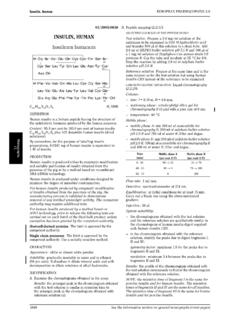
Transcription of HUMAN PLASMA FOR FRACTIONATION - …
1 EUROPEAN PHARMACOPOEIA PLASMA for fractionationwith a mixture of 19 volumes ofglacial acetic acid Rand81 volumes ofmethanol at 600 nm in an instrument having a linear responseover the range of measurement. Calculate the result as themean of 3 measurements of each suitability: in the electropherogram obtained withthe reference solution on cellulose acetate or on agarosegels, the proportion of protein in the principal band is withinthe limits stated in the leaflet accompanying the : in the electropherogram obtained with the testsolution on cellulose acetate or on agarose gels, not morethan 5 per cent of protein has a mobility different from thatof the principal band. This limit is not applicable if albuminhas been added to the preparation as a stabiliser; for suchpreparations, a test for protein composition is carried outduring manufacture before addition of the of molecular size. Liquid chromatography( ).Test solution.
2 Dilute the preparation to be examined witha9g/lsolutionofsodium chloride Rto a concentrationsuitable for the chromatographic system used. Aconcentration in the range of 4-12 g/l and injection of50-600 g of protein are usually immunoglobulin(molecular size) BRPwith a 9 g/l solution ofsodiumchloride Rto the same protein concentration as the : size:l= m, = mm, orl= , = ; stationary phase:hydrophilic silica gel forchromatography Rof a grade suitable for FRACTIONATION ofglobular proteins with relative molecular masses in therange 10 000 to 500 phase: dissolve g ofdisodium hydrogenphosphate dihydrate R, dihydrogenphosphate monohydrate R, chloride Rand 50 mg ofsodium azide Rin 1 litre ofwater : spectrophotometer at 280 the chromatogram obtained with the reference solution,the principal peak corresponds to the IgG monomer andthere is a peak corresponding to the dimer with a relativeretention to the principal peak of about Identifythe peaks in the chromatogram obtained with the testsolution by comparison with the chromatogram obtainedwith the reference solution.
3 Any peak with a retention timeshorter than that of the dimer corresponds to polymers : in the chromatogram obtained with the testsolution: relative retention: for the monomer and for the dimer,therelativeretentiontothecorrespon dingpeakinthechromatogram obtained with the reference solution is1 ; peak area: the sum of the peak areas of the monomer andthe dimer represent not less than 90 per cent of the totalarea of the chromatogram and the sum of the peak areasof polymers and aggregates represents not more than3 per cent of the total area of the chromatogram. Thisrequirement does not apply to products where albuminhas been added as a stabiliser; for products stabilised withalbumin, a test for distribution of molecular size is carriedout during manufacture before addition of the activity( ). The consumption ofcomplement is not greater than 50 per cent (1 CH50permilligram of immunoglobulin).Prekallikrein activator( ): maximum 35 IU/ml,calculated with reference to a dilution of the preparation tobe examined containing 30 g/l of and anti-B haemagglutinins( ).
4 Carry outthe tests for anti-A and anti-B haemagglutinins. If thepreparation to be examined contains more than 30 g/lof immunoglobulin, dilute to this concentration beforepreparing the dilutions to be used in the test. The 1 to 64dilutions do not show antibodies( ). It complies with the test foranti-D antibodies in HUMAN immunoglobulin for to hepatitis B surface antigen: IU/g of immunoglobulin, determined by a suitableimmunochemical method ( ).Water. Determined by a suitable method, such as thesemi-micro determination of water ( ), loss on drying( )ornearinfraredspectrophotometry( ), thewater content is within the limits approved by the ( ). It complies with the test for ( ). It complies with the test for per kilogram of the rabbit s mass a volume equivalentto g of immunoglobulin but not more than 10 ml perkilogram of body the liquid preparation, store in a colourless glasscontainer, protected from light, at the temperature statedon the label.
5 For the freeze-dried preparation, store in anairtight colourless glass container, protected from light, at atemperature not exceeding 25 label states: for liquid preparations, the volume of the preparation inthe container and the protein content expressed in gramsper litre; for freeze-dried preparations, the quantity of protein inthe container; the amount of immunoglobulin in the container; the route of administration; for freeze-dried preparations, the name or compositionand the volume of the reconstituting liquid to be added; the distribution of subclasses of immunoglobulin Gpresent in the preparation; where applicable, the amount of albumin added as astabiliser; the maximum content of immunoglobulin :0853 HUMAN PLASMA FORFRACTIONATIONP lasma humanum ad separationemDEFINITIONH uman PLASMA for FRACTIONATION is the liquid part of humanblood remaining after separation of the cellular elements fromblood collected in a receptacle containing an anticoagulant,GeneralNotices(1)applytoal lmonographsandothertexts2073 HUMAN PLASMA for fractionationEUROPEAN PHARMACOPOEIA separated by continuous filtration or centrifugationof anticoagulated blood in an apheresis procedure; it isintended for the manufacture of PLASMA -derived a carefully selected, healthy donor who, as far as canbe ascertained after medical examination, laboratory bloodtests and a study of the donor s medical history, is free fromdetectable agents of infection transmissible by PLASMA -derivedproducts may be used.
6 Recommendations in this fieldare made by the Council of Europe [RecommendationNo. R (95) 15 on the preparation, use and quality assuranceof blood components,or subsequent revision]; a directive ofthe European Union also deals with the matter:CommissionDirective 2004/33/EC of 22 March 2004 implementingDirective 2002/98/EC of the European Parliament and ofthe Council as regards certaintechnical requirements forblood and blood of donors. Immunisation of donors to obtainimmunoglobulins with specific activities may be carriedout when sufficient supplies of material of suitable qualitycannot be obtained from naturally immunised for such immunisations are formulatedby the World Health Organisation (Requirements for thecollection, processing and quality control of blood, bloodcomponents and PLASMA derivatives, WHO Technical ReportSeries, ,1994orsubsequentrevision).Records. Records of donors and donations made are kept insuch a way that, while maintaining the required degree ofconfidentiality concerning the donor s identity, the originofeachdonationinaplasmapoolandther esultsofthecorresponding acceptance procedures and laboratory testscan be tests.
7 Laboratory tests are carried out for eachdonation to detect the following viral markers:1. antibodies against humanimmunodeficiency virus 1(anti-HIV-1);2. antibodies against HUMAN immunodeficiency virus 2(anti-HIV-2);3. hepatitis B surface antigen (HBsAg);4. antibodies against hepatitis C virus (anti-HCV).Pending complete harmonisation of the laboratory tests tobe carried out, the competent authority may require that atest for alanine aminotransferase (ALT) also be carried test methods used are of suitable sensitivity andspecificity and comply with the regulations in force. If arepeat-reactive result is found in any of these tests, thedonation is not PLASMA UNITSThe PLASMA is prepared by a method that removes cells andcell debris as completely as possible. Whether preparedfrom whole blood or by plasmapheresis, the PLASMA isseparated from the cells by a method designed to preventthe introduction of micro-organisms. No antibacterial orantifungal agent is added to the PLASMA .
8 The containerscomply with the requirements for glass containers ( )or for plastic containers for blood and blood components( ). The containers are closed so as to prevent anypossibility of 2 or more units are pooled prior to freezing, the operationsare carried out using sterile connecting devices or underaseptic conditions and using containers that have notpreviously been obtained by plasmapheresis or from whole blood (afterseparation from cellular elements), PLASMA intended for therecovery of proteins that are labile in PLASMA is frozen within24 h of collection by cooling rapidly in conditions validatedto ensure that a temperature of 25 C or below is attainedat the core of each PLASMA unit within 12 h of placing in thefreezing obtained by plasmapheresis, PLASMA intended solelyfor the recovery of proteins that are not labile in PLASMA isfrozen by cooling rapidly in a chamber at 20 C or belowas soon as possible and at the latest within 24 h of obtained from whole blood, PLASMA intended solelyfor the recovery of proteins that are not labile in PLASMA isseparated from cellular elements and frozen in a chamber at 20 Corbelowassoonaspossibleandatthelatestwi thin72 h of is not intended that the determination of total proteinand factor VIII shown below be carried out on each unitof PLASMA .
9 They are rather given as guidelines for goodmanufacturing practice, the test for factor VIII beingrelevant for PLASMA intended for use in the preparation ofconcentrates of labile total protein content of a unit of PLASMA depends onthe serum protein content of the donor and the degree ofdilution inherent in the donation procedure. When plasmais obtained from a suitable donor and using the intendedproportion of anticoagulant solution, a total protein contentcomplying with the limit of 50 g/l is obtained. If a volumeof blood or PLASMA smaller than intended is collected intothe anticoagulant solution, the resulting PLASMA is notnecessarily unsuitable for pooling for FRACTIONATION . Theaim of good manufacturing practice must be to achieve theprescribed limit for all normal of factor VIII in the donation depends onthe collection procedure and the subsequent handlingof the blood and PLASMA . With good practice, IU/mlcan usually be achieved, but units of PLASMA with a loweractivity may still be suitable for use in the productionof coagulation factor concentrates.
10 The aim of goodmanufacturing practice is to conserve labile proteins asmuch as protein. Carry out the test using a pool of not fewerthan 10 units. Dilute the pool with a 9 g/l solution ofsodium chloride Rto obtain a solution containing about15 mg of protein in 2 ml. To ml of this solution in around-bottomed centrifuge tube add 2 ml of a 75 g/l solutionofsodium molybdate Rand 2 ml of a mixture of 1 volumeofnitrogen-free sulphuric acid Rand 30 volumes ofwater R. Shake, centrifuge for 5 min, decant the supernatantliquid and allow the inverted tube to drain on filter the nitrogen in the residue by the method ofsulphuric acid digestion ( ) protein content is not less than 50 VIII. Carry out the test using a pool of not fewer than10 units. Thaw the samples to be examined, if necessary,at 37 C. Carry out the assay of factor VIII ( ), usinga reference PLASMA calibrated against the InternationalStandard for HUMAN coagulation factor VIII in PLASMA .