Transcription of Identifying Anxiety-Igniting Thoughts
1 A printable tool for helping clients examine their Anxiety-Igniting ThoughtsCatherine Pittman, , HSPPC ommon Anxiety-Igniting Thoughts from the CortexTake some time to examine the cortex-based tendencies described on the following pages. We call them Anxiety-Igniting Thoughts because they have the potential to activate the amygdala. They could be a primary source of your anxiety. In the descriptions to follow, we will identify the potential sources of these different processes in the from Pittman & Karle s ( 2015) Rewire your Anxious BrainAdapted from Pittman & Karle s ( 2015) Rewire your Anxious BrainPessimismOne of the simplest ways that you can see the influence of your cortex is to consider, in general, the way that you view yourself, the world, or the future. When the cortex helps us to interpret our experiences and to make predictions about what is likely to happen in the future, our general perspective can have a strong impact.
2 Some people tend to be optimistic and expect the best, while others are more pessimistic and expect the worst. Optimism is the more common approach, and it also tends to result in less anxiety. If you tend to be pessimistic, you are likely to have increased anxiety. Furthermore, a pessimistic attitude can reduce your willingness to try to change your anxiety, since you don t expect success, even though changes may prove helpful. The following assessment will allow you to examine whether you tend to engage in negative, pessimistic AssessmentDirections: Check all statements that apply to you. Once complete, add up the number of checked boxes. r When I have an upcoming presentation or examination, I worry quite a bit and fear that I won t do I generally expect that if something can go wrong, it I m often convinced that my anxiety will never When I hear that something unexpected has happened to someone, I typically imagine that it is something I frequently prepare myself for negative events that I fear will occur, but which never If it weren t for bad luck, I wouldn t have any luck at Some people want to make the world a better place, but that seems pretty hopeless to Most people will let you down, so it s best not to expect too much.
3 Total Checked Responses If you agreed with many of these statements, you have a tendency to worry and will benefit from cortex-based interventions, including thought stopping, cognitive restructuring, distraction, and mindfulness. WorryWorry is a source of anxiety for many people, and the central difficulty for those with Generalized Anxiety Disorder. Worry can involve images or Thoughts . It is focused on problem-solving designed to plan responses to expected future difficulties. You may be a worrier, if you have a habit of frequently thinking about possible negative events that could occur. The following assessment will allow you to explore whether you tend to worry. Worry AssessmentDirections: Check the statements that you agree with.
4 Once complete, add up the number of checked boxes. r I am good at imagining all kinds of things that could go wrong in a specific I sometimes worry that my symptoms are the result of some medical illness that has not been diagnosed I know I tend to worry about trivial When I am busy (at work or at other activities), I don t have as much Even when things are going well, I seem to think about what could go I sometimes feel that, if I don t worry about a specific situation, something will surely go Even if there is a small possibility that something negative could have happened, I tend to dwell on that I have trouble falling asleep because of my Thoughts . Total Checked Responses If you agreed with many of these statements, you have a tendency to worry and will benefit from cortex-based interventions, including thought stopping, cognitive restructuring, distraction, and mindfulness.
5 Adapted from Pittman & Karle s ( 2015) Rewire your Anxious BrainAdapted from Pittman & Karle s ( 2015) Rewire your Anxious BrainObsessive ThinkingObsession or Holding on to Certain Thoughts or BehaviorsAnother way in which the cortex can increase your anxiety is when it won t let go of a certain idea or behavior. A person can feel compelled to think about something, or to carry out a certain behavior. When this happens, the individual feels preoccupied with a particular situation and can t stop thinking about it. With compulsions, someone might find that they repeatedly engaging in a specific behavior which gives them temporary relief, but which they feel they must perform over and over. If you find yourself preoccupied with certain Thoughts or compulsions and you have trouble getting past them, this is definitely a problem that arises from the cortex pathway.
6 The following assessment will allow you to identify difficulties with obsession or holding onto Thinking AssessmentDirections: Check all statements that apply to you. Once complete, add up the number of checked boxes. r I can spend a long time rehashing certain events in my When I forget to do something or I make some kind of mistake, it takes me a long time to come to terms with If a friend or relative disappoints me, it can take me months to get over being upset and return to a good relationship with the I can get very upset if I can t keep certain objects in order or good I can become preoccupied with arranging, counting, or evening up I need to repeatedly check on things in order to reduce my anxiety, either by checking with people or inspecting something, like my I tend to go over my mistakes or embarrassing moments in my mind, playing them over and Unpleasant Thoughts or images frequently come into my mind and I can t get them out.
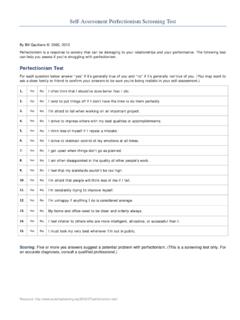
7 Total Checked Responses If you agreed with many of these statements, obsessive thinking may be a source of your anxiety, and you may benefit from thought stopping and distraction. Adapted from Pittman & Karle s ( 2015) Rewire your Anxious BrainAdapted from Pittman & Karle s ( 2015) Rewire your Anxious BrainPerfectionismPlacing unrealistically high standards on yourself or others is a sure way to increase your anxiety. Because none of us are capable of perfection, high standards have the effect of setting ourselves up for failure. Whether you learned perfectionistic expectations from your parents or whether you see them as a part of your own personality, these expectations are Anxiety-Igniting Thoughts .
8 perfectionism AssessmentDirections: Check below to see if you show signs of perfectionism . Once complete, add up the number of checked boxes. r I have high standards for myself, and usually hold myself to I usually have a right way to do something, and it is difficult to vary from that People consider me extremely conscientious and careful as a When I am wrong, I am very embarrassed and When others are watching me, I am concerned that I am going to humiliate I almost never perform at a level that I am satisfied I have a hard time letting go of mistakes I I feel I have to be hard on myself, or I won t be good enough. Total Checked Responses If you agreed with many of these statements you may have difficulties with perfectionism , and will benefit from cortex-based interventions, including cognitive restructuring and is the tendency to make our problems into catastrophes.
9 When you catastrophize, a small set back seems like a huge disaster. If you are a person who feels that your whole day is ruined if one specific thing goes wrong, you are catastrophizing. This cortex-based interpretation can result in a great deal of anxiety, but, once you recognize it, you can take steps to reduce it. Catastrophizing AssessmentDirections: Put a check next to any of the statements below that seems to describe you. Once complete, add up the number of checked boxes. r I often imagine the worst when I am thinking about how some situation might turn I can make a mountain out of a People would think I am going crazy if they knew the awful Thoughts that go through my I often feel as if I can t handle one more thing going When something doesn t turn out the way that I want it to, I find it difficult to I admit that I overreact to problems that others would not consider so much of a Even a small set back, like being stopped for a traffic light, can infuriate Sometimes what begins as a small doubt in my mind becomes an overwhelming, negative thought as I dwell on it.
10 Total Checked Responses If you agreed with many of these statements you have a tendency to catastrophize and will benefit from cortex-based interventions, including thought stopping, cognitive restructuring, and mindfulness. Adapted from Pittman & Karle s ( 2015) Rewire your Anxious BrainAdapted from Pittman & Karle s ( 2015) Rewire your Anxious BrainGuilt and ShameGuilt and shame are emotions that come from the frontal and temporal lobes. Whereas guilt involves a feeling that one has behaved in a way that one finds unacceptable, shame is related to feeling that other people will perceive you in a negative way. Both emotions are very anxiety-provoking. Guilt and Shame AssessmentDirections: Examine the following statements and check those you agree with.