Transcription of IDENTIFYING RISKS WHEN PRESCRIBING OPIOIDS
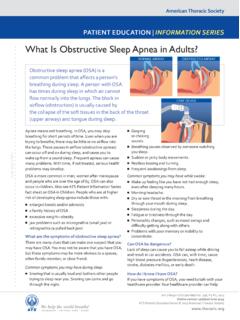
1 IDENTIFYING RISKS when PRESCRIBING OPIOIDS when deciding whether to initiate or continue opioid therapy, it is important to carefully weigh the potential benefts against the potential RISKS . This fact sheet contains information about some of the more commonly known RISKS that you should consider. Most of the information comes from the CDC Guideline for PRESCRIBING OPIOIDS for Chronic Pain, available on the CDC website. Other sources are also referenced as appropriate. WHO IS AT RISK? Patients with sleep -disordered breathing, including sleep apnea Pregnant women Patients with renal or hepatic insuffciency Patients aged >65 years Patients with mental health conditions Patients with substance use disorder Dowell D, Haegerich TM, Chou R. CDC Guideline for PRESCRIBING OPIOIDS for Patients with prior nonfatal overdose Chronic Pain United States, 2016.
2 MMWR Recomm Rep 2016;65(No. RR-1):1 49. DOI: STRATEGIES TO MITIGATE RISK AND PROMOTE PATIENT SAFETY Clinicians should consider the following strategies: 1. Offer naloxone to patients at risk of an opioid overdose. 2. Educate patients and household members on naloxone use and overdose prevention. 3. Remind patients to safeguard all medications and keep them out of reach, especially from children and vulnerable members of the household. ASSOCIATION BETWEEN RISK AND opioid DOSAGE AND TYPE There is a higher overdose risk when initiating treatment with extended-release/ long-acting OPIOIDS as compared to immediate-release OPIOIDS . [CDC Guideline, pg. 21] Risk increases with higher opioid dosage (>50 MME per day). ADVERSE CHILDHOOD EXPERIENCES AND OPIOIDS ? Adverse childhood experiences (ACEs) are traumatic events that occur during childhood.
3 While ACEs are not a direct risk for substance misuse, it is helpful to understand the impact that these experiences can have on adult physical and mental health so that you can recognize RISKS that might arise from them. For more information, refer to the November 2019 volume of CDC VitalSigns. Adverse Childhood Experiences (ACEs), Preventing early trauma to improve adult health (2019, November). Center for Disease Control Vital Signs. Department of Health and Human Services Centers for Disease Control and Prevention LEARN MORE RISK FACTORS AND RISKS OF opioid THERAPY RISK FACTORS RISKS OF opioid THERAPY sleep -disordered breathing, such as sleep apnea Decreased respiratory drive Worsening of central sleep apnea in obstructive sleep apnea patients Further desaturation in obstructive sleep apnea patients not on continuous positive airway pressure (CPAP) Pregnancy Effects on the mother: Preterm delivery or issues like growth restriction, abruptio placentae, preterm labor, arrhythmias, intrauterine passing of meconium Effects on the fetus.
4 Birth defects like neural tube defects, congenital heart defects, oral clefts, clubfoot, gastroschisis Neonatal abstinence syndrome/neonatal opioid withdrawal syndrome Stillbirth Renal or hepatic insufficiency Greater peak effect and longer duration of action of OPIOIDS , reducing the dose at which respiratory depression and overdose may occur. Age 65 or older Increased risk for falls and fractures Reduced renal function and medication clearance due to age can result in a smaller therapeutic window between safe dosages and dosages associated with respiratory depression and overdose. Mental health conditions Increased risk of opioid misuse, overdose, and/or opioid use disorder (OUD) Concurrent use of benzodiazepines and OPIOIDS may increase risk of potentially fatal overdose History of alcohol or substance use disorder Increased risk of opioid misuse, overdose, and/or OUD History of nonfatal overdose Increased risk of repeat overdose Increased risk of OUD LEARN MORE | MORE