Example: bankruptcy
IMPACT ASSESSMENT - INTRAC
the completion of a project or programme. These studies can make a better assessment of whether any changes were sustained after the project or programme finished. Another way of carrying out impact assessment is to investigate impact throughout a project or programme. This can be done by embedding questions on impact
Tags:
Information
Domain:
Source:
Link to this page:
Documents from same domain

Theory of Change - INTRAC
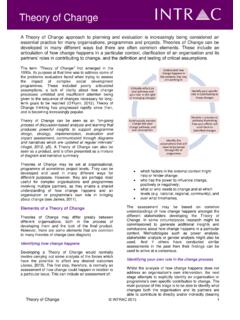
www.intrac.org1 1. The reality of change Theory of Change is nothing new. It is not just a donor fad or yet another hoop to jump through. It is an on-going process of reflection to explore change and how
Theory of Change - INTRAC
www.intrac.orgA Theory of Change approach to planning and evaluation is increasingly being considered an essential practice for many organisations, programmes and projects. Theories of Change can be
PARTICIPATORY LEARNING AND ACTION (PLA)
www.intrac.orgPLA was originally called Participatory Rural (or Rapid) Appraisal (PRA). It became very popular in the 1980s and 1990s, and has since kept its popularity with many CSOs. PRA was originally designed for use during appraisals and needs assessments in rural areas. However, it can be used at any stage of the project cycle – design, planning,
BASIC TOOLS FOR DATA COLLECTION - INTRAC
www.intrac.orgObservation: At its most simple, observation involves ‘seeing’ things – such as objects, processes, relationships, events – and formally recording the information. There are different types of observation. Structured or direct observation is a process in which observations are recorded against an agreed checklist.
Monitoring and Evaluation: New Developments and …
www.intrac.orgConference overview As development organisations, we are all finding ourselves placing a greater emphasis on measuring for results, on looking for evidence of impact, on justifying our effectiveness and on responding to a growing demand for accountability. Development organisations are continually experimenting with innovative

PROCESS TRACING
www.intrac.orgPROCESS TRACING . Process tracing is a qualitative analysis methodology. The main purpose of process tracing is to establish whether, and how, a potential cause or causes influenced a specified change or set of changes. This is done by applying formal tests to examine the strength of evidence linking potential causes to the changes.
QUANTITATIVE AND QUALITATIVE METHODS - INTRAC
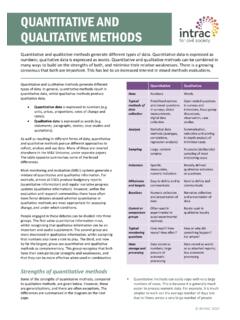
www.intrac.orgquantitative methods are seen as weaker, qualitative methods are seen as (relatively) stronger. Some of the main strengths of qualitative methods are listed below, and are summarised in the diagram above. As with the section on quantitative methods, these are general rules only, and there are often exceptions. Quantitative methods ...
SECONDARY DATA SOURCES - INTRAC
www.intrac.orgFurther papers in the M&E Universe explain other simple data collection tools and methods. To access these papers directly, click on the relevant links below. Author(s): INTRAC . Contributor(s): ... Interviews Focus group discussions Observation Photography and video Surveys and questionnaires Case studies and stories of change
QUALITATIVE COMPARATIVE ANALYSIS (QCA) - INTRAC
www.intrac.orgQualitative Comparative Analysis (QCA), developed by Charles Ragin in the 1970s, was originally developed as a research methodology. Lately, it has increasingly been applied within monitoring and evaluation (M&E). QCA is a methodology that enables the analysis of multiple cases in complex situations, and can help explain why change
THEORY OF CHANGE
www.intrac.orgTheories of Change can be developed in many ways. Common elements include ... stakeholder analysis or gender analysis might also be used. And if others have conducted similar assessments in the past then their findings can be used to arrive at a consensus.
Related documents
Student Engagement in Online Learning: What Works and Why
psychology.usu.eduTo ensure that online learning can help address these problems, professionals dedicated to online learning are under pressure to explore and evaluate strategies for getting students engaged in their online studies. These ... course completion rates were 3% lower than on-campus course completion rates (78% versus 81%). On the other hand, the ...

DESE/DPH Protocols for Responding to COVID-19 Scenarios ...
www.doe.mass.edueducational and public health communities, as well as cities and towns, work together to ensure as many children and adults as possible receive flu vaccines. This will reduce the number of students who need to stay home due to illness. Effective Monday, February 28, the DESE mask requirement was lifted statewide. Masking
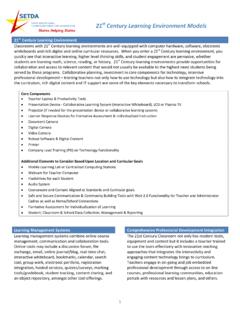
21st Century Learning Environment - ed
files.eric.ed.govensure students’ success in the 21st Century workplace and post‐secondary education. In another cluster, teachers receive the skills and knowledge necessary to implement technology in the classroom through Web‐ enhanced lessons, project‐based learning, and virtual field trips.

Guideline on the quality of Transdermal Patches
www.ema.europa.euenhancement strategies. A transdermal patch, which may also be considered a Transdermal Drug Delivery System ( TDDS), is defined as a flexible, multi -layered, pharmaceutical single dose preparation of varying size containing one or more active substances to be applied to the intact skin for systemic absorption . This is normally

Versant 4 Skills Essential Test - Official Test Guide
www.pearson.comcan use it to develop useful strategies for the test day. The test is divided into six parts based on the question types as shown in the table. Each part starts with instructions and a sample item. Each question is timed, and the total length of the test is approximately 30 minutes. As well as reading this guide, we recommend that you