Transcription of Improving your school’s Timetable
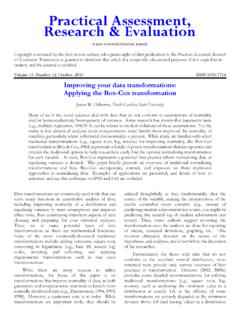
1 Page 1 of 7 Improving your school TimetableWhite PaperonImproving your school s TimetableAn effective Timetable is an essential feature of a good school . It controls (and supports, or inhibits) the school s activities, period by period for the school year. A school which does not take great care to get a quality Timetable , with a good rhythm to support the pedagogy, will be forever struggling Heads and Deputy Heads are often quick to see the fl aws in the school s curricular structure or in its Timetable . And perhaps the fl aws become clearer as time goes what s to be done about them? How to make changes successfully? How to keep all your colleagues informed, involved, and persuaded?
2 Will the change be to the Timetable cycle?And to the curriculum time allocated to the subjects as well?Or just to the curricular structure? More blocks or fewer? More setting or less?This white paper discusses these questions. It is intended to inform and guide you on some of the key decisions you will need to page 2 Changing the time-frame : what are the factors involved?page 4 Changing the Timetable cycle : Sharing out the timepage 5 Research on the effect of timetabling on studentspage 6 Keeping everyone on-side : informing colleaguespage 7 Managing change : Practical ways forward for the timetablerImproving your Timetable Date of this version: 22 January 2018 Always check for a later versionpage 2 of 7 Improving your school TimetableMore details at the time-frame : what are the factors involved ?
3 New Heads often bring change Change needs advance planning What are (valid) reasons for changes in the Timetable structure?The Law of Novelty : Quite often, about one year after the appointment of a new Head, there is a major change in the school s curricular often this involves a change of the time-frame (ie. changing the number of lessons in the week/fortnight or the length of lessons). For example, this may be necessary in order to align schools that are joining together in a consortium (eg. for the delivery of a range of 14-19 diplomas). Or there may be other reasons (see below).However, changing the Timetable cycle is not something to be undertaken lightly or in a hurry!
4 It is always best to plan for the September after next! Everyone needs to be consulted. Parents in particular may react angrily to your plans if the start/end times of schooling are the start-time or end-time is to be changed then the local bus/taxi companies will need to be consulted as well as parents. The local transport authority may not be able to cope if several schools are synchronised. If lunch time is to be moved then the caterers and lunch-time supervisors will need to be involved. Some extra-curricular activities may happen at lunch time and the new arrangements will possibly affect considering changes to the Timetable cycle (see items 1 - 5 below, and page 4) you should also take into account the adverse effect of long lessons on some subjects, see page 5.
5 Fewer periods per cycle (longer lessons) may reduce corridor traffi c but they usually have an detrimental effect on pedagogy and may adversely affect your exam reasons for changing the Timetable cycle Most often the change has been from a 1-week cycle to a 2-week cycle. Sometimes the the number of periods in the 2-week cycle is exactly double that of the one-week cycle, then:Scenario A is that the pattern of lessons in Week-1 is very different from Week-2,Scenario B is that Week-1 and Week-2 are almost identical,Scenario C is that the number of periods in the 2-week cycle is more or less than double the one-week cycle. 1. Pedagogical reason:Scenario A might be used to reduce the Friday afternoon is bad effect.
6 Instead of the same class having an uninspiring teacher on Friday afternoon every week, it is reduced to once a fortnight ..thus possibly Improving learning, and behaviour?(Monitoring absences for each class by odd / even Friday afternoons might show a pattern.)Also, to reduce the effect of public holidays if they tend to be the same day (eg. Mondays in the UK). 3 of 7 Improving your school TimetableMore details at Managerial reason:Same as 1, but intended to reduce staff grumbling about the same diffi cult class every Friday. It may improve staff morale. It may reduce staff absence. 3. Curricular reason:Scenario B (and scenario A) allow some time-slots to alternate (eg.)
7 Monday-period-3 is ICT in week-1, but Spanish in week-2).So it may be expanding the curricular experiences of the students, giving two subjects instead of one. 4. Managerial reason:As in (3) scenario B (and A) allows some time-slots to alternate (eg. ICT in week-1, Spanish in week-2). In effect this is giving a half-period of ICT to the class (by giving them one period per fortnight).Another example: 2 hours per week is too much for History (say) in KS3 and 1 hour per week is not enough, so we go for 3 (hour) lessons per this method is sometimes used when the robber-barons of the Heads of Department can t agree to give up any periods for a new or expanding subject, and the Head avoids a confrontation by this device (typically going from a 25-period-week to a 50-period-fortnight).
8 5. Managerial & curricular reasons:Scenario C is an extension of reason 4. If (for example) a 25-period week is changed to a 60-period fortnight, then the main reason for the change to a 2-week cycle may be to disguise that fact that the amount of curriculum-time for a subject often cannot remain the example, if Maths had 4 periods in a 25-period week (16%) then if it has double the number (8 periods) in a 2-week 60-period cycle its curriculum-time has been reduced (to ) ..or if it has 9 periods it has 15% .. also the next result is that no-one can have the same as before (so no department is being obviously singled out) and the Head can then adjust the balance of time in the direction s/he wants, and/or which is more appropriate to the students needs (if the staffi ng and their specialisms allow a change of direction like this).
9 Machiavellian? Or pragmatic?(As a further refi nement, a school already with a 50-period fortnight may change to a 60-period fortnight for the same reason.) Although it may be tempting to make a change in the time-frame, for any of the reasons above, the ultimate test is : Will it actually help the students? See also page structuresSee sections and in The Timetabler s CookBook for more about alternative discusses a non-rectangular week, with staggered starts and/or fi nishes, to allow greater utilisation of your resources (staffi ng and accommodation).Section discusses staggered lunch-breaks, and modular or grid 4 of 7 Improving your school TimetableMore details at the Timetable cycle : Sharing out the time Heads of Subjects (the robber-barons of the curriculum) need careful handling when their time allocations are changed, particularly if the time is reduced.
10 Professional discussions about the impact are needed and perhaps even counselling. As Head, if an Art teacher leaves, don t just assume that you need to appoint a new Art teacher; else your school can never change curricular direction. Instead, analyse the school s Staff Loading Chart for next year (see Section in The Timetabler s CookBook ).Sharing out the time:( ppw = periods per week, ppf = periods per fortnight)40 ppw 1 lesson = 60 ppf 1 lesson = ppw 1 lesson = 50 ppf 1 lesson = 2%30 ppw 1 lesson = ppw 1 lesson = 4%100 modules pw (eg. on a 15-minute grid) 1 module = 1%75 modules pw (eg. on a 20-minute grid) 1 module = effect of any changes:Of course when you change the timeframe, individual subjects gain or lose time in each year and may gain or lose time subjects are taught to small groups, others are taught to large.