Transcription of Insider Threat Webinar Transcript - CDSE
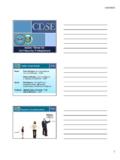
1 011614 Webinar Insider Threat Brief Today s conference is being recorded, if you have any objections you may disconnect at this time. The host for today s call is Mr. Peter DeCesare, thank you and you may begin. Pete: Good afternoon! Welcome to the CDSE Learn at Lunch Webinar . Today s topic is Insider Threat . I am Peter DeCesare, the Counterintelligence Curriculum Manager here at CDSE. Linda Adams is our production manager today. Linda please take a few minutes to explain how the DCO Webinar works. Linda: Thanks Pete! Before we get started let s take a tour of our DCO meeting room. In the bottom left hand corner that s marked with a green arrow here, you ll find a notes box. This lists the call in number and other announcements. If you are disconnected from the audio, this number will remain on screen for your reference. Also on the screen you ll see our notes regarding using full screen. If you look at the gray banner on top of your screen, you ll find the full screen option there.
2 However, when poll questions appear, select full screen again to return to normal view and respond to the polls. You ll find a file share box in the location indicated by the yellow arrow. Here if you select a file the save to my computer button will highlight and you can download this file which is the pdf of the slides to your computer. It s the same thing that was sent out earlier in your welcome email. You ll also find a Q&A box for entering questions to the presenters. This is marked here with a blue arrow and it s on the right side of the screen. To communicate with us, simply type your question into the box as shown. Any questions and answers that are not covered during the Webinar will be posted to the website. During this Webinar , we will be asking two types of poll questions. For open answer poll questions all you have to do is type your answer in the chat box that will appear on the right of the screen.
3 Don t forget to click the full screen again if you have been viewing in that mode, or you will not see the poll question. The other poll question will provide multiple choice answers for you to respond to and all you have to do is choose what you believe to be the best answer and we ll provide you feedback. Don t forget again to click on the full screen if you ve been viewing in that mode or you won t see the poll question. Okay Pete that about covers the technical part so back to you. Pete: Thank you Linda! Before we get started, please be aware that the video portion of this Webinar is being recorded. Once the red recording light appears, we will begin. The counterintelligence folks have been giving Threat briefings for years, advising the community about the foreign intelligence Threat and telling spy stories about some of our more infamous espionage cases from Benedict Arnold to John Walker, Rick Ames, Bob Hanson and many others.
4 Recently however, we have become more focused on the Insider Threat . Following the Ft. Hood shooting, Wiki Leaks, NSA s Whistle Blower Eric Snowden, and the most recent Navy Yard shooting, the community is feverously reacting to the Insider Threat . In November 2013, the President signed a memorandum which requires all agencies to establish an Insider Threat Program to help deter, detect and mitigate the potential Insider Threat to help protect our nation s classified information. In the near future, we expect a conforming change to the NISPOM which will also include language to incorporate Insider Threat program requirements for protecting classified information possessed within our cleared contractors. Our guest speaker today is Nicole Haager. Nicole has been an Intelligence Operations Specialist within the Counterespionage Division of the DSS CI Directorate for four years. A former Army CI Special Agent, Iraqi veteran, and investigator, Ms.
5 Haager has a vast experience as an Intelligence Operations Specialist, collector and analyst. Welcome Nicole! Nicole: Thank you Pete! Today we are going to discuss the Insider Threat . What is Insider Threat ? Why is the Insider Threat significant? How do you recognize the Insider Threat ? How can you help defeat the Insider Threat ? From a CI perspective, the Insider Threat is an employee with access to a classified or controlled environment who has the opportunity, capability, and intent to purposefully compromise sensitive information and/or materials for distribution to entities who pose a risk to the security interests of the United States. Next slide please! Linda: Okay Nicole, here s our first poll for everyone, this will be a fill in the blank. Question: Specifically what types of information are at risk due to Insider threats ? So you can just type into the blanks at the bottom of the chat box and we got some folks responding.
6 Oh great, we have classified and proprietary, intellectual property, everything, PII, sensitive information, CUI, SBU (I m not sure what that stands for), classified, classified PII, sensitive but unclassified, proprietary infrastructure, OPSEC, export control, loss of life, sensitive but unclassified (oh I see that is SBU, thank you), COMSEC, FOUO, PII classified export control. Okay we re starting to get some repeats here. COMSEC, ITAR, prep info, information technology, weapons, SBI. They re slowing down here, violence, unfortunate demise of life, network access, wow all kinds of things. Alright, so how did they do Nicole? Nicole: And I believe that everyone is pretty much hit on everything we have here on the slide. Now the Threat posed by Insider activity in support of foreign powers, criminal enterprises, and terrorist groups has the potential to endanger lives, compromise resources, and significantly diminish our capacity to effectively execute our mission.
7 So, as you can see Insider Threat has a substantial impact on National Security and industry. Next slide please! Globalization poses new challenges with the increase of dual or multiple citizenships and country of origin cards which allow persons to travel to issuing country without first obtaining a visa. This, unfortunately, could result in diluted or conflicting allegiances. Next slide please! However changing business environment definitely affects the Threat of Insider activity with layoffs and downsizing, furloughs, sequestration, transferring jobs overseas, all of which could contribute to our workforce losing obligations of loyalty in the workforce, which may in turn diminish the expectation of loyalties to the nation. Next slide please! Industry has increasingly become more vulnerable to Insider threats due to the increased access to sensitive information. Snowden and Manning are excellent examples of cases where, maybe their access should have been restricted to the programs or duties for which they were assigned.
8 Also frequent travel, conflicting national loyalties, the vulnerabilities created by all of these trends increase the risk of Insider Activity. Next slide please! Linda: Alright here we have our next poll Nicole. Question: What are some of the more common PEIs or Potential Espionage Indicators? Let me grab the chat box over here so everyone can give us your answers, we ve got some responses coming in. Let s see we have security violations, late night working, odd hours, working late, lots of foreign travel, after hours, bad economic status, foreign travel, extra hours, dual citizenship, inappropriate excessive questions, increase of financial obligations, financial trouble, unannounced foreign travel, gambling problems, (we didn t see that one this morning), extra money travel, weird hours, repeated security violations, requesting access to a program, request for greater access, late hours, affluent odd hours, divorce, high risk, unexplained increase in money, excessive time off, alcoholism, international web activity.
9 We got some different ones this afternoon. Alright let s see how they did. And our next slide says: Exploitable behavior, we didn t see that this morning that was good to see this time around and I believe we re all familiar with the list of PEIs that are commonly noticeable in cases where a trusted employee has engaged in espionage. I would like to add to this list undue affluence, disgruntlement, mental instability, and another that I will explain bit and I think that while one person did touch on this a bit, when with the absence of financial hardships when in certain situations you might expect for a person to have some sort of financial problems for example: A person who s going through a divorce, and maybe paying for a separate home, child support, spousal support etc, and that person never seems to complain about their finances. Instead it s business as usual or maybe they re still spending money or buying another car, so those could also be indicators.
10 Not to say that every person who exhibits one or more of these indicators is involved with illicit behavior, but most of the persons who have been involved in Insider activity in the past were later found to have displayed at least some of these indicators although their former co workers and supervisors rarely felt compelled to report this behavior to the proper authorities. Next slide please! Linda: Alright our next poll is to ask the folks if they can define Anomaly? And here s your chat box so let s see what we get. We get deviation, exception, oddity, something unusual, strange occurrence, out of the ordinary, something odd or out of place, abnormal, when a foreign company has access to something they shouldn t have, different from the norm, not the standard, (this group is hitting the nail on the head), bizarre, variance, questionable (that s a good one too). Alright I ll leave that there for second and come over here.