Transcription of INSTRUCTIONS TO LEARN HOW TO USE A LATHE
1 INSTRUCTIONS TO LEARN HOW TO USE A LATHE The LATHE is a machine tool used principally for shaping pieces of metal (and sometimes wood or other materials) by causing the workpiece to be held and rotated by the LATHE while a tool bit is advanced into the work causing the cutting action. The basic LATHE that was designed to cut cylindrical metal stock has been developed further to produce screw threads, tapered work, drilled holes, knurled surfaces, and crankshafts. Modern lathes offer a variety of rotating speeds and a means to manually and automatically move the cutting tool into the workpiece.
2 Machinists and maintenance shop personnel must be thoroughly familiar with the LATHE and its operations to accomplish the repair and fabrication of needed parts. TYPES OF LATHES Lathes can be divided into three types for easy identification: engine LATHE , turret LATHE , and special purpose lathes. Some smaller ones are bench mounted and semi-portable. The larger lathes are floor mounted and may require special transportation if they must be moved. Field and maintenance shops generally use a LATHE that can be adapted to many operations and that is not too large to be moved from one work site to another.
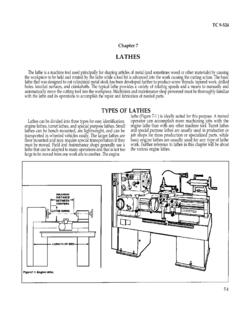
3 The engine LATHE (Figure 7-1) is ideally suited for this purpose. A trained operator can accomplish more machining jobs with the engine LATHE than with any other machine tool. Turret lathes and special purpose lathes are usually used in production or job shops for mass production or specialized parts, while basic engine lathes are usually used for any type of LATHE work. Further reference to lathes in this chapter will be about the various engine lathes. ENGINE LATHES Sizes The size of an engine LATHE is determined by the largest piece of stock that can be machined.
4 Before machining a workpiece, the following measurements must be considered: the diameter of the work that will swing over the bed and the length between LATHE centers (Figure 7-1). Categories Slight differences in the various engine lathes make it easy to group them into three categories: lightweight bench engine lathes, precision tool room lathes, and gap lathes, which are also known as extension-type lathes. These LATHE categories are shown in Figure 7-2 Different manufacturers may use different LATHE categories.
5 Lightweight Lightweight bench engine lathes are generally small lathes with a swing of 10 inches or less, mounted to a bench or table top. These lathes can accomplish most machining jobs, but may be limited due to the size of the material that can be turned. Precision Precision tool room lathes are also known as standard manufacturing lathes and are used for all LATHE operations, such as turning, boring, drilling, reaming, producing screw threads, taper turning, knurling, and radius forming, and can be adapted for special milling operations with the appropriate fixture.
6 This type of LATHE can handle workpieces up to 25 inches in diameter and up to 200 inches long. However, the general size is about a 15-inch swing with 36 to 48 inches between centers. Many tool room lathes are used for special tool and die production due to the high accuracy of the machine. GAP OR EXTENSION-TYPE LATHES Gap or extension-type lathes are similar to toolroom lathes except that gap lathes can be adjusted to machine larger diameter and longer workpieces The operator can increase the swing by moving the bed a distance from the headstock, which is usually one or two feet.
7 By sliding the bed away from the headstock, the gap LATHE can be used to turn very long workpieces between centers. LATHE COMPONENTS Engine lathes all have the same general functional parts, even though the specific location or shape of a certain part may differ from one manufacturer The bed is the foundation of the working parts of the LATHE to another (Figure 7-3). The main feature of its construction are the ways which are formed on its upper surface and run the full length of the bed. Ways provide the means for holding the tailstock and carriage, which slide along the ways, in alignment with the permanently attached headstock The headstock is located on the operator's left end of the LATHE bed.
8 It contains the main spindle and oil reservoir and the gearing mechanism for obtaining various spindle speeds and for transmitting power to the feeding and threading mechanism. The headstock mechanism is driven by an electric motor connected either to a belt or pulley system or to a geared system. The main spindle is mounted on bearings in the headstock and is hardened and specially ground to fit different LATHE holding devices. The spindle has a hole through its entire length to accommodate long workpieces.
9 The hole in the nose of the spindle usually has a standard Morse taper which varies with the size of the LATHE . Centers, collets, drill chucks, tapered shank drills and reamers may be inserted into the spindle. Chucks, drive plates, and faceplates may be screwed onto the spindle or clamped onto the spindle nose. The tailstock is located on the opposite end of the LATHE from the headstock. It supports one end of the work when machining between centers, supports long pieces held in the chuck, and holds various forms of cutting tools, such as drills, reamers, and taps.
10 The tailstock is mounted on the ways and is designed to be clamped at any point along the ways. It has a sliding spindle that is operated by a hand wheel and clamped in position by means of a spindle clamp. The tailstock may be adjusted laterally (toward or away from the operator) by adjusting screws. It should be unclamped from the ways before any lateral adjustments are made, as this will allow the tailstock to be moved freely and prevent damage to the lateral adjustment screws. The carriage includes the apron, saddle, compound rest, cross slide, tool post, and the cutting tool.