Transcription of International Baccalaureate Diploma Programme Options …
1 1 Revised: Jan 31, 2018 International School of Tanganyika____ Secondary School _____ International Baccalaureate Diploma Programme Options 2018-20 _____ 2 Revised: Jan 31, 2018 Dear Parents and Students I would like to welcome you to the 2018-2019 IB Diploma and Courses Options book. If you are considering joining the International Baccalaureate Programme here at IST, reading this first is the best starting point. The school has offered this Programme for many years and we find that it is an excellent preparation for courses at universities and colleges all over the world in a wide variety of subject areas. We believe it is the best preparation for those who are moving onto further education, and that the Programme produces young adults with a broad academic base, enquiring minds and diverse social interests. The Diploma allows for the study of 6 subjects with 3 at higher level and 3 at standard level in 6 group areas.
2 They should choose, to the extent possible, higher level subjects (3) that they are passionate about, and perhaps even aim to study at university level. This booklet will give you some information to help you choose the best Options for your IB Diploma . Students have left IST to continue their education at places such as the University of Cambridge, the London School of Economics, Princeton, Yale, MIT and McGill. I hope the following pages will give you the information you require, but if they do not, please do not hesitate to contact me. Yours faithfully, Jeremy George IB Diploma Coordinator 3 Revised: Jan 31, 2018 Contents Why the International Baccalaureate Diploma Programme ? 4 Teaching and Learning Philosophy at IST 6 the ib DP Programme at IST 6 Entry Requirements for IB Diploma and Courses Programmes at IST 7 Diplomas, Certificates and College/University transcripts 8 The Academic Subjects 9 The Extended Essay 10 Theory of Knowledge 10 CAS 11 Personal and Social Education 11 The Academic Subjects in Detail Group 1: English A Literature, English A Language and Literature, 12 Swahili A Literature, School Supported Self Taught Literature SL only Group 2: Language Acquisition: choosing an appropriate 15 level of challenge Group 2: Language B, Language ab initio 16 Group 3: Economics, Geography, History, Psychology 18 Group 4: Environmental Systems and Society, Physics, 23 Chemistry, Biology, Design Technology Group 5.
3 Mathematical Studies SL, Mathematics SL, Mathematics HL 28 Group 6: Visual Arts, Theatre, Music 31 Deadlines for changing between subjects and levels 36 4 Revised: Jan 31, 2018 Why the International Baccalaureate Diploma Programme ? We teach the IBDP Programme because we believe in its mission statement: the ib Programme aims to develop inquiring, knowledgeable and caring young people who help to create a better and more peaceful world through intercultural understanding and respect. To this end the IBO works with schools, governments and International organizations to develop challenging programmes of International education and rigorous assessments. These programmes encourage students across the world to become active, compassionate and lifelong learners who understand that other people with their differences can also be right . (IBO Mission Statement) Furthermore IST aims to develop in its students the qualities listed in the ib Learner Profile: IB Learner Profile The aim of all IB programmes is to develop internationally minded people who, recognizing their common humanity and shared guardianship of the planet help to create a better and more peaceful world.
4 As IB learners, we strive to be: Inquirers: We nurture our curiosity, developing skills for inquiry and research. We know how to learn independently and with others. We learn with enthusiasm and sustain our love of learning throughout life. Knowledgeable: We develop and use conceptual understanding, exploring knowledge across a range of disciplines. We engage with issues and ideas that have local and global significance. Thinkers: We use critical and creative thinking skills to analyse and take responsible action on complex problems. We exercise initiative in making reasoned, ethical decisions. Communicators: We express ourselves confidently and creatively in more than one language and in many ways. We collaborate effectively, listening carefully to the perspectives of other individuals and groups. Principled: We act with integrity and honesty, with a strong sense of fairness and justice, and with respect for the dignity and rights of people everywhere.
5 We take responsibility for our actions and their consequences. 5 Revised: Jan 31, 2018 Open-minded: We critically appreciate our own cultures and personal histories, as well as the values and traditions of others. We seek and evaluate a range of points of view, and we are willing to grow from the experience. Caring: We show empathy, compassion and respect. We have a commitment to service, and we act to make a positive difference in the lives of others and in the world around us. Risk-takers: We approach uncertainty with forethought and determination; we work independently and cooperatively to explore new ideas and innovative strategies. We are resourceful and resilient in the face of challenges and change. Balanced: We understand the importance of balancing different aspects of our lives intellectual, physical and emotional to achieve well-being for ourselves and others. We recognize our interdependence with other people and with the world in which we live.
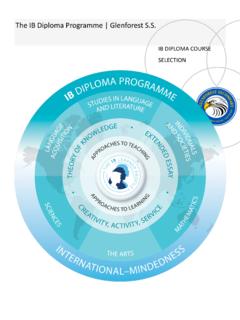
6 Reflective: We thoughtfully consider the world and our own ideas and experience. We work to understand our strengths and weaknesses in order to support our learning and personal development. the ib learner profile represents 10 attributes valued by IB World Schools. We believe these attributes, and others like them, can help people become responsible members of local, national and global communities. At IST we believe in the breadth of the ib Diploma Programme , seen in the Diploma model below. These subjects in the circle are explained in greater detail later on. Central to the Programme are Approaches to Teaching and Learning, highlighting the ib s aim of pedagogical excellence and a desire to instil a passion of lifelong learning, Theory of Knowledge (TOK) which challenges students to reflect critically on diverse ways of knowing and areas of knowledge, and to consider the role knowledge plays in a global society; CAS - Creativity, Action, Service - which encourages students to develop those elements; and the extended essay, a piece of original research on a topic of interest.
7 6 Revised: Jan 31, 2018 Teaching and Learning Philosophy at IST Effective learning Student learning is the highest priority at IST. The most effective learning happens in a context in which students feel understood, safe and confident. Teaching and learning at IST follows a constructivist approach, where students actively shape their understanding in interaction with teachers and peers. Effective learning requires students to be engaged, motivated and inspired by their teachers, peers and environment, as well as intrinsically. Motivation increases when students have choice and control over their learning in authentic contexts. Students must master core skills and acquire substantive knowledge, which are necessary for the active, critical, and inquiry-based learning we value. Students learn more effectively when teachers actively promote a growth mindset, purposefully fostering perseverance, practice and hard work in their students.
8 Challenge and support IST believes that support and challenge maximise the potential of each individual student. All students are capable of making educational progress when they are appropriately supported and challenged. Therefore teachers at IST challenge students to continuously grow in their understanding and skills. 7 Revised: Jan 31, 2018 IST supports a diverse range of learning needs, as students come to us with various levels of readiness, learning support needs and interests. Working with diverse classmates enriches our students education and prepares them for life. It is vital that all students receive prompt, clear feedback about their performance, with a focus on how to improve. It is also essential that students have ongoing opportunities to communicate their experience of the teaching and learning process to their teachers. International -mindedness Teaching and learning at IST promote International -mindedness by aiming to develop students sense of identity as global as well as national citizens.
9 The curriculum contributes to this by stimulating students curiosity about the world and commitment to solving its problems. Students benefit from working with classmates and teachers from diverse cultural backgrounds. Curriculum To implement this teaching and learning philosophy, IST follows IB curriculum programmes in the Elementary and Secondary years, as defined by the International Baccalaureate Organisation. The curriculum is balanced and holistic, providing varied opportunities for students to learn and demonstrate their learning. It enables students to gain understanding and skills in ways that are disciplinary, trans-disciplinary and interdisciplinary. It encourages students to be reflective and to act upon their learning. the ib DP Programme at IST The two years leading to graduation at IST are based primarily on courses leading to the ib Diploma exams. Students entering grade 11 will be expected to enrol in six courses in addition to Theory of Knowledge (if on the full Diploma ) and Personal and Social Education (PSE).
10 These courses will be selected from offerings in Groups 1 to 6. All students must also participate in the school s CAS Programme . Diploma students take 3 subjects at higher level, 3 subjects at standard level, and do an Extended Essay. On a case by case basis, students may be advised to take an IB Courses program that may involve some selected courses at HL and could also include the writing and submission of an extended essay. IB Courses students are expected to follow the CAS program and TOK. Course selection at this stage in a student s life entails important decisions and should be made in consultation with parents, teachers and the counsellors. These choices must take into account each student s: long-term education and career goals demonstrated skills and strengths current interests It is the responsibility of each student and their parents to ensure that subjects chosen match the entry requirements of individual universities for which the student may apply at a later stage.