Transcription of Intravenous Fluid Guidelines: Adults
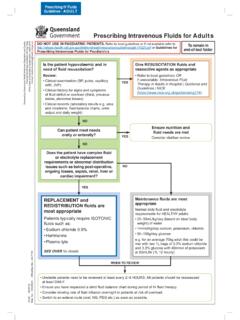
1 Intravenous Fluid guidelines : Adults Before Prescribing Is my patient Euvolaemic? Hypovolaemic? Hypervolaemic? Can my patient have Fluid enterally? Why does my patient need IV fluids? How much Fluid does my patient need? What type of Fluid does my patient need? Fluid Status Assessment History: Limited oral intake, abnormal losses, co-morbidities Clinical examination: Pulse, BP, capillary refill, JVP, oedema, postural hypotension, lung fields Clinical monitoring: NEWS, Fluid balance, weight, CXR Laboratory investigations: FBC, U&Es Special Considerations Obesity: Use ideal body weight. Seek senior advice if BMI>40 Frail, Elderly, CCF or Renal impairment: consider smaller volumes of maintenance Fluid (20-25mL/kg/day) Bleeding: Replace with blood products if required Diabetes or patient on VRII Routine Maintenance The Fluid of choice for patients unable to take enteral fluids but with no abnormal losses is: Sodium Chloride + Dextrose 4% + 20-40mmol/Litre of Potassium Chloride.
2 Omit the potassium if the patient is hyperkalaemic. Sodium Chloride + Dextrose 4% is not suitable for hyponatraemic patients, neurosurgical patients or patients with high GI losses. Use Sodium Chloride or Hartmann s for these patients. Maintenance Requirements Avoid more than 2500mL of Sodium Chloride + Dextrose 4% per day as this may cause hyponatraemia. If the patient requires a larger volume than this, refer to Fluid Resuscitation or Replacement & Redistribution. Plan to deliver the daily routine maintenance volume over 12 to 16 hours. Component Requirement Water 25-30mL/kg/day 20-25mL/kg/day in the elderly, frail, or those with CCF or renal impairment.
3 Round the daily requirement to the nearest 500mL bag. Na+, K+ and Cl- 1mmol/kg/day of each Glucose 50 100g/day Fluid (1 Litre) Na K Cl Ca Glucose NaCl + Dextrose 4% + KCl 40mmol 31 40 71 0 40g NaCl + Dextrose 4% 31 0 31 0 40g Hartmann s 131 5 111 2 0 NaCl 154 0 154 0 0 Dextrose 5% 0 0 0 0 50g Based on NICE Clinical Guideline 174: Intravenous Fluid therapy in Adults in hospital (July2017) Fluid Resuscitation Patients with physiological abnormalities due to presumed hypovolaemia/abnormal distribution of Fluid Refer to resuscitation flow chart. ABCDE approach. Early senior input Give 500mL sodium chloride or Hartmann s over 15 mins (250mL if CCF/IHD/elderly) Re-assess Repeat as indicated up to 2 Litres (1 Litre if CCF/IHD) Seek advice from Critical Care if the patient has not responded to a maximum of 2 Litres of Fluid on the ward Replacement & Redistribution Patients with ongoing losses or abnormal distribution of fluids ( vomiting, diarrhoea, high output stoma, sepsis) Give sodium chloride (+/- KCl)
4 Or Hartmann s in addition to routine maintenance fluids Adjust rate of IV fluids for current and ongoing deficits Seek senior advice for complex patients Reassessment Reassess patients regularly and adjust the Fluid prescription as required. Seek senior advice if a patient is not responding to IV fluids as expected. Stop routine maintenance fluids when the enteral route is available.