Transcription of Intravenous Medicine Administration
1 Intravenous Medicine AdministrationSelf-directed Learning PackageMargaret A. ConnollyKatherine Hill Lynne RobertsonDebbie ThompsonPinky VirhiaFirst published August 2007 Revised July 2014 For review July 2016 Contribution by Christina Ronyane Practice Development Department, NHS Greater Glasgow and Clyde 2014. All rights reserved. No part of this document may be reproduced, stored in a retrieval system or transmitted in any form or by any means electronic, mechanical, photocopying,recording or otherwise without the prior permission of Practice Development Department, NHS GG&C. Practice Development DepartmentAcute Services DivisionAcknowledgement of sources of illustrationsFigure 1 page 7 Yellow Card Reproduced with the kind permission of the MHRA. Figure 2 page 9 Peripheral venous access.
2 Reproduced with the kind permission of Smith and 3 page 10 Midline. Images provided by Vygon (UK) Ltd Vygon (UK) Ltd 4 page 10 Peripherally inserted central catheter. Provided by Vygon (UK) Ltd - Vygon (UK) Ltd 5 page 10 Non Skin Tunnelled Central Line. Reproduced with the kind permission of Smith and 6 page 11 Skin Tunnelled central venous access. Provided by Vygon (UK) Ltd - Vygon (UK) Ltd 7 page 11 Indwelling Central Venous Access Device. Provided by Vygon (UK) Ltd - Vygon (UK) Ltd 10 page 19 anaphylaxis algorithm - Reproduced with the kind permission of the Resuscitation Council (UK).Practice Development Department. Adult Intravenous Medicine Administration Workbook 1 ContentsPrerequisites for undertaking the IV Medicine Administration course.
3 2 Aims ..2 Learning Objectives ..2 Introduction .. Legal Aspects .. Competence .. Checking of Intravenous medication .. Clinical incident Adverse Medicine reaction reporting ..72. Advantages and ..83. Nursing care .. Access Devices.. Peripheral Intravenous Devices .. PICC (peripherally inserted central catheter) .. Non-Skin Tunnelled Central Venous Access Device .. Skin tunnelled central venous access devices (Hickman Lines) .. Indwelling Central Venous Access Devices ..115 Methods of Administering Intravenous Medications .. Bolus Administration .. Intermittent Intravenous infusion.. Continuous Intravenous infusion.. Fluid Balance ..136. Sources of Information ..147. Mechanical Infusion Devices ..148. Complications of Intravenous Medicine Administration .. Infiltration / Extravasation.
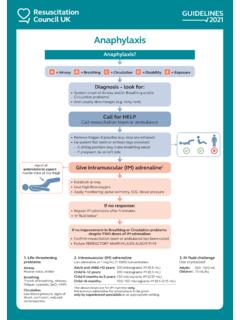
4 Infection .. Emboli .. Insufficient Mixing .. anaphylaxis ..189. Stability of Medicines in Solution ..2010. Interaction of medicines with the syringe / bag ..20 SELF Basic Calculations - A Quick Reference Guide ..23 SECTION 1: UNITS AND EQUIVALENCES ..24 SECTION 2: CALCULATING DOSE AS VOLUME ..27 SECTION 3: Medicine STRENGTHS AND STATED CONCENTRATIONS ..30 SECTION 4: DURATION OF INFUSION ..32 SECTION 5: INFUSION RATE CALCULATIONS ..34 Practice Questions ..36 Mock Test ..37 Answers to Practice Questions ..39 REFERENCES ..40 Other Useful Resources ..412 Practice Development Department. Adult Intravenous Medicine Administration WorkbookNB For the purposes of this document the term nurses will be taken to mean registered nurses (adult), registered nurses (children), registered nurses (mental health), registered midwives, medical technical officers (MTO) and operating department practitioners (ODP).
5 Pre-requisites for undertaking the IV Medicine Administration course:1. All candidates must be registered general nurses, registered midwives, MTOs or ODPs currently working in a clinical area. They should also have at least 6 months post qualification experience and be nominated by their clinical manager. 2. Prior to attending the study day, candidates must have appropriate support available for assessment and completion of 3 month period of supervised Each candidate must work in an area where there is a clinical need for this skill, and it is integral to their role. 4. This self directed learning package must be completed as the candidate will be tested on its contents during the study day. Criteria for competence in this skill1. Attendance at a recognised NHS study day in the United Kingdom or completion of an E-Learning package which involves: Successfully demonstrating numeracy skills by achieving 100% pass in a Medicine calculation test Undertaking a period of supervised practice leading to verification of competency by Senior Charge Nurse/ Midwife, team leader or agreed deputy Receipt of a certificate of competence by Corporate Practice Development Department NHSGG&C2.
6 Thereafter the nurse will be responsible for maintaining, updating and reviewing his/her Intravenous Medicine Administration skills (NMC The Code 2008. HPC Standards of conduct, performance and ethics 2012). It is imperative that candidates complete the pre-course workbook prior to attending the study Aims To prepare individual practitioners to competently administer medication via the Intravenous route. To ensure the application of evidence-based practice in developing the individual practitioners role in the Administration of Intravenous therapy. Learning ObjectivesFollowing attendance at a NHS GG&C IV Medicine Administration study day and a period of supervised practice, the practitioner will be able to:1. Demonstrate awareness of the resources available to increase knowledge of Intravenous (IV) therapies (medusa, BNFC, BNF, IV Medicine monographs, Medicine compendium).
7 2. Define the registered practitioner s legal and professional responsibilities in the checking, preparation and Administration of IV therapies. 3. Identify national and local policies in relation to IV therapy. 4. Demonstrate the ability to accurately complete necessary mathematical calculations prior to preparation of IV therapy. 5. Identify the advantages and disadvantages of choosing the IV route of Administration . 6. Identify the advantages and disadvantages of peripheral and central IV access devices. 7. Define the steps required to check, prepare and administer medications for IV Administration including equipment required. 8. Critically analyse the potential complications associated with IV therapy and discuss appropriate actions to prevent and/or treat these complications.
8 9. Identify issues surrounding stability and compatibility of IV therapies. 10. Demonstrate the safe handling of equipment used in IV therapy, needles, syringes, ampoules, vials, Administration sets and infusion devices. 11. Describe the procedure for reporting incidents and accidents involving self, patient and others12. Describe the essential maintenance of equipment used in IV therapy. Practice Development Department. Adult Intravenous Medicine Administration Workbook 3 IntroductionIntravenous Medicine Administration is the Administration of sterile preparations of medicines directly into a vein, via a peripheral or central line, for therapeutic reasons ( 2007). Historically this was a role undertaken by medical practitioners, however the nurses role has evolved significantly and the NMC / HPC are supportive of practitioners who seek to expand their scope of practice.
9 The conditions for expanding the scope of professional practice include adequate training and supervision to ensure competence in practice (NMC 2009).Before carrying out an expanded role the practitioner should always ask: Will patient care be improved? Are the essential values of nursing and midwifery protected? Are you competent to fulfil the role? Do you have managerial support? If you answer No to any of these questions, there may be a risk to patient care and to your professional Practice Development Department. Adult Intravenous Medicine Administration Workbook1. Legal CompetenceAt present the Administration of Intravenous medication is considered an extended role of the nurse. Competence in this skill is achieved by attending a study day, successfully passing a calculations test and completing a period of supervised competency 1In your place of work what systems are in place to ensure the competence of practitioners with Administration of Intravenous medicines?
10 List the main areas of the health care professional s accountability in relation to the Administration of IV Development Department. Adult Intravenous Medicine Administration Workbook Checking of Intravenous medicationAt present in NHS Greater Glasgow and Clyde all Intravenous medications are required to be checked by 2 registered practitioners prior to Administration . Ideally both practitioners would be competent in Intravenous Medicine Administration ; however, in practice, this is often not possible. Both individuals checking the medication should be aware of its use, side effects, recommended route and method of Administration prior to the Administration of the must be either:Two registered nurses band 5 or above and one must be competent in performing such a skill OR One registered nurse/ band 5 or above competent in performing such a task to administer and a doctor or pharmacist to check OROne doctor to administer and a registered nurse band 5 or above / pharmacist to check.