Example: marketing
Introduction to Graphs: Breadth-First, Depth-First Search ...
Introduction to Graphs: Breadth-First, Depth-First Search, Topological Sort Chapter 23 Graphs So far we have examined trees in detail. Trees are a specific instance of a construct called a graph. In general, a graph is composed of edges E and vertices V that link the nodes together.
Tags:
Information
Domain:
Source:
Link to this page:
Documents from same domain

Introduction to Database Systems - math.uaa.alaska.edu
www.math.uaa.alaska.edu10/19/2009 1 Introduction to Database Systems Introduction to Database Systems •So, what is a database, anyway? •An integrated, self-describing collection of

Creating Windows Forms Applications with Visual Studio …
www.math.uaa.alaska.eduCreating Windows Forms Applications with Visual Studio and C# CSCE A331 Visual Studio on a Windows platform gives you a multitude of classes to easily create

Random Number Generation C++
www.math.uaa.alaska.eduRandom Number Generation C++ It is often useful to generate random numbers to produce simulations or games (or homework problems :) One way to generate these numbers in …

Random Number Generation C++ - math.uaa.alaska.edu
www.math.uaa.alaska.eduRandom Number Generation C++ It is often useful to generate random numbers to produce simulations or games (or homework problems :) One way to generate these numbers in …

IEEE Recommended Practice For Software Requirements Speci ...
www.math.uaa.alaska.eduL. M. Gunther David A. Gustafson Jon D. Hagar John Harauz Robert T. Harley Herbert Hecht William Heßey Manfred Hein Mark Heinrich Mark Henley Debra Herrmann John W. Horch Jerry Huller Peter L. Hung George Jackelen Frank V. Jorgensen William S. Junk George X. Kambic Richard Karcich Ron S. Kenett Judith S. Kerner Robert J. Kierzyk Dwayne L ...

Derivation of the Inverse Hyperbolic Trig Functions
www.math.uaa.alaska.eduDerivation of the Inverse Hyperbolic Trig Functions y =sinh−1 x. By definition of an inverse function, we want a function that satisfies the condition x =sinhy e y−e− 2
Standard Template Library and the Java Collections Classes
www.math.uaa.alaska.eduJava Collections Java has a collections framework that is similar to the Standard Template Library, but does make inheritance and polymorphism a larger component of the library. There are several classes in the library; here is an overview: There are some methods that every class implements in the Collections framework. This is kind of nice

VSOLW XS LQWR WZR ILOHV 7KH LPSOHPHQWDWLRQ LV …
www.math.uaa.alaska.edu& 6hsdudwh +hdghu dqg ,psohphqwdwlrq )lohv & fodvvhv dqg riwhq ixqfwlrq surwrw\shv duh qrupdoo\ vsolw xs lqwr wzr ilohv 7kh khdghu iloh kdv wkh h[whqvlrq ri k dqg frqwdlqv fodvv ghilqlwlrqv dqg ixqfwlrqv 7kh

Integrating an Absolute Value - University of Alaska system
www.math.uaa.alaska.edujx3 5x2 + 6xjdx = applying the de nition of absolute value Z 2 0 x3 5x2 + 6x dx+ Z 3 2 (x3 5x2 + 6x) dx+ Z 4 3 x3 5x2 + 6x dx = using anti-derivative 1 4 x4 5 3 x3 + 3x2 2 0 + 1 4 x4 + 5 3 x3 3x2 3 2 + 1 4 x4 5 3 x3 + 3x2 4 3 = 8 3 + 5 12 + 37 12 = 74 12: Created Date:
Related documents
Causal Directed Acyclic Graphs - Harvard University
imai.fas.harvard.eduCausal Directed Acyclic Graphs Kosuke Imai Harvard University STAT186/GOV2002 CAUSAL INFERENCE Fall 2019 Kosuke Imai (Harvard) Causal DAGs Stat186/Gov2002 Fall 20191/16. ... 1 Identify all paths from any vertex in A to any vertex in B 2 Check if each path isblocked 3 If all paths are blocked, then A is d-separatedfrom B by C
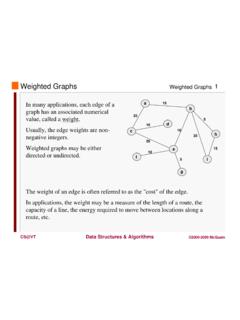
Weighted Graphs 1 - Courses
courses.cs.vt.eduWeighted Graphs Data Structures & Algorithms 2 CS@VT ©2000-2009 McQuain Shortest Paths (SSAD) Given a weighted graph, and a designated node S, we would like to find a path of least total weight from S to each of the other vertices in the graph. The total weight of a path is the sum of the weights of its edges. a i g f e d c b h 25 15 10 5 10 ...

Chapter 2 Graphs - Cornell University
www.cs.cornell.edu2.2. PATHS AND CONNECTIVITY 27 (a) Airline routes (b) Subway map (c) Flowchart of college courses (d) Tank Street Bridge in Brisbane Figure 2.4: Images of graphs arising in different domains. The depictions of airline and subway systems in (a) and (b) are examples of transportation networks, in which nodes are destinations and edges represent direct connections

CS224W: Machine Learning with Graphs Jure Leskovec, http ...
web.stanford.eduUsing effective features over graphs is the key to achieving good model performance. Traditional ML pipeline uses hand-designed features. In this lecture, we overview the traditional features for: Node-level prediction Link-level prediction Graph-level prediction For simplicity, we focus on undirected graphs.

INTRODUCTION TO RANDOM GRAPHS - CMU
www.math.cmu.eduRandom graphs were used by Erdos [285] to give a probabilistic construction of˝ a graph with large girth and large chromatic number. It was only later that Erdos˝ and Renyi began a systematic study of random graphs as objects of interest in their´ own right. Early on they defined the random graph G n;m and founded the subject.
5.3 Planar Graphs and Euler’s Formula
www2.math.upenn.edu5.3 Planar Graphs and Euler’s Formula Among the most ubiquitous graphs that arise in applications are those that can be drawn in the plane without edges crossing. For example, let’s revisit the example considered in Section 5.1 of the New York City subway system. We considered a graph in which vertices represent subway stops and edges represent

Euler Paths and Euler Circuits - Jeremy L. Martin
jlmartin.ku.eduEuler Paths and Euler Circuits An Euler path is a path that uses every edge of a graph exactly once. An Euler circuit is a circuit that uses every edge of a graph exactly once. I An Euler path starts and ends atdi erentvertices. I An Euler circuit starts and ends atthe samevertex.
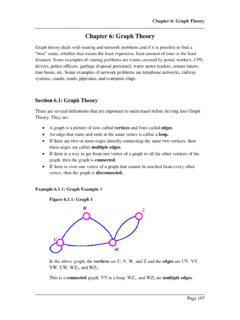
Chapter 6: Graph Theory
www.coconino.eduLeonhard Euler first discussed and used Euler paths and circuits in 1736. Rather than finding a minimum spanning tree that visits every vertex of a graph, an Euler path or circuit can be used to find a way to visit every edge of a graph once and only once. This would be useful for checking parking meters along the streets of a city, patrolling the