Example: stock market
Introduction to Kernel Methods
Kernels as Generalized Distances Gaussian kernel Choosing the best feature space Motivation Given a set of vectors, there are many tools available for one to use to detect linear relations among the data Ridge Regression Support Vector Machines (SVM’s) Principal Component Analysis (PCA) But what if the relations are non-linear in the
Tags:
Information
Domain:
Source:
Link to this page:
Documents from same domain
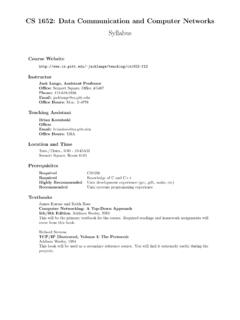
CS 1652: Data Communication and Computer Networks …
people.cs.pitt.edufrom the application layer to the data-link layer. Concurrent with the lectures, you (in groups of two) will be building a functional TCP/IP stack and a small web server that will run on it.

Informal proofs - University of Pittsburgh
people.cs.pitt.eduInformal proofs Proving theorems in practice: • The steps of the proofs are not expressed in any formal language as e.g. propositional logic

MIPS Floating Point Instructions
people.cs.pitt.edu11/9/2011 1 MIPS Floating Point Instructions CS/COE 447 Why Floating Point? • Sometimes need very small, or very large numbers? Non-integers?
Foundations of Artificial Intelligence
people.cs.pitt.edu“The branch of computer science that is concerned with the automation of in-telligent behavior” (Luger+Stubblefield, 1993) Views of AI fall into four categories: Thinking humanly Thinking rationally Acting humanly Acting rationally Examining these, we will plump for acting rationally (sort of) AIMA Chapter 1 (after Russell and Norvig) 3

Propositional logic: Horn clauses
people.cs.pitt.edu• Horn form (Horn normal form) • Two inference rules that are sound and complete with respect to propositional symbols for KBs in the Horn normal form: – Resolution (positive unit resolution) – Modus ponens (A∨¬B) ∧(¬A∨¬C ∨D) Can be written also as: (B ⇒ A) ∧(( A ∧C) ⇒ D) CS 2740 Knowledge Representation M. Hauskrecht ...
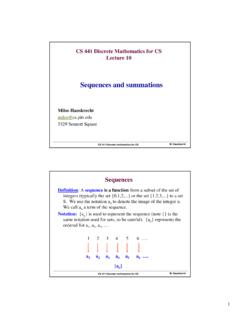
Sequences and summations
people.cs.pitt.eduSequences and summations CS 441 Discrete mathematics for CS M ... Arithmetic progression Definition: An arithmetic progression is a sequence of the ... -1, 3, 7, 11, … 3 CS 441 Discrete mathematics for CS M. Hauskrecht Geometric progression Definition A geometric progression is a sequence of the form: a, ar, ar2, ..., ark, where a is the ...

Time Series: Autoregressive models AR, MA, ARMA, ARIMA
people.cs.pitt.eduGaussian White Noise {A particular useful white noise is Gaussian white noise, wherein the w ... -20 0 20 40 60 80 12/77. Time Series Analysis The procedure of using known data values to t a time series ... Measures of Dependence A complete description of a time series, observed as a
Probabilities: Expected value
people.cs.pitt.eduExpected value Investment problem: • You have 100 dollars and can invest into a stock. The returns are volatile and you may get either $120 with probability of 0.4, or $90 with probability 0.6. • What is the expected value of your investment? • M. Hauskrecht Expected value Investment problem: • You have 100 dollars and can invest into a ...
Sets and set operations - University of Pittsburgh
people.cs.pitt.edu• Ordered-n tuples are used to represent an ordered collection. Definition: An ordered n-tuple (x1, x2, ..., xN) is the ordered collection that has x1 as its first element, x2 as its second element, ..., and xN as its N-th element, N 2. Example: • Coordinates of a point in the 2-D plane (12, 16) x y
Mathematical induction & Recursion
people.cs.pitt.eduMathematical induction • Used to prove statements of the form x P(x) where x Z+ Mathematical induction proofs consists of two steps: 1) Basis: The proposition P(1) is true. 2) Inductive Step: The implication P(n) P(n+1), is true for all positive n. • Therefore we conclude x P(x).
Related documents
Introduction to Generalized Linear Models
statmath.wu.ac.atIntroduction Generalized Linear Models Structure For example, a common remedy for the variance increasing with the mean is to apply the log transform, e.g. log( yi) = 0 + 1 x 1 + i) E (log Y i) = 0 + 1 x 1 This is a linear model for the mean of log Y which may not always be appropriate. E.g. if Y is income perhaps we are really interested

Lecture 1 Introduction to Multi-level Models
www.biostat.jhsph.eduGeneralized Linear Models (GLMs) g( μ ) = 0 + 1*X1 + … + p*Xp Counts – Log-linear: log{E(Y)} = 0 + 1Age + 2Gender Example: Age & Gender 1 = log-RR for a 1 unit increase in Age, Comparing people of the SAME GENDER. WHY? Self-Check: Verify Tonight 16 D. Responses are independent B. All the key covariates are included in the model

Poisson Models for Count Data
data.princeton.edu4.1 Introduction to Poisson Regression As usual, we start by introducing an example that will serve to illustrative regression models for count data. We then introduce the Poisson distribution and discuss the rationale for modeling the logarithm of the mean as a linear function of observed covariates. The result is a generalized linear model with
Introduction to Density Functional Theory
vergil.chemistry.gatech.eduGeneralized Gradient Approximations (GGA’s) •The uniform electron gas isn’t such a great model because in molecules, the electron density can vary rapidly over a small region of space •One way to improve over LSDA is to make the functional …
Introduction to Coding Theory Lecture Notes
u.cs.biu.ac.ilIntroduction to Coding Theory Lecture Notes∗ YehudaLindell DepartmentofComputerScience Bar-IlanUniversity,Israel January25,2010 Abstract These are lecture notes for an advanced undergraduate (and beginning graduate) course in Coding Theory in the Computer Science Department at Bar-Ilan University. These notes contain the technical
The Comprehensive R Archive Network
cran.r-project.orgWe would like to show you a description here but the site won’t allow us.