Transcription of ITC SEPTEMBER 2021 PAPER 1 QUESTION 2 SUGGESTED …
1 ITC SEPTEMBER 2021 PAPER 1 QUESTION 2 SUGGESTED SOLUTION 1 SAICA 2021 Part (a) Prepare the journal entry/entries required to recognise the impairment loss on the FluSlay formula in the accounting records of PharmCon for FY2021 Support your answer with a detailed impairment calculation. Round all calculated amounts to the nearest R1 000 Marks Impairment journal entry Dr. R 000 Cr. R 000 30 June 2021 Dr. Impairment loss (P/L) 3 650 1 Cr. Accumulated amortisation and impairment on formula (SFP) 3 650 Recognition of impairment loss on FluSlay formula Marker s note: If a candidate prepares a calculation and finds that the recoverable amount exceeds the carrying amount ( no impairment) he/she will not prepare a journal entry. In this case, the calculations should still be marked in the absence of a journal The impairment loss is calculated as follows: R 000 R 000 Carrying amount at 30 June 2021 (given) 37 850 1 Recoverable amount at 30 June 2021, calculated as the higher of: 34 200 1P Fair value less costs of disposal (C1) 34 200 Value in use (C2) 32 410 Impairment loss 3 650 C1: Calculation of fair value less costs of disposal Mada-gascar Kenya Calculation of most advantageous market: Selling price 39 440 38 800 + Pharmaceutical product regulatory review costs (2 880) (2 880) + Legal fees (1 960) (1 070) + New chemical registration fees payable to regulator (650) (650) + Net price 33 950 34 200 Thus, most advantageous market 34 200 1P Therefore fair value less cost of disposal 34 200 ITC SEPTEMBER 2021 PAPER 1 QUESTION 2 SUGGESTED SOLUTION 2 SAICA 2021 C2.
2 Calculation of value in use 2022 2023 2024 2025 2026 2027 2028 2029 2030 2031 Marks Continued sales of FluSlay drugs* 15 800 11 900 9 300 6 800 6 150 2 Pharmaceutical product production costs* (4 800) (3 620) (2 830) (2 069) (1 870) 2 Costs to maintain expected sales* (1 200) (1 050) (980) (760) (700) 2 Incremental litigation insurance cover (50) (52) - - - - - - - - 2 Net cash inflows 9 750 7 178 5 490 3 971 3 580 Growth (decline) rate @ (12%) 3 150 2 772 2 440 2 147 1 889 3 Discount rate @ 7% 1 Present value of future cash flows 32 410 If included additional FluSlay sales from enhancements to the formula. [- 1] If included FluSlay formula enhancement costs and additional production and sales costs directly related to additional FluSlay sales. [- 1] If included promotional product support campaign. [- 1] * Marks for correctly applying the inclusion in the calculation over the first 5 years. N1: Marks allocated for excluding future cash flows related to improvements to future cash flows related to the formula.
3 N2: Mark for excluding future cash flows related to uncommitted restructuring ( ). Available 20 Maximum 20 Communication skills presentation 1 Total for part (a) 21 ITC SEPTEMBER 2021 PAPER 1 QUESTION 2 SUGGESTED SOLUTION 3 SAICA 2021 Part (b) Evaluate the impact of the production challenges in SEPTEMBER 2020 by (i) calculating all relevant variances in respect of material for the AllexKids production, as follows: material price and mix variances in detail per material type; a material yield variance based on the total variance only. Round all amounts to the nearest cent. Marks Material prices AI F BP S AQ x AP 58 000 69 600 10 800 12 000 Price variance 4 000 F 1C Material mix variance Act input in std mix Actual input Grams Rand Mix variance Grams Rand 10,600 R 61,480 R 3,480 10,000 R 58,000 21,200 R 61,480 R (8,120) 24,000 R 69,600 10,600 R 12,720 R 1,920 9,000 R 10,800 10,600 R 16,960 R 960 10,000 R 16,000 * 53,000 R 152,640 R (1,760) 53,000 R 154,400 * Marker note: this amount could be R1,2 if the standard cost card is adjusted.
4 However, then ALL variances must be based on R1,2 thereafter. A number of possible alternatives were noted and considered during the marking process. Alternative 1: AI F BP S AQ x SP 58 000 69 600 10 800 16 000 (10 000 x 1,6) Mix variance 3 480 F 8 120 A 1 920 F 960 F Total AQ in std mix x SP1 61 480 (53 *1/5*R5,8) 61 480 (53 *2/5*R2,9) 12 720 (53 *1/5*R1,2) 16 960 (53 *1/5*R1,6)* 1 2C 4 Material yield variance OUTPUT QUANTITY APPROACH Expected output 51, (53 000 x ) Actual output 45, (53 000 x ) Material loss (6, ) Cost of material (1 440 / 490) YIELD LOSS (20, ) A number of possible alternatives were noted and considered during the marking process. 1 1 1 1 ITC SEPTEMBER 2021 PAPER 1 QUESTION 2 SUGGESTED SOLUTION 4 SAICA 2021 Alternative 1: OUTPUT QUANTITY APPROACH Expected output 51,940 (53 000 * ) Actual output 45,050 (53 000 * ) Material loss (6,890) Cost of material (1 440 / 490) YIELD LOSS (20, ) Alternative 2: Actual input 53,000 (Given) Abnormal loss % 13% Abnormal loss (6,890) Cost of material (1 440 / 490) YIELD LOSS (20, ) Alternative 3.
5 INPUT QUANTITY APPROACH Actual output 45,050 (53,000* ) Standard input for actual output 45, (45,050 Actual input 53,000 Abnormal loss on input 7, Cost of input YIELD LOSS (20, ) Alternative 4: Actual input 53,000 53,000 Standard input 500 490 Expected output 106 108 Actual input 53,000 53,000 Abnormal loss 6,890 6,890 46,110 46,110 Standard input 500 490 Yield difference ( ) ( ) Cost per 500 1, 1, YIELD LOSS (20, )# (20, ) # ( *1440) 1 1 1 1 2 1 1 1 1 1 1 1 1 1 1 ITC SEPTEMBER 2021 PAPER 1 QUESTION 2 SUGGESTED SOLUTION 5 SAICA 2021 Alternative 5: Standard input Act input in std mix a b c d e f (a*b) (c-f) (e*a) Cost per gram Grams Rand Yield variance Grams Rand AI R 9 194 R 53 324 R (8,156) 10,600 R 61,480 F R 18 388 R 53 324 R (8,156) 21,200 R 61,480 BP R 9 194 R 11 033 R (1,687) 10,600 R 12,720 SW R 9 194 R 14 710 R (2,250) 10,600 R 16,960 Total 45 969 R 132 392 R (20,248) 53,000 R 152,640 Actual output 45,050 (53 000 / ) Alternative 6.)
6 Usage variance Actual output 45,050 45,050 Standard input for actual output 45,969 Cost of material R132, R132, Actual input 53,000 Rand Value R154,000 Material Usage variance (R22, ) (R132, R154,000) Mix (R1,760) Yield (R20, ) 1 1 1 1 1 1C Available 12 Maximum 12 Total for part (b)(i) 12 ITC SEPTEMBER 2021 PAPER 1 QUESTION 2 SUGGESTED SOLUTION 6 SAICA 2021 Part (b) Evaluate the impact of the production challenges in SEPTEMBER 2020 by (ii) recommending improvements that could be made to the production and procurement processes for AllexKids medication, based on the variances calculated in (b)(i), as well as those noted by management.
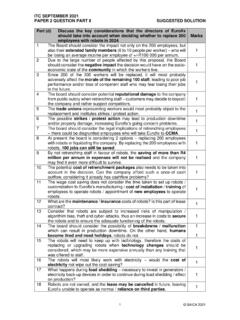
7 Round all amounts to the nearest cent. Marks 1. The change in sweetener price is a planning variance as it represents a change in the materials price that was not controllable management should have adjusted the cost card to the new rate before the variances were calculated. 1 2. Management should consider researching other suppliers, especially local suppliers, that may be able to offer better deals (and are based in SA). 1 3. Consider negotiation with suppliers for bulk discounts. 1 4. Consider whether EOQ would be a better inventory model to use than JIT: consider stock-holding cost versus production breakdowns as a result of delivery issues. 1 5. Regarding materials, a significant impact on profit is the adverse yield variance which arose as a result of the incorrect calibration of machinery and abnormal loss there should be better supervision ( employ an additional supervisor, schedule more checks). 1 6. The favourable variance (fixed overhead volume) for AllexKids implies that the compressors used for AllexKids operated at greater than planned capacity because of the extension of machine time consider whether it will be possible in future to continue to use the capacity by, for instance, working double shifts or over the long term, purchasing more machinery.
8 1 1 7. Replace machinery with machinery that uses newer technology, which will alert users to incorrect calibration. 1 8. Rearrange the factory layout so that the company is more easily able to respond to changes. 1 9. Have contracts with employees that allow for overtime and working double shifts when required (consider cost-benefit). 1 10. The favourable fixed overhead volume variance reflects that the company responded to the increased demand up until full capacity. 1 11. As much as demand increased the company s capacity was reached which resulted in the decreased market share. 1 12. Consider increasing production capacity, new facilities, or double shifts. 1 13. Strict controls must be in place to authorise changes to the standard mix. For example, the change in the proportion of the materials used may result in changes to the medical properties of the medicines produced. This may lead to customers getting sick and may result in lawsuits against the company and fines by regulators 1 1 Available 15 Maximum 6 Communication skills logical argument 1 Total for part (b)(ii) 7 Total for part (b) 19 ITC SEPTEMBER 2021 PAPER 1 QUESTION 2 SUGGESTED SOLUTION 7 SAICA 2021 Part (c) Discuss any ethical considerations that would arise for PharmCon from employing a key-stakeholder relationship manager, based on the discussion and resolutions at the recent board meeting of the company.
9 Note to markers: This QUESTION is marked based on the discussions made and the principle discussed. Candidates can motivate their discussion from not being in the best interest of the company, good for the self and good for others, various ethical theories and KING IV. Marks 1. Appointing a key-stakeholder relationship manager / creating the position: In principle, the appointment of a key-stakeholder relationship manager may be justifiable and consistent with Principle 16 of King IV whereby the board should adopt a stakeholder inclusive approach that balances the needs, interests and expectations of material stakeholders in the best interest of the organisation over time. 1 2. Their reason and motive for the role and job description (for this position) would be to build close, influential relationships with industry bodies and lawmakers in the RSA healthcare industry: Consequently the motives and integrity of the board in the best interest of the company could be seen as questionable.
10 1 3. CEO / COO s believes that companies are for-profit companies and need to increase the prices to invest in research of life-saving products: Management do not believe that the moral obligation of the company extends beyond compliance with laws and regulations and maximizing profit and although they are rationalising their reason, this could still be perceived to be ethical based on their set of moral values. 1 4. The recruitment process of appointing the manager: Should the appointment of the stakeholder relationship manager be done in a manner that does not involve a transparent and rigorous recruitment process (which appears to be the case as the CEO is targeting a particular individual), there is a risk that not necessarily the best person for the job (that exudes specific characteristics and competence for the job) will be appointed / no other qualities of the person are considered apart from their connections.