Transcription of JBCC March 2014 AGREEMENTS - Master Builders …
1 Page 1 of 14 jbcc March 2014 AGREEMENTS 1 2 3 4 5 6 7 Text books available concerning jbcc 2014 General - Contract Documents issued by jbcc Synopsis of important changes jbcc PBA 2007 2014 Contract Data Tender process Commentary on Individual Clauses agreement Contract Data 1 1 2 6 6 13 13 1. TEXT BOOKS At this stage ( March 2016) There is only one text book that is known to have been published. This is jbcc 2014 AND ALL THAT , by JR (Jim) Garner. This book covers the three AGREEMENTS published by jbcc (see below) and the MBSA 2014 Domestic Subcontract agreement .
2 The book contains a clause by clause analysis of each of these AGREEMENTS , a synopsis of the most important changes from the jbcc 2007 and MBSA 2008 AGREEMENTS . It includes copies of the 2014 AGREEMENTS and the related Contract Data documents, advice and comment on possible amendments, seventy standard letters for use with the Principal Building agreement (PBA) and sections on related subjects such as the Construction Industry Development Board. There are also Flow Charts illustrating procedure relating to major clauses such as payment and completion.
3 2. GENERAL CONTRACT DOCUMENTS The following contract AGREEMENTS are produced by jbcc : Principal Building agreement (PBA): The latest edition of this is the 6th Edition, March 2014 ; Nominated/Selected Sub-contract agreement : The latest edition of this is the 6th Edition, March 2014 ; Page 2 of 14 Minor Works agreement : The latest edition of this is the 5th Edition, March 2014 . Additionally MBSA have published a 2014 Domestic Subcontract agreement for use with the jbcc 2014 PBA. 3. SYNOPSIS 0F IMPORTANT CHANGES TO THE PRINCIPAL BUILDING agreement FROM EDITION JULY 2007 TO EDITION March 2014 2007 Clauses 2014 Clauses Comments 1 to 40 general Nil Nil 1 to 30 agreement general The first change that will be noticed is that the arrangement of clauses has been revised.
4 There are now only 30 clauses instead of the previous 40 clauses. The non-variation clause is now in the agreement Language has been adjusted in a number of places to give greater certainty. For example the requirement for updating the programme is now regularly rather than continuously , as in edition , removing any suggestion that the contractor must be in a process of updating the programme every day. Provisions relating to delivery of notices have been changed. Most important is that the delivery date is now deemed , not presumed as in edition and fax is no longer a permitted means of delivering notices.
5 Clause provides that failure by a party to enforce its rights shall not constitute waiver or affect such party s rights A new provision has been introduced that the agreement , in the event of conflict, shall take priority over other contract documents. This is an improvement, but it would be even better if priority of all contract documents were allocated priority. CD also provides for them being recorded in the single place provided for recording amendments and that amendments recorded elsewhere are of no force or Page 3 of 14 25 10 to 12 24 29 nil 10 19 23 effect The concept of Works completion has been deleted, eliminating a need for a Works Completion clause.
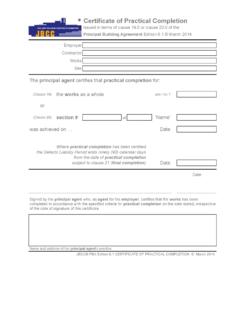
6 This has further implications including the defects liability period commencing at the date of practical completion instead of on the date of Works Completion. It has been considered that other provisions giving the employer various possible means of dealing with a dilatory contractor are sufficient. There is still a requirement for a list of outstanding work at practical completion (now called the list for completion), but no certificate is to be issued when this work has been completed. The provisions for Works completion were introduced in the 1998 Edition and adjusted in successive previous editions, but never worked well.
7 The insurances provisions have been consolidated into a single clause, as have the termination provisions. The requirement for the practical completion list to be finite, with no provision for adding new items, is further clarified. The period required by the principal agent for inspection(s) must be recorded in Contract Data. An important change has been made to the clause relating to extension of time. In Edition there is a time bar both in relation to the period allowed to notify the intention to claim and in relation to the time allowed to submit the detailed and evaluated claim.
8 In Edition the second time bar has been removed, though a permitted time to submit the detailed claim is given. A further notable change is that delay by a nominated subcontractor has been moved from the category for which extension of time, but not adjustment of the contract value is granted, to the category that includes adjustment of the contract value. The period, from date of certification has been lengthened Page 4 of 14 31 and 34 N/S 32 & 34 40 25 and 26 N/S 26 and 30 from 7 to 14 calendar days.
9 The subcontractor due payment date is also 7 calendar days later, but still 7 days after the contractor is due to be paid. The meaning term default interest has been changed to mean a rate of interest which is 6% per annum above the defined rate of interest (effectively 3% above prime interest rate). This change is because the previous arrangement resulted in a default rate under prime interest rate in the low interest rates prevailing in 2012-13. That encouraged late payment, which is the reverse of the objective. The new basis ensures that the default rate will remain materially above prime.
10 In the N/S agreement he period by which the Contractor may defer payment to an n/s subcontractor, on payment default by the Employer, has been reduced from 90 to 30 calendar days. An affidavit of the Employer s default must also be issued to the subcontractors Adjustment of the subcontract value and the final account are dealt with in a single clause. The contractor s rights to suspend the works have been increased. They are now in clause 28 (also in ) In the dispute resolution clause the procedure for adjudication has been adjusted. Now, once the disagreement has become a dispute the party that declared the disagreement has only ten working days to refer it for resolution by adjudication, failing which the dispute is to be resolved by arbitration, not adjudication.