Example: biology
K-12 Computer Science Curriculum Guide
» A breakdown of the basic properties (full year vs. semester, whether the curriculum stands alone or can be integrated into another course, etc.) » Teacher training and other support resources » Required and recommended technology and other materials and their costs » Relationships to other courses and intended path-ways, when applicable
Tags:
Information
Domain:
Source:
Link to this page:
Documents from same domain

Principal Preparation Program Self-Study Toolkit for use ...
edc.orgPrincipal Preparation Program Self-Study Toolkit for use in developing, assessing, and improving principal preparation programs Candidate Admissions •Clinical Practice • Course Content • Performance Assessment • Pedagogy-Andragogy • Graduate Performance Outcomes . QM Self-Study Toolkit The Wallace Foundation generously supports this ...
Supporting Emergent Bilingual Children in Early Learning
edc.orgUsing specific teaching strategies to help children be successful ... Other methods of promoting vocabulary development include teacher narration and open- ... Emergent bilingual children might have trouble following and participating in a whole-class conversation.
Integrating Technology into Early Learning
edc.orgdia as tools in early childhood programs serving children from birth through age 8. Nemeth, K. N. (2015). Technology to support dual language learners. In C. Donohue (Ed.), Technology and digital media in the early years: Tools for teaching and learning (pp. 115–128). Paciga, K. A. & Donohue, C. (2017). Technology
Related documents
Ontario Curriculum Grades 11 and 12, Native Studies
www.edu.gov.on.caSuch courses must be offered as full-credit courses,to ensure that students meet admission requirements. In Grades 9-12,half-credit courses,which require a minimum of fifty-five hours of scheduled instructional time,must adhere to the following conditions: • The two half-credit courses created from a full course must together contain all of the

CURRICULUM FRAMEWORK: TWO-YEAR B.ED. PROGRAMME
ncte-india.orgEngagement with the Field: Tasks and Assignments for Courses 7b & 8-10 _____ Total- 650 marks Note: a). 1/2 indicates a half paper which is allocated both half the time of effective hours per week and also half the marks assigned to a full paper. b).* Optional Courses can be from among the following – Vocational/Work Education, Health and

Introducing A New Confirmation Curriculum
www.pcusa.orgConfirmation Curriculum Professing Our Faith seeks to provide youth with a foundational understanding of our faith, tradition, and Presbyterian practices. It will be added to the We Believe line of Younger Youth survey courses. This “sampler” includes the Scope and Sequence of the full curriculum as well as a preview of the first session of the
The Ontario Curriculum, Grades 9-12: English As a Second ...
www.edu.gov.on.caThis document replaces The Ontario Curriculum, Grades 9 to 12: English as a Second Language and English Literacy Development, 1999. Beginning in September 2007, all courses in English as a Second Language (ESL) and English Literacy Development (ELD) for Grades 9 to 12 will be based on the expectations outlined in this document.

ICT TRAINING COURSES FOR TEACHER PROFESSIONAL …
files.eric.ed.govthe curriculum is paramount to any successful ICT-related initiative. Teacher training courses, both pre and in-service, can help teachers who are tentative to move faster and adopt technology while they show the more enthusiastic teachers new …
Syllabus MEDICAL ASSISTING PROGRAM CERTIFICATE OF …
images.template.netThe revised curriculum will be coordinated with two other courses, Medas 201B and Medas 201C. Upon completion of Medas 201A and 201B, students are eligible for a 160-hour externship working in local medical offices and clinics. The curriculum content of the Medical Assisting program is also being updated and
Doctrinal Elements of a Curriculum Framework
www.usccb.orgThe document Doctrinal Elements of a Curriculum Framework for the Development of Catechetical Materials for Young People of High School Age was developed by the Committee on Evangelization and Catechesis of the United States Conference of Catholic Bishops (USCCB). It was approved by the full body of the USCCB at its November 2007
Grades 9 and 10 Mathematics - Ministry of Education
www.edu.gov.on.ca3 Introduction This document replaces The Ontario Curriculum,Grades 9 and 10: Mathematics,1999. Beginning in September 2005,all Grade 9 and 10 mathematics courses will be based on the expectations outlined in this document.
THE ONTARIO CURRICULUM, GRADES 11 AND 12 | …
www.edu.gov.on.caThe updated Ontario curriculum, in combination with a broader range of learning options outside traditional classroom instruction, will enable students to better customize their high school education and improve their prospects for success in school and in life. The revised curriculum recognizes that, today and in the future, students need to be
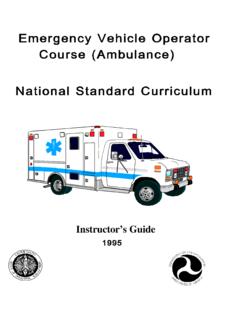
95 EVOC Instructor Guide - EMS
www.ems.govThe new course is recommended for anyone who operates an ambulance. The revised curriculum is appropriate for either rural or urban operations. The curriculum is made up of an instructor guide and participant manual which allow for the inclusion of local and State laws and organizational operation procedures. The revised curriculum will consist