Transcription of Principal Preparation Program Self-Study Toolkit for use ...
1 10th Edition Principal Preparation Program Self-Study Toolkit for use in developing, assessing, and improving Principal Preparation programs Candidate Admissions Clinical Practice Course Content Performance assessment Pedagogy-Andragogy Graduate Performance Outcomes QM self -Study Toolkit The Wallace Foundation generously supports this work. Copyright 2018 by Education Development Center, Inc. All rights reserved. Cover Graphic: Suggested citation: King, C. (2018). Quality Measures Principal Preparation Program Self-Study Toolkit : For use in developing, assessing, and improving principa l Preparation programs (10th ed.)
2 Waltham, MA: Education Development Center, Inc. Copyright Notice This document is protected by United States copyright law and may not be reproduced, distributed, transmitted, displayed, or otherwise published without the written permission of Education Development Center, Inc. You may not alter or remove any trademark, copyright or other notice. 2018 Education Development Center, QM self -Study Toolkit Table of Contents Theory of Domains and Indicators at a 8 Candidate Course Clinical Performance Graduate Performance of 2018 Education Development Center, QM self -Study Toolkit Introduction The 10th edition of Quality Measures represents a milestone in more than a decade of EDC work with school districts and Principal Preparation programs across the country.
3 Working to prepare principals to lead chronically low performing schools, with an end goal of improving student achievement. Substantial changes in QM content, format, and methods are reflected in this edition and are in direct response to feedback from users as well as insights gleaned from our own observations of user implementation over the course of the past two years with a diverse pool of programs and school districts. It is with sincere appreciation that we extend our thanks to The Wallace Foundation, whose generous funding supported the production of this 10th edition of QM as part of the launch of the University Principal Preparation Initiative (UPPI) in the fall of 2016.
4 UPPI programs from Albany State University, Virginia State University, Florida Atlantic University, San Diego State University, University of Connecticut, Western Kentucky University, and North Carolina State University engaged their Self-Study teams in the collection of baseline Program data using Quality Measures tools and protocols in partnership with affiliated school district staff. We would also like to acknowledge survey feedback received from school district identified Preparation programs that conducted self -studies in partnership with their affiliated school districts as an initial step in their partner collaboration efforts.
5 Members of the National Training Provider- Principal Graduate Professional Learning Community (TPPG PLC) were another important contributing source to this edition of the Quality Measures Toolkit . Contributions included, but were not limited to, careful review and feedback on Professional Standards for Educational Leaders (PSEL, 2015) as part of a 2016 PLC session in Massachusetts. Additional contributors included members of the first training cohort of QM Facilitators who co-facilitated self -studies with non-Wallace funded Principal Preparation programs as part of their training, and provided feedback and suggestions for improving tools and processes.
6 Finally, it is with heartfelt gratitude that I acknowledge Melissa Lin. Her countless hours of tool editing and formatting, Self-Study meeting coordination and scheduling, information and materials management, and exemplar catalogue design and population have supported the evolution of Quality Measures since 2009. Her talented support has been a consistent source of both inspiration and aspiration to QM users, trainers, facilitators, and developers. Cheryl L. King, QM Principal Investigator Education Development Center, Inc.
7 2018 Education Development Center, QM self -Study Toolkit Overview Education Development Center, Inc., funded by The Wallace Foundation, is pleased to introduce the 10th edition of Quality Measures evidence-based tools and protocols. The QM Toolkit is intentionally designed to be a self -led, analytic, and topic-specific resource for use in the critical self -examination, reflection, and peer review of Principal Preparation Program effectiveness. Highlights and New Resources The 10th edition of the QM Toolkit reflects several important changes that respond to new research findings, performance standards for education leaders, and feedback from QM Program and school district partners.
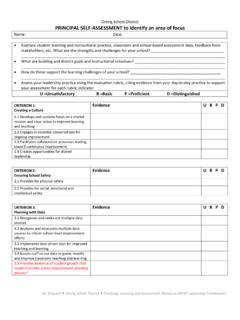
8 Among the more noticeable changes is a return (by popular demand) to a rubric format and developmental level continuum. Also incorporated, as part of the 10th edition, is more detailed guidance on assembling supporting evidence that includes: types of evidence, descriptions for each type, and illustrative examples by domain and level of evidence strength. In addition to these changes, this edition of the tool includes: selected references that are organized by domain, the QM theory of change, and an at a glance look at QM domains and indicators.
9 Research Base and Performance Standards QM tools are grounded in the seminal research of Linda Darling-Hammond on exemplary Principal Preparation practices. QM rubric indicators and criteria describe the characteristics associated with effective practices from the literature and empirical research on adult transformational pedagogy. In addition, indicators and criteria are tightly linked to Professional Standards for Educational Leaders (PSEL). Rubric Organization and Rating Continuum This Quality Measures Toolkit includes a rubric for each of the following Program domains: 1) candidate admissions, 2) course content, 3) pedagogy-andragogy, 4) clinical practice, 5) performance assessment , and 6) graduate performance outcomes.
10 Each domain identifies specific indicators of effective practice and criteria. Rubrics provide a detailed description of indicators and performance criteria for each Program domain. A four-level performance continuum allows teams to examine their Program practices against indicator criteria at each level of the continuum to determine the degree to which their Program meets the stated criteria for a particular level. Evidence-Based Protocol QM uses an interactive facilitated process to complete the Program Self-Study .