Example: air traffic controller
LANT ROWTH EVELOPMENT - NCERT
15.4 Plant Growth Regulators 15.5 Photoperiodism 15.6 Vernalisation 240 BIOLOGY 15.1 GROWTH Growth is regarded as one of the most fundamental and conspicuous characteristics of a living being. What is growth? Growth can be defined
Tags:
Information
Domain:
Source:
Link to this page:
Documents from same domain
ntse exam notification - National Council Of …
ncert.nic.inExamination: The tentative pattern of written examination will be as follows: Stage-I & Il : examination at the State/UT level will comprise of three papers i.e.
14 Effects Electric Current and Its - National …
ncert.nic.in76 EXEMPLAR PROBLEMS 3. Three bulbs A, B, C are connected in a circuit as shown in Figure 14.2. When the switch is ‘ON’ (a) bulb C will glow first. (b) bulb B and C will glow simulaneously and bulb A will

SEMICONDUCTOR AND SIMPLE CIRCUITSnot to be …
ncert.nic.in469 Semiconductor Electronics: Materials, Devices and Simple Circuits semiconductors. However , after 1990, a few semiconductor devices using organic semiconductors and semiconducting polymers have been
ENVIRONMENTAL CHEMISTRY - National Council …
ncert.nic.in400 CHEMISTRY (c) Hydrocarbons: Hydrocarbons are composed of hydrogen and carbon only and are formed by incomplete combustion of fuel …
LAWS OF MOTION
ncert.nic.inLAWS OF MOTION 91 In practice, the ball does come to a stop after moving a finite distance on the horizontal plane, because of the opposing force of friction which
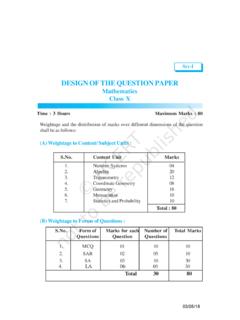
DESIGN OF THE QUESTION PAPER Mathematics …
ncert.nic.inDESIGN OF THE QUESTION PAPER, SET-I 207 (A) 18 5 (B) 17 5 (C) 17 8 (D) 1 7. In the adjoining figure, PA and PB are tangents from a point P to a circle with centre O.
CHAPTER 10
ncert.nic.in(A) Main Concepts and Results Circle, radius, diameter , chord, segment, cyclic quadrilateral. • Equal chords of a circle (or of congruent circles) subtend equal angles at the
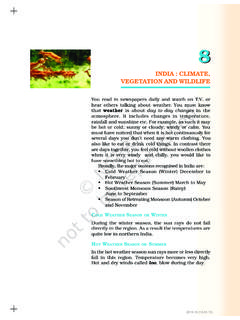
INDIA : CLIMATE, VEGETATION AND WILDLIFE
ncert.nic.inINDIA : CLIMATE, VEGETATION AND WILDLIFE 59 year. Therefore, they always appear gr een and are called evergreen forest as you may notice in Figure
Objectives Polymers - National Council of …
ncert.nic.in427 Polymers C:\Chemistry-12\Unit-15.pmd 28.02.07 Polymers can also be classified on the basis of mode of polymerisation into two sub groups.
TEXTBOOK IN GEOGRAPHY FOR CLASS IX
ncert.nic.inFOREWORD The National Curriculum Framework, (NCF) 2005, recommends that children’s life at school must be linked to their life outside the school. This principle
Related documents

PLANT GROWTH AND DEVELOPMENT
www.ncert.nic.in15.4 Plant Growth Regulators 15.5 Photoperiodism 15.6 Ver nalisation 2021-22. 240 BIOLOGY 15.1 GROWTH Growth is regarded as one of the most fundamental and conspicuous characteristics of a living being. What is growth? Growth can be defined as an irreversible permanent increase in size of an organ or its parts or

Nutrients Plants Require for Growth
www.extension.uidaho.edulost from the plant root zone by overirrigation or high precipitation. Boron promotes the translocation of sugars and cell development and is believed to be important for growth regulators (table 2). Boron is not mobile in plants. Consequently, B deficiency symptoms most often appear on the growing tip of the plant.
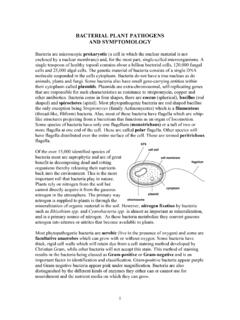
Bacterial Plant Pathogens - Washington State University
s3.wp.wsu.eduthat leak into intercellular space or grow within the vascular tissue of the plant. Depending on the species of bacteria and the tissue infected they produce and release enzymes that degrade cell walls, growth regulators that alter the plants normal growth, toxins that degrade cell membranes and complex sugars that plug water conducting tissue.

Plant Growth Regulators - Iowa State University
extension.agron.iastate.eduPlant growth regulators (PGRs) are organic compounds, other than nutrients, that modify plant physiological processes. PRGs, called biostimulants or bioinhibitors, act inside plant cells to stimulate or inhibit specific enzymes or enzyme systems and help regulate plant me- ...

CHAPTER. 15. PLANT GROWTH AND DEVELOPMENT
kea.kar.nic.inReproductive growth- After the vegetative growth, plants produce flowers which is the reproductive part of the plant. This is called reproductive growth/phase. 15.2- Growth curve – It is an ‘S’ shaped curve obtained when we plot growth against time (Fig. 15.2). It is also called ‘sigmoid ‘curve.This curve mainly shows four phases
PLANT PROPAGATION - tmnehs.gov.in
tmnehs.gov.inDifferent growth regulators may be used to promote rooting. Good response in cuttings can be obtained by over night dipping in 100-200 ppm IBA. 2000 to 5000 ppm of indolebutyric acid (IBA), indoleacetic acid (IAA) and nephtalenacetic acid (NAA) through quick dip methods are the most successful growth regulators.
PLANT PATHOLOGY - Elsevier.com
booksite.elsevier.comGrowth Regulators in Plant Disease 196 Detoxification of Low-Molecular Weight Antimicrobial Molecules 201 Promotion of Bacterial Virulence By avr Genes 202 Role of Type III Secretion in Bacterial Pathogenesis 202 Pathogenicity and Virulence Factors in Viruses and Viroids 202 chapter six HOW PLANTS DEFEND THEMSELVES AGAINST PATHOGENS
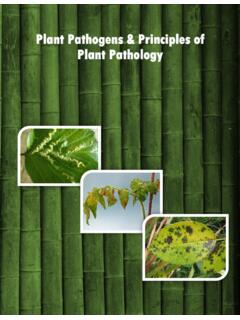
Plant Pathogens & Principles of Plant Pathology
www.agrimoon.comPlant pathology can also be defined as the study of the nature, cause and prevention of plant diseases. Plant pathology is related to most of the old and new sciences like biology, physics, chemistry, physiology, mathematics, genetics, soil science, biochemistry, biotechnology etc. Plant pathology has the following major objectives. 1.