Example: dental hygienist
Learning a Unified Classifier Incrementally via Rebalancing
ble to the imbalance among classes. Among the previous works, the one presented in [9] is the most relevant to ours. Dong et al.[9] propose a class rectification loss to rectify the learning bias of cross-entropy loss given the imbalanced data. Our …
Information
Domain:
Source:
Link to this page:
Documents from same domain
ESRGAN: Enhanced Super-Resolution Generative Adversarial ...
openaccess.thecvf.comESRGAN: EnhancedSuper-Resolution Generative Adversarial Networks Xintao Wang 1, Ke Yu , Shixiang Wu2, Jinjin Gu3, Yihao Liu4, Chao Dong 2, Yu Qiao , and Chen Change Loy5 1 CUHK-SenseTime Joint Lab, The Chinese University of Hong Kong 2 Shenzhen Institutes of Advanced Technology, Chinese Academy of Sciences 3 The Chinese University of Hong Kong, …
Finding Tiny Faces in the Wild With Generative Adversarial ...
openaccess.thecvf.comfaces, which are unfriendly for the face classifier. Toward-s this end, we design a refinement sub-network to recover some detailed information. In the discriminator network, the basic GAN [17, 12, 8] is trained to distinguish the real and fake high resolution images. To classify faces or non-
What Have We Learned From Deep Representations for …
openaccess.thecvf.comwhat these powerful models actually have learned. In this paper we shed light on deep spatiotemporal net-works by visualizing what excites the learned models us-ing activation maximization by backpropagating on the in-put. We are the first to visualize the hierarchical features
Squeeze-and-Excitation Networks - openaccess.thecvf.com
openaccess.thecvf.comSqueeze-and-Excitation Networks Jie Hu1∗ Li Shen2∗ Gang Sun1 hujie@momenta.ai lishen@robots.ox.ac.uk sungang@momenta.ai 1 Momenta 2 Department of Engineering Science, University of Oxford Abstract Convolutional neural networks are built upon the con-
RegularFace: Deep Face Recognition via Exclusive ...
openaccess.thecvf.comRegularFace: Deep Face Recognition via Exclusive Regularization Kai Zhao Jingyi Xu Ming-Ming Cheng ∗ TKLNDST, CS, Nankai University kaiz.xyz@gmail.com cmm@nankai.edu.cn
Protecting World Leaders Against Deep Fakes
openaccess.thecvf.comProtecting World Leaders Against Deep Fakes Shruti Agarwal and Hany Farid University of California, Berkeley Berkeley CA, USA {shrutiagarwal, hfarid}@berkeley.edu
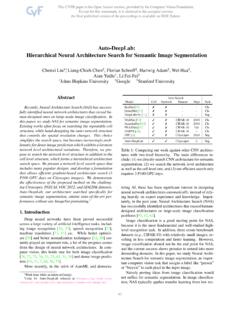
Auto-DeepLab: Hierarchical Neural Architecture Search for ...
openaccess.thecvf.comAuto-DeepLab: Hierarchical Neural Architecture Search for Semantic Image Segmentation Chenxi Liu1∗, Liang-Chieh Chen 2, Florian Schroff2, Hartwig Adam2, Wei Hua2, Alan Yuille1, Li Fei-Fei3 1Johns Hopkins University 2Google 3Stanford University Abstract Recently, NeuralArchitectureSearch(NAS)hassuccess-
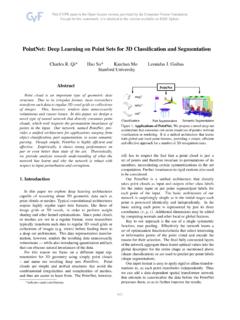
PointNet: Deep Learning on Point Sets ... - CVF Open Access
openaccess.thecvf.comPointNet: Deep Learning on Point Sets for 3D Classification and Segmentation Charles R. Qi* Hao Su* Kaichun Mo Leonidas J. Guibas Stanford University
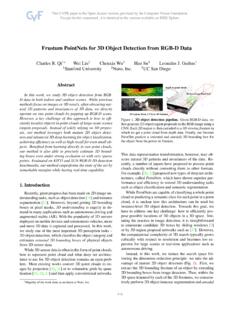
Frustum PointNets for 3D Object Detection From RGB-D Data
openaccess.thecvf.comFrustum PointNets for 3D Object Detection from RGB-D Data Charles R. Qi1∗ Wei Liu2 Chenxia Wu2 Hao Su3 Leonidas J. Guibas1 1Stanford University 2Nuro, Inc. 3UC San Diego Abstract In this work, we study 3D object detection from RGB-D data in both indoor and outdoor scenes.
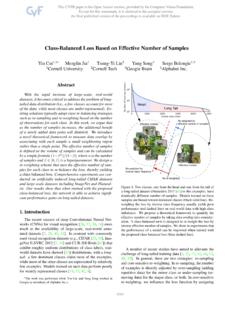
Class-Balanced Loss Based on Effective Number of Samples
openaccess.thecvf.comand large-scale datasets including ImageNet and iNatural-ist. Our results show that when trained with the proposed class-balanced loss, the network is able to achieve signifi-cant performance gains on long-tailed datasets. 1. Introduction The recent success of deep Convolutional Neural Net-works (CNNs) for visual recognition [26, 37, 38, 16] owes
Related documents

DETERMINING THE CONC ENTRATION OF SUGAR(S ) IN A …
www.usm.eduble in this e xperiment. Preparing The Solutions Although we only need 800 mL of each solution, we will actually prepare 1 liter of each beca use it is convenient and will give you some extra solution for emergencies. To make a 3% (wt/vol.) sucrose solution we would need 30 g (0.03 x 1000) of sucrose di s-

Topical and Transdermal Drug Products - USP-NF
www.uspnf.comemulsion. Conversely, when water or an aqueous solu-tion is the dispersed phase and oil or oleaginous material is the continuous phase, the system is designated as a water-in-oil emulsion. Emulsions are stabilized by emulsi- ... ble bases and, in addition, contain no water-insoluble substances such as petrolatum, anhydrous lanolin, or waxes ...

Irrigation Water Quality Standards and Salinity Management ...
soiltesting.tamu.edu1) the total concentration of solu - ble salts, 2) the relative proportion of sodi - um to the other cations, 3) the bicarbonate concentration as related to the concentration of calcium and magnesium, and 3 Irrigation Water Quality Standards and …

<61> Microbiological Examination Of Nonsterile Products ...
www.uspnf.comconditions. ble spore suspension may be maintained at 2° to 8° for a validated ... Phosphate Buffer Solu-introduced. tion pH 7.2, or Soybean–Casein Digest Broth. A surface-active agent such as 1g per L of polysorbate 80 may be added to assist the suspension of poorly wettable substances. If necessary, adjust to a

An Introduction to Manifolds (Second edition)
im0.p.lodz.plble the historical origin of the concepts, and have augmented the bibliography with historical references. Every author needs an audience. In preparing the second edition, I was partic-ularly fortunate to have a loyal and devoted audience of two, George F. Leger and Jeffrey D. Carlson, who accompanied me every step of the way. Section by section,
Distributed Optimization and Statistical Learning via the ...
stanford.eduble to measure and store very detailed information about each example; and third, because of the large scale of many applications, the data is often stored or even collected in a distributed manner. As a result, it has become of central importance to develop algorithms that are both rich enough to capture the complexity of modern data, and scalable
Quality Control Analytical Methods: Microbial Limit Tests ...
www.arlok.comble Number (MPN). The MPN method is reserved for TAMC in low bioburden samples, and is not suitable for the estima-tion of fungal recovery. USP chapTer <61> meThod suiTabiliTy TesT (meThod ValidaTioN) The suitability test is conducted to dem-onstrate the applicability of the method for detection of microbial contamination in the test product.
The Tragedy of the Commons Author(s): Garrett Hardin ...
www.hendrix.eduThe Tragedy of the Commons Author(s): Garrett Hardin Source: Science, New Series, Vol. 162, No. 3859 (Dec. 13, 1968), pp. 1243-1248 Published by: American Association for the Advancement of Science